The world woke up back
on a late April Tuesday morning to the horrific images of a cargo airliner
crashing in
Afghanistan. The huge fireball left by the plane when crashing was a clear picture
of the tragedy.
The aircraft was a
Boeing 747-400 carrying only cargo on board. This load was mostly military
equipment, vehicles and other supplies. It seems there wasn’t any attack and
for now, the most plausible theory is that it was an accident.
The load probably wasn’t
well secured and went loose during takeoff towards the tail. This in turn would
have altered the center of gravity of the aircraft, making it stall and fall.
It is certainly the most likely cause.
However, this accident
brings to the front a problem that is currently missing in the headlines: wars
are increasingly private and states are increasingly dependent on
mercenaries.
We are only a few
months from NATO leaving Afghanistan and with Iraq already abandoned. Today
there are more non-military than American
military personnelin these two countries, as it has been during the past half decade. The
United States has gotten used to fight its wars with remote-drones-and
outsourcing them to others.
Most of these
contractors are non-combatant personnel. They are engineers, doctors, foremen
and all kinds of project managers, belonging to Western companies that have won
bids for reconstruction projects. There are also many who are local labor.
But then there is the
category of mercenaries. These are responsible for the security of the bases
or, as in the case of the crashed plane, of transporting personnel and
equipment to operational theaters.
This is nothing new.
Spain lived in their own flesh what it means to engage third parties with the
crash of a plane carrying its soldiers back from Afghanistan. It was the
biggest loss of personnel -60 soldiers died- in a single day for the Spanish army since
the Civil War, in 1939. But the influence of contractors has increased as
increased the conflicts in which the United States was involved.
This has made modern
armies, starting with the American, depend largely on mercenaries. Without
them, NATO operations in Afghanistan would stall because there is no country in
the coalition -not even the US- capable of, for example, maintaining the cargo capacity
that handle the various subcontractors.
The troops would be
out of fuel and ammunition, but also they would have to stop patrolling to
start doing tasks like peeling potatoes or guard bases. Jobs that once were
assigned to the soldiers and today are made by mercenaries.
This work is reflected
on the bills. Between 2008 and 2011, companies like Blackwater or DynCorp
pocketed a total of 132 billion dollars, a budget larger than that of any other
American agency in the same period. And we must bear in mind that this is only
the invoice for the Americans and it does not include all contractors. Personal
like embassy security guards is not included in that number.
The economic issue of
employing mercenaries is joined with the moral problems that cause the
mercenaries. Several times they have been involved in scandals in Iraq and Afghanistan, some high-profile.
But even after Blackwater’s shooting in central
Baghdad, the
mercenary army has done nothing else but to increase. It is certainly a good deal for some. But at what cost to the states?
Two Israeli attacks on
Syria in less than 48 hours mean, at least unofficially, the entrance of the
West in the Arab conflict. Israeli incursions have not only complicated a conflict already
very convulsed. And as it happens with everything the Jewish state does, the
consequences of these actions will resound beyond its borders.
The attacks came from
outside Syrian airspace. According to both Reuters and AP, Israeli aircrafts
entered Lebanon from the south and from within Lebanese territory, they
released their weapons.
This fact highlights
the impunity of Israel in the region. It's not the first time that Israel
targets military objectives beyond its borders invading foreign airspace, nor
the first time it does it with Syria. It is not even the first time that Syria is the target since the beginning of its bloody
civil war.
Both Turkey and the Arab League
have strongly condemned the attack. On the other hand, the vulnerability of
Hezbollah and Syria has been highlighted. Again. Little or nothing can they do
against the technological superiority of Israel.
Tel Aviv in the
meantime neither confirms nor denies the news. All the information on the press
was leaked through anonymous sources, faceless informants and unidentified
spokespersons. The official stance is to deny the attack and to insist that
there is no interest in entering the Syrian conflict.
That last part may be
true. Assad, although an uncomfortable neighbor, is not a belligerent one. And
without doubt, the government of Bashar al-Assad is better than some of the
alternatives among the rebels, such as al-Nusra’s Islamists, who have been
linked to al-Qaeda.
Photo: IAF
No one in Tel Aviv
wants another Islamist government in the region after the experience with Egypt.
In contrast, Syria's Assad is a controllable and controlled danger. The Syrian
government has limited itself to be an intermediary between Iran and Hezbollah.
And this is probably what has led to these attacks.
Israel's red lines in
this case are different to those for Obama. The United States does not want to get involved in Syria and puts the limit in the
use of chemical weapons, but deliberately does not specify how or how much is
too much.
For Israel, the red
line is the transfer of advanced military
equipment to
Hezbollah, and it does not mind getting into Syria as it has done for years. In
Wired, Noah Shachtman speculates that the danger comes not from the
type of missiles held by the Lebanese militia, but their numbers.
Currently Israel is
able to defend themselves from the threats in possession of Hamas with the Iron Dome missile defense system. For
the Fateh-110 Israel has another system, the Arrow-2, but unlike the Iron
Dome, it has not been tested in combat.
This is aggravated by
the fact that these systems are not foolproof and all they can achieve is minimizing
the impacts. They will never be able to avoid them altogether, that’s something
completely out of reach.
If Israel allows
arming Hezbollah with substantial amounts of Fateh-110 (which can also carry
chemical weapons), this further reduces interception rates. And it is enough for
one of the missiles to impact in an Israeli city to destabilize the whole region.
That may be the main
reason for Israel to get into the conflict. However, it is an extremely selfish
reason and their actions have consequences for more people than those in the
Jewish state.
To begin with, the Assad
regime has now the perfect excuse to demonize the rebels. According
to a spokesman of the regime, the rebels are "friends of Israel" and
the attack was made in a coordinated manner.
The UN has helped to
this extent, albeit involuntarily, by saying through Carla del Ponte that chemicals
attacks recently detected in Syria may actually have been the work of rebel militias. They later announced in a separate
statement that there are no definitive
conclusions yet.
Beyond Syria’s and
Israel’s borders, these attacks push the West into a war that it doesn’t want.
According to Robert Fisk, if there is no condemnation of the bombing means the de facto U.S. and European support for Israel's actions.
Obviously Washington
is not going to condemn the attacks. In fact Obama has already said that Israel
has the right to defend itself, without specifying further. Surely his
government is upset that Netanyahu did not inform in advance of the incursions,
but that will not change its official position.
The Israeli attack has
also polarized the Arab public. Except for Jordan, no other country in the area wants Europe and
America to send aid in the form of weapons and military equipment to the
rebels. Let alone to have a Western military intervention in Syria.
On the other side of
the world, the recent visit of Israeli Prime Minister to China has been the
perfect excuse for the Asian giant to begin the rehearsal of his role as a global superpower. Meanwhile,
the two former superpowers -the United States and Russia- continue to disagree in almost everything.
GoPro cameras have found a place in Syria too. The results, however, are kind of surrealist. It almost transforms the video below in a picture taken out of a videogame. Something that, on the other hand, it wouldn't be that weird in a conflict that has seen a homemade tank controlled by a Playstation gamepad or a remote-controlled rifle operated from a laptop.
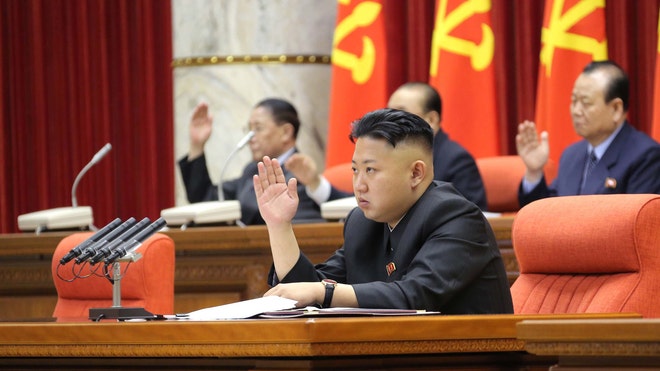
Kim Jong-un seems to
be finally wearing his father’s shoes. He is even surpassing the boldness of
his predecessor. The young one is pushing an escalation of the nuclear
diplomacy the North Koreans have mastered for years. However, the dangers come from
the lack of knowledge about the new leaders more than from what it may actually
happen in the end.
Most of what is
happening now has happened before to some degree. The US and South Korea
usually have drills in the region. North Korea usually responds harshly to it.
And North Korea usually tests every new Prime Minister of the South when they
access the office. That is all according to the script.
It wouldn’t even be the
first time they exchange fire. As recently as in the past three years, North
Korea shelled a South Korean island, which retaliated. The North also -allegedly-
sank a South Korean corvette, an act that didn’t have a military response from
the South.
There are, however,
too many changes to be able to know what will happen next. There are new
leaders in both Koreas and in China. The latter, only ally of the North
Koreans, recently distanced from them by sanctioning the Kim regime in the UN
for their last nuclear test.
But being more
isolated is where NK’s strength resides. The Kim dynasty has made of isolation
a weapon and it is partially the reason it has survived for so long. A society
open to the world, like Iran’s, wouldn’t have been so forgiving of the
difficulties it is going through in exchange for nukes.
The speech of threat to
the South forms part of that strategy too. Despite the recent lack of food and famine due to a poor harvest, Kim has been able to keep the North’s society
united around the leadership by crying wolf in the form of the US and Seoul.
By keeping a constant
message of fear, Kim manages to maintain cohesion among North Koreans. This may
be more needed than ever before if the rumors of an attempted coup that
surfaced on March 13th are true.
Kim Jong-un, however,
has gone a step further with that speech of threat since he accessed the
office. He has surpassed his father successfully launching a satellite, test
firing another long-range rocket (that failed) and resuming the nuclear program.
These last successful
trials (the satellite launch and the nuclear test) may have encouraged the
young Kim to impatiently launch threats his country cannot
fulfill, like attacking mainland America. The latest moves have been cutting
communications with the south, banning access to the joint factory park of
Kaesong and pointing the batteries of missiles and artillery to the south.
The truth is no one really
wants war. South Korea’s capital, Seoul, would be likely carpeted from the
north and little could be done to minimize it. Only during the first hour of
conflict, 500,000 rounds of artillery could hit the capital. Conservative
estimates suggest a death toll of at least 100,000 casualties only in the city.
North Korea also knows
that they would have only 24 hours, maybe 48, until they would be obliterated
by the US. The use of nuclear weapons so close to its own population would be
suicidal for the north without the intervention of the US. Both Koreas would
have too much to lose and little to gain.
Jean Lee, the
Pyongyang AP bureau chief and one of the few Western reporters on the ground, said that even
amid the latest threats, “Inside Pyongyang, much of the military rhetoric feels
like theatrics.”
Business was going as
usual and, she noted, “in a telling sign that even the North Koreans don’t
expect war, the national airline, Air Koryo, is adding flights to its spring
lineup and preparing to host the scores of tourists they expect.” Forcing the south and the US to the negotiation table is
what is worth for the North Koreans.
Photo AP
The rest of the actors
aren’t any keener to go to war. Japan doesn’t want to be again the target of a
nuclear attack and they know they are within the range of North Korean missiles.
The US, on the other hand, is fairly safe North Korea can’t hit its territory.
But being in withdraw from Iraq and Afghanistan, it doesn’t make sense to get
involved in what could be the bloodiest conflict since 1945.
On the other side, China
is not interested in a conflict in the area. Focused on the economy, a war in
the region would threaten the growth of the country. An influx of refugees
inside its north-eastern border is an added problem. Added to that, if North
Korea is annihilated, it could mean US troops on its border while Kim’s regime
is now a firewall that would be disadvantageous to lose.
All things considered,
recent history tells us it is not likely this will escalate into a full blown
war. But as Foreign Policyputs
it, “for half a century, neither side believed that the benefits of
starting a major war outweighed the costs; the worry is that the new North
Korean leader might not hold to the same logic, given his youth and
inexperience”. Kim Jong-un is not crazy as some draw him, but our best
bet is hoping he is not suicidal either.
France knew it was
stirring a hornets’ nest when it invaded Mali earlier this year. So did the USA
and the EU. Yet they pushed through and eventually, together with several African
nations’ troops, managed to achieve victory. François Hollande even went
to Mali to get a photo-op on the trail of that moment.
But that photo and
that victory are as close to reality as George W. Bush’s photo aboard a US
carrier with the “Mission Accomplished” banner behind him. To be honest, the
difference is that this time they know it. And they fear it.
Winning is easy.
Keeping the spoils of war is much more difficult. Ask the Americans in Iraq.
That is precisely what France is trying to avoid, getting into another Vietnam -yes,
they have the same example in their history books too.
Even for the invasion,
France had to stretch its forces. It needed the support of the USA and other
European allies if only to fill auxiliary roles. Holding the ground, even just
leading a coalition of African forces, is proving more
challenging.
The land to patrol is
vast -as demonstrated by the attack on the gas refinery in Algeria. The
Islamists are also well armed;
these are not Syrian rebels. They have powerful friends and
some of them were armed by Gadaffi to fight against the same French and
Americans they are fighting now just a few months ago.
Even the fighting is not
over yet, as demonstrated by the recent deaths of African and French soldiers in
combat missions. Not in ambushes, combat missions. And even a really weak
al-Qaeda is being able to maintain a guerrilla war.
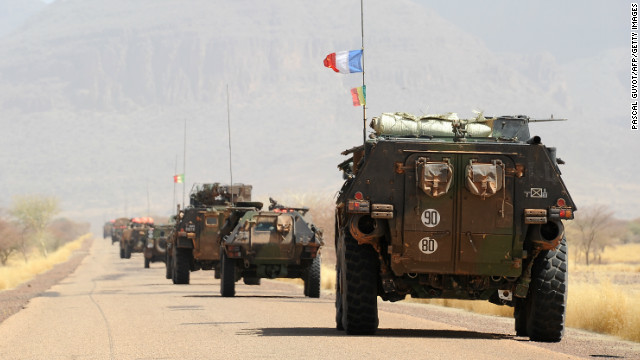
French convoy in Mali/Reuters
That is why France
wants out. And they
want it fast. Hollande’s Government is pushing the UN to create a rapid
reaction 10,000-strong multinational force, heavy armed and under French
leadership if needed. But under the UN flag and with bigger contributions from
other nations.
However, those other
nations are likely to be African or Asian. The US, the UK and other European
countries pledged only support aid. Canada has already ruled
out combat roles for its forces. A picture that sounds all
too familiar.
Syria has become a broken toy
no one wants to get their hands on. Truth be told, the situation has escalated
and it is way more complicated now. What used to be black or white has now
dozens of shades of gray in between. The Balkanization of the conflict has
derived in a war with dozens of splinter cells with targets too different
between themselves.
There is no more a homogeneous
opposition. Some groups want to oust Assad. Others just want to defend their neighborhoods.
The Kurds are happy taking care of their own business watching the rest killing
themselves. And then there are the ones looking for a Yihad. For those ones,
the -theoretically- socialist and laic regime of Assad is as good as a target
as anything else.
That is why steps are given
carefully. Slow and shy attempts on all sides. Take for example Russia, who
started championing Assad. Now they are rather looking for a golden retirement
for him and his family in a third country.
We have as well the Arab
states of the Gulf. They are between a rock and a hard place. On one hand they
would love nothing more than getting rid of Iran’s friend in the region. On the
other hand, they are frightened a revolution like that could caught them at
home.
In a similar place is Israel,
whose is irritated by Assad but fears who could come after him. They have the
bad experience of Egypt, where Mubarak was a manageable leader that didn’t give
them too many problems. Things have changed with Morsi, if only on the public
arena.
The last one to risk a move
has been the USA, announcing they will help directly the Syrian opposition. With
a clear red line: no weapons or training. Just medicines and food to avoid future
problems.
The Americans don’t want
another Afghanistan or Libya. In the former they helped the Taliban; in the
later they helped the Gadaffi opposition. Both groups turned their backs on
America, one of them in a war still going on, the other one with the attack on
Bengazhi’s embassy and Mali.
The Syrian opposition however
thinks that all that about food and medicines is good intentions but nothing
more. A video uploaded to Facebook shows how much they esteem the help provided by Washington.
However, the lack of a
pipeline of weapons from the West isn’t stopping Syrians of getting armed. Recently
some images of what looks like Chinese
surface-to-air missiles appeared online. How they got there is a mystery. But
even without sponsors, Syrians have demonstrated a high dose of imagination. One
of them is a Playstation-controlled
tank they created out of scrap pieces. That is bringing the game of Libya to a whole new level.
France and the UK have been trying to solve that. They are the top supporters of lifting an EU-embargo on Syria. They are even considering going freelance and arm the rebels themselves, even if that means defying the European Union.
Several Gulf states, however,
keep funding and arming rebel groups. Qatar
and Saudi Arabia are among them. This, again, could turn counterproductive in
the end for the Americans. Without a direct control on the arms pipeline, those
weapons could end up in the hands of groups that aren’t so worrying for those
Muslim states, like al-Nusra. And this would be the same problem all over
again, only that way closer to strategic allies like Israel.
Over 12% of the Money spent
in rebuilding Iraq has been wasted. That is the conclusion reached by the
latest enquiry on the matter by the USA. And it could be worse.
Nothing is more
painful for Americans than paying taxes. That is why the “taxpayer’s money” is
scrutinised so closely. And the quantity wasted this time is considerable: more
than $8b.
An estimation, by the
way, that could be short. Stuart Bowen, head of the committee redacting the
document, told Wired
that the total could be much more because they only could audit superficially
the account. An account that only includes money spent on reconstruction, not
the overall military operation cost which ascends to $800b.
To the 12% of the $60b
for rebuilding Iraq, we should add the unknown amount wasted in Afghanistan
already. Last year an independent investigation by the BBC revealed that a “significant
portion” of the $400m invested in 2011 alone was going to be lost.
Photo: US Army
One thing you can’t
deny them is creativity when it comes to useless spending. Sometimes it was in
the form of unfinished projects. Sometimes by paying contractors that then didn’t
meet the requirements. There is even a case of a school that wanted $10,000 for
refurbishment works and got $70,000 without knowing well why.
Probably the case of
the “Sons of Iraq” program is especially relevant. It was seen as a
expense to avoid expenses. Planned
by the now villain Gen. Petraeus it focused on paying of Sunni groups in Iraq
to work for the Americans instead of against them. Bribe them, one could say.
Those bribes added up to $370m between 2007 and 2008. But worst of all, without
being clear if it was a success, they exported the system to Afghanistan.
It is impossible not
to think other uses that money could have had. $8b is a lot of money. Enough,
for example, to pay for five more missions of the space shuttle. Or for almost
a whole year of the Environmental Agency’s budget. Instead they are collecting
dust in some warehouse in the middle of the desert. Published first on Iniciativa Abierta in Spanish
How the US, the UK and France spend most of their forces
in private wars
After
several weeks of war in Mali, the United Nations has decided to discuss the
possibility of sending a contingent of peacekeepers to the African country.
France, which has so far led the offensive, has been willing to actively
participate in a hypothetical multinational force whose mission would be to
keep the peace in the region.
That is not
the norm. According to the latest UN report on peacekeeping missions, none of
the G8 countries are among the top contributors of personnel. They are the
biggest money donors, as several of them must endow an extra amount for being
on the UN Security Council -which approves and oversees all missions. But
soldiers from other countries, mainly from Africa and Asia, are the ones that
put their lives at risk on the ground.
The first
strong economy on the list appears at number 11 and it is Brazil, which
contributes nearly 2,200 soldiers. In the 15th position we find the
first member of the Security Council (China, contributing 1,869 soldiers). We
need to dig until the 20th position to find the first member of the
G8, Italy (1,127 soldiers). Behind the Italians are France in the 26th
(968 soldiers) and way behind the United Kingdom in 45th place (283
soldiers) and the U.S. in 57th place (128 soldiers).
One of the
main reasons for the lack of Western troops as peacekeepers at the UN is that the
organization always tries to implement local solutions to local problems. For
example, most of the peacekeepers in Somalia right now are African, while in the
missions from the 90’s and 2000’s in the Balkans, European troops were the core
of the contingent.
Photo: AP
However Pakistan
and Bangladesh, the two biggest net contributors for armed personnel, are present
far away from their area of influence. More precisely they are present in
Africa -in the Ivory Coast, Liberia, Darfur (Sudan) and Congo- despite having a
serious problem close to home with neighboring Afghanistan and tensions with
India (another top contributor). Nepal, also in the top 10, has nearly a
quarter of its troops in Lebanon, a country with which it shares no cultural,
religious or historical ties or even a similar climate.
Meanwhile,
European countries seem to have a predilection for the Middle East. 98% of
Italian troops at the UN, 97% of Spain’s, 91% of France’s and 77% of Germany’s
are in the UNIFIL mission in Lebanon. 97% of British blue berets are deployed
in Cyprus. On the other hand, the Americans have 67% of their staff in Haiti.
These
figures contrast with the number of troops that all these countries have
deployed in Afghanistan. Even after sending home 33,000 soldiers in 2011, the
U.S. has 68,000 troops still on Afghan soil, two thirds of the total of peacekeepers
deployed by the UN worldwide.
France has
deployed around 2,500 troops in Mali. Along with more than the 500 it has in
Afghanistan, they make a total of three times the number of boots that the
country dedicates to peacekeeping missions. Both Mali and Afghanistan are
considered scenarios on the global war on terror against al-Qaeda and its
affiliates.
In fact,
the countries with the largest contingents in the so-called war on terror (the
US, the UK, Germany, Italy, France and Spain), have a total of about 90,000 soldiers fighting in a frontline that stretches from Afghanistan to Mali and
Somalia. That number does not include some personnel that do not appear on the
books, as the pilots of American drones. Furthermore, none of these operations
is supported by the UN, but by NATO.
The total
number of UN peacekeepers is a similar figure of 94,090. However, between the
six countries mentioned before (the US, the UK, Germany, Italy, France and
Spain) they only add 3,400 soldiers to the UN-led operations -less than 3.5% of
the total. They provide, however, 59% of the funds for peacekeeping missions,
without which none of these operations would be possible. A formula -the world powers
pay the bill; let others do the fighting- reminiscent of certain aspects of the
theory of dependency and colonialism.
In the event that finally a UN mission to Mali
is approved, and providing France finally gets a prominent place, it would be a
significant change of policy for the big countries. France would become the
only country that currently forms part of the G8, the UN Security Council and a
significant contributor of troops to the UN.
The year started
strong with a French air and ground offensive in Mali. Although many cannot
help but see parallelisms between what is happening in Africa and what happened
in Iraq, the fact is that they are two different realities.
For starters, France
had been called in by the Malian government itself and has the support of the
UN and regional countries. However, it is not like they have a lack of reasons
to be interested in rescuing them. From the rich uranium mines that feed the
French "nuclear deterrence" to the fact that if al-Qaeda succeeds in
the Sahara they would have a base of operations in Europe's backyard, just
three hours away by plane. It all adds up.
To avoid greater
evils, France has gone with almost everything they have in their arsenal, short
of the very best. Apart from its aircraft carriers, nuclear weapons or tanks, everything else is represented in Mali. And despite that, they already got
a slap in the face, with the death and display of the bodies of two French
marines, a la Black Hawk Down in Somalia.
Photo: Joe Penney/Reuters
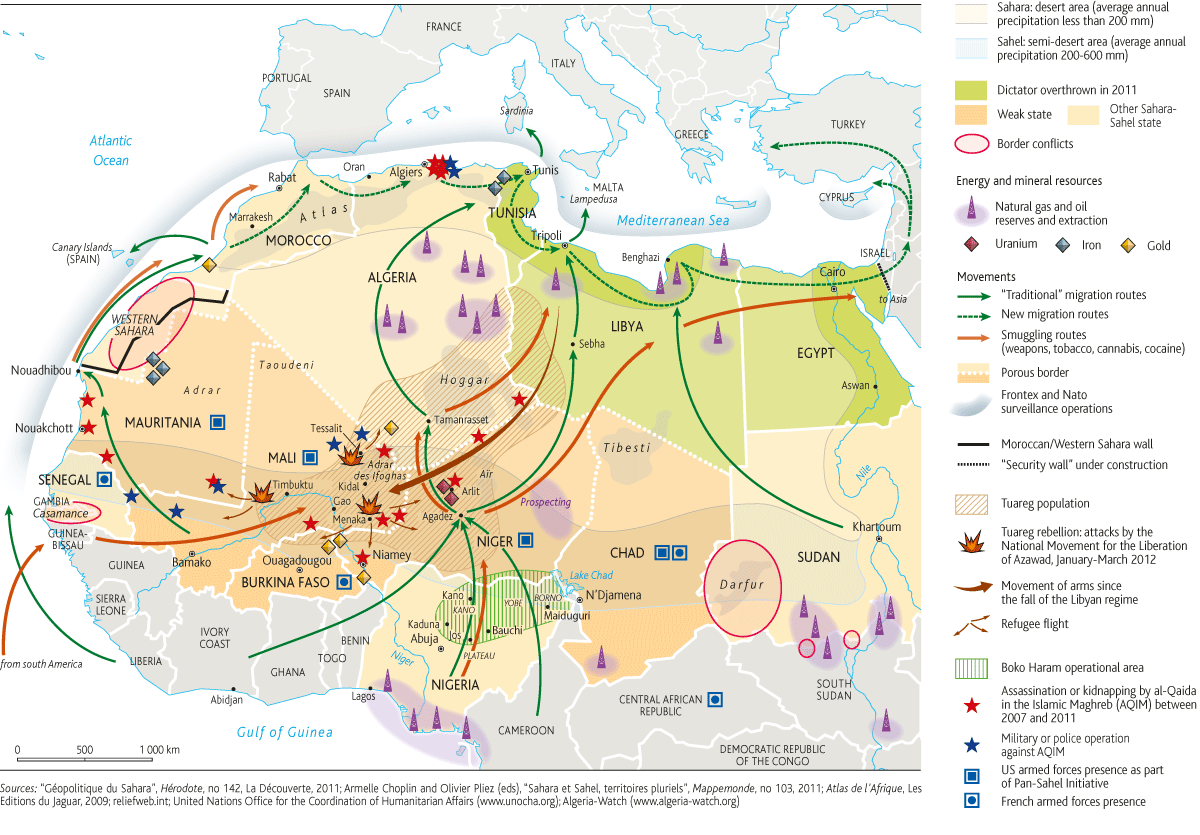
There is no wonder that
Somali touches seep into Mali. Actually the West African country is just
another front in a war that extends several thousand kilometers. It is a covert
war, far from the newspapers’ leads, that has been fought for a decade and in
which Mali becomes the third front. (See map below)
Starting in the east,
the French base in Djibouti is also the home of several multinational squadrons
fighting piracy off the coast of Somalia. What is less known is that it also
has American drones that daily pound al-Shabab and other Islamist groups’ positions
in Yemen and Somalia, even more frequently than they do it in Afghanistan and
Pakistan. That is quite something.
A little further west
we have a UN mission in Darfur, another one in the newly created South Sudan
and one more in Chad, all of them with the presence of European or American
soldiers. The later have created a vast intelligence network over the past five
years, deployed in the area with their eyes put on Boko Haram.
Click to enlarge
Back in Mali, both
Boko Haram al-Shabab are present, advising and assisting the rebels. Al-Qaeda
in the Islamic Maghreb (AQIM) is actively coordinating with them and other
Islamist groups like Ansar Dine.
Its potential danger
is palpable and there are facts that confirm it, such as the recent kidnapping
in Algeria of a gas plant and killing of hostages in the subsequent rescue
operation. Sites part of UNESCO’s Human Historical Heritage like Timbuktu have
been severely damaged by the religious extremism of these groups, in actions reminiscent
of the blowing up of the giant Buddhas in Afghanistan by the Taliban.
Culture is not the
only victim of these groups. After the war in Libya, the Tuareg -under the
National Movement for the Liberation of Azawad (MNLA) - decided to join Ansar
Dine and conquer northern Mali. After they got it, the Islamists ousted them from
power and imposed Sharia law in the region.
The creation of an
Islamist state in Mali is what most worries the West. After the withdraw in
Iraq and Afghanistan -both left in a precarious state-, and the growing
popularity of religious groups in Egypt, Libya and the Syrian revolution, the vision
of a Sharia ruled belt ranging from Yemen to Mali both terrifies Washington,
Paris and London and makes the wettest wildest dreams of the radical Islamists.
However, for now the
U.S. and the EU have left France alone at it. The conflict can easily get stalled
and nobody wants another Afghanistan now that they are getting out from there. The most they have committed is to provide transport planes, tankers and drones.
Moreover, the French
have a better understanding of the area and it isn’t the first time they have
gotten involved there. If someone has to go, it is just the natural thing to
let the French do it.
Last week we woke up
to the unsettling news of Al Assad cooking sarin-filled ammunitions. It is not
that we didn’t know that Syria has chemical weapons. We knew it. But some
intelligence reports suggest now that the regime of Assad may be loading them
on the delivery recipients.
Immediately, the US
stated that using chemical weapons would be a “red line” that if crossed would
carry “consequences”. It is easy to imagine those consequences in the form of a
Libya-style intervention.
If the reports are
true it would show significant weakness for the Assad regime. That shouldn’t
come as a surprise. The rebels are closing the gap with Damascus' airport and
fighting for its control, with flights having to be cancelled for hours at some
points in the past few weeks. For now, the airport is open but the road to the
city is a battlezone.
The recent blackout of the Internet seemed also like a desperate measure by the Syrian government to
cut the leaking of videos and information from within Syria. Mixing the sarin and
loading them onto the delivery recipients would be the prelude of another
desperate measure. Because if done, it all becomes way more complicated.
Photo: TRDefence
While separate on
their active ingredients, it is somewhat stable and relatively easy to store.
But once mixed, and considering the decades-old technology employed by Syria,
it must be used immediately or there would be risks of leaks and deterioration.
It is also more difficult
to store, due to the sarin being extremely corrosive. Add to that the
degradation of the quality of the gas. In fact, to avoid all these problems, Iraqi
soldiers -who used the same tech when attacking the Kurds in the 80’s- mixed
the gas on the spot just before firing the ammunitions or loading them onto the
bombs.
However, some people
see on these reports more of a remake of the Iraq invasion than a real threat.
Calling wolf on weapons of mass destruction to fuel their own interest
-whatever they could be. And it is not only the Russians, who have a clear conflict
of interest with Syria, but also activists among the rebel ranks.
Those rebels, or at
least some of them, are what several analysts have said we should be worried
about. They are talking of a proper nightmare scenario. If the Assad government fails, all those chemical weapons that do really
exist could end up in the hands of the rebel groups, some of them linked to
al-Qaeda. And those rebels have already stated that they want those weapons,
while their methods aren’t always that different from what they say to be
fighting.
This isn’t a new
problem. The US came up with a solution to a similar problem in Pakistan, setting
a back-up plan in case the government failed to secure the nuclear stockpile of
the country. However, Syria is not Pakistan. There are no dollars to put into
Assad’s account to shield the sites storing the weapons -for now, Assad just keeps moving them around- and it is
unlikely Russia would see with good eyes an intervention on Syrian soil by
American soldiers -that was the plan B in Pakistan.
Instead, the Americans
are hoping to train Syrian rebels to secure and handle those weapons. But that
plan can only work if those rebels arrive before al-Qaeda linked groups to the
sites and if Assad’s government cooperates to some degree. Two very big if’s in
a very volatile environment.
President Obama announced yesterday he’s determined to “finish the job” in Afghanistan. Cool. Now, just define what means “job” and “finish” and then all that will worth something. Until then, it’s all words but strategy in Afghanistan is, so far, sinking fast. And in the lack of ideas, the White House is going back to the traditional solution: more force.
Next Tuesday Obama is expected to unveil -for the first time in prime time- a new boost to the troops on the ground in Afghanistan. The place to announce it will be perfect: West Point military academy. In fact, hours and hours of study and discussions are behind Obama’s decision. The options were between 15,000 and 40,000 extra soldiers. Finally, after several weeks of guessing, almost everyone has narrowed down that number to something between 30,000 and 35,000.
What doesn’t seem to change is the strategy for the war. Even Gen. Stanley McChrystal already warned about that in his timid report from August, little has been done. Karzai is still in the chair and, despite his promises to tackle corruption, it’s unlikely that will happen in his term, let alone in one year as McChrystal would have desired.
But yet, more troops are also needed. But what for? According to McClatchy papers, 23,000 soldiers would go to combat and support operations; 7,000 to develop, strengthen and co-ordinate the southern headquarters; with the rest 4,000 effectives destined to train the Afghan army and police. This increase of troops in Central Asia would mean, according to Spencer Ackerman, the deployment of almost every available battalion in operative theaters, leaving just a few back at home available for duty (see links below).
According to another report from The Washington Independent, in December 2009, a total of 50,600 soldiers and 24,000 National Guards will be available for deployment. The rest will be either in Iraq or Afghanistan or resting back from a tour in a combat zone. In January, those numbers would drop to 12,400 -of which most of them from heavy units (cavalry and tanks)- boots available to deploy in case there is a problem in, let’s say, Korea.
However, it seems yet insufficient, especially regarding the number of trainers. If NATO wants to accomplish its promise of doubling the numbers of the Afghan army, from the present 94,000 effectives to 250,000; the General in charge of the training mission -Lt. Gen Bill Caldwell- will need much more than 4,000 trainers.
As for the rest of the thirty-something thousand troops, the New York Times suggests that 10,000 soldiers could be deployed to Kandahar; 5,000 to Helmand and another 5,000 to the east of the country. His job won’t be easy.
Main target will be to stabilize the south and, once that’s done, recover the control of the rest of the country. Time for that, just until next year’s autumn. McCrhystal warns of it clearly in his August report: “Failure to gain the initiative and reverse insurgent momentum in the near-term (next 12 months) -while Afghan security capacity matures- risks an outcome where defeating the insurgency is no longer possible”.
As if those guys didn’t have enough pressure over their shoulders already.
(Available units from the National Guard and the Army now and in the close-mid term)
Afghan National Army soldiers practice firing during a NATO training. Photo: U.S. Army Sgt. Matthew Moeller, 5th Mobile Public Affairs Detachment
Afghan elections votes have been casted, have been counted and have given the victory to Mr. Hamid Karzai, the current president. But nobody still gives him the victory officially. Even with the allegations of fraud behind, Karzai has achieved only a 54.6 percent of the votes according to the first full results to be released. His opponent, Abdullah Abdullah won a 27.7 percent of the votes.
However, still nothing is already sold.
The EU independent observers monitoring the elections have made allegations on 1.5m votes. That’s as much as a quarter of all votes casted. Three in four of those -maybe- fraudulent votes, are for Mr. Karzai. If finally all or some of those votes are casted out, that could lead into a second round. Indeed, preparations for it are already underway.
Of course, Karzai’s team hasn’t received well this. They accuse the independent observers of interfering in Afghan matters and of being “partial, irresponsible and in contradiction with Afghanistan's constitution”. Not that it surprises me. For most of the process Afghan officials didn’t even try to hide corruption and fraud; it was highly unlikely to start seeing them acting like a democratic western politician.
But there is another important number in the final -for now- results: the turnout. 38.7 percent, which for western standards might seem low, but for what we saw on the election day it might be quite high. Almost utopical.
Meanwhile, controversy and debate continues in the home front, especially in Europe. In the eight years of war, the US and the UK have been the biggest contributors to losses in the battlefields but many other countries have lost soldiers too in Afghanistan. However, until now it was only due to occasional encounters with the Taliban or accidents. 2009 brought a shift into that.
The surge of the Taliban in areas before under control of the ISAF, the loss of key areas in the south, the stalled positions for the alliance for years and the civilian casualties all led into the erosion of the support for the “good war” -in contraposition to Iraq- both in Europe and America. As for the first ones, Gordon Brown, Angela Merkel, José Luis Rodríguez Zapatero and Nicolas Sarkozy have pledged for a withdraw before 2012. Canada as well voted for that date in the Parliament. The Poles will do the same soon.
It is so, the same old song for the Americans. Like in Iraq, everyone starts to be tired of shooting an invisible foe. Generals are asking for more troops. Many Senators -mostly Republicans- back that option. Former Presidential candidate John McCain admits that more boots on the ground maybe won’t solve the problem, but definitely it cannot be solved without them.
Obama, however, is thinking in a switch for Afghan strategy. Those days from the beginning where he pledged for more troops to the please of the military are gone. In the mind of many Democrats -and maybe even Obama- flies the ghost of Vietnam. Public opinion is already eroding. As with the Southeastern Asian country, lose the home front and you’ll lose the war.
In order to change that, measures are taking place. Home opinion is much linked to abroad performance, and it’s linked to Afghan public opinion. To gain the Afghan’s hearths, tighter rules of engagements are on to tackle on the Taliban and more non-lethal gear is being deployed to minimize casualties among civilians.
But most dangerous than that is letting Afghanistan have on the Democrats the effect Iraq had on the Republicans. Afghanistan is already seen as the “Obama war”. If the identification prevails, he better win it or he will lose more than a war abroad.
It seems like if the shit is about to hit the fan in Afghanistan. If it haven’t, yet. Problems, problems and more problems is the only thing on sight for the Western coalition and their Afghan allies.
Day after day allegations for fraud on the last presidential elections grow exponentially. Hamid Karzai needs right now only a 1.2% plus one vote more to be elected president without a second round. That’s however a false impression. According to the numbers of the Independent Electoral Commission, around 150,000 votes may be part of the fraud, so far. It’s an important amount, as much as a 4.3% of the total votes.
It doesn’t matter. As Monica Bernabe reports for El Mundo, the Independent Electoral Commission is taking them into account anyway. They are doing the same for the votes of many districts were the turnout was over 90% favourable to Karzai. According to the Electoral rules in Afghanistan, any result over the 90% favourable to an only candidate must be put on hold until investigated for fraud. Not this time.
It’s not the only allegations coming out. There are also many votes for nine previous candidates that dropped from the final lists, but whose names were in the ballots already printed. These votes are valid, however, but the Electoral Commission hasn’t got the same opinion. In the end, one less vote counted is also one less vote needed for Karzai to proclaim himself winner, as the absolute majority needed for it is achieved against the total number of votes. Less votes counted, less votes needed to be president.
However, a ridged election is not the worse of the problems for NATO. Gordon Brown and other Western figures have already praised the victory of democracy in Afghanistan (sic), but Afghanistan’s war won’t be won in the polls or the battlegrounds, but by winning people’s hearts.
As for that, it was a huge slap for NATO forces the mistake from last weekend in where dozens of civilians died when a coalition jet bombed a tanker truck surrounded by Afghans. Gen. McChrystal has been developing a tougher approach on close air support and harder rules for bombing missions, while focusing the attention in a softer handle of the situation and engaging in talks with the Taliban to support Obama’s strategy. He has even issued a handbook for commander on the ground with the new directives, including stopping driving as crazy guys in an Alabama highroad and encouraging the “human terrain” attitude.
All that, however, won’t be of any good if mistakes as the one from last weekend are to be repeated. The fireball from the tanker truck is a more vivid propaganda for the good of the Taliban than any sense of virtual security that Americans and their allies can provide. In fact, zones controlled before by American local allies are now boiling under Taliban control and their influence is spreading.
Even worse. The incident is starting to create cracks inside the Alliance. The attack was ordered in to protect some German soldiers, against McChrystal direct orders, and this is widening a rift between the US and Germany. A rift that the US has had since the beginning with all the participants in the NATO-led coalition but Britain, Canada and the Dutch. Apart from them, the presence of the rest is almost symbolical or they don't engage in combats.
With no protection nor real democracy to offer, the Western economic aid is their only argument. But if they want their aid to be of any use, better start getting rid of all that corruption. Right now, it's suspected an 85% of the money spent in Afghanistan end up directly or indirectly into Taliban hands. Not only the money, also the gear. No wonder why many in Afghanistan like a war state. It's much more profitable. And no wonder either back at the home front moral is as low as never before.
U.S. Soldiers conduct a key leader engagement at Shabow-Kheyl, Afghanistan on April 8, 2009. Photo: UPI Photo/Christopher T. Sneed/U.S. Army
I’m not too eager of stopping working for long (journalism is more a lifestyle than a business, although others may have a different opinion). But sometimes it’s good to take a break. And that’s what I’m going to do from today.
Meanwhile, here are the main issues to follow during the next two weeks:
- Iraq: No more multi-national task force in Iraq. Instead, from today on, it will be just a sole force of one country, exclusively American.
- Iran: Yesterday was the 40th day anniversary of Neda Soltan’s death. Tehran saw again thousands in the streets mourning those killed in the repression by the government forces. And the Basiji, again, fought them back violently. At least 20 people died during last month post-electoral clashes.
But the scars are still fresh. An Iranian court urged the police to present charges against those detained (hundreds of them) and finally around two dozens will be prosecuted. Another prominent reformist was moved from his cell to a government house where he will be under house arrest.
It’s to expect a surge in the clashes again for the next weeks.
- Afghanistan/Pakistan: Helmand offensive still goes on. Yesterday, two British soldiers were killed and the casualty report doesn’t make anything but grow. The near Presidential election, due the 20th of August, promises a few busy weeks ahead. Karzai will win again, almost for sure, but his popularity is decreasing. The Talibans have already called for a boycott of the polls.
Meanwhile, in the southern country the drone wars go on. A recent attack killed, according to the CIA, one of Osama bin Laden’s son. The operations in Swat valley, carried on by Pakistani militaries with assistance from the Americans, have allowed thousands of refugees to go back to their homes, avoiding what could have been the worst refugee crisis since Rwanda.
But the Taliban menace persists. Pakistan signed yesterday a deal with Tajikistan to secure the region, cooperate in security matters and blahblahblah. So beautiful; the ‘Stans fighting together...
And just in case the Taliban weren’t enough trouble, a separatist group from Balochistan started to attack foreign aid workers in the area.
- China: The Uighur revolt still is on the frontpages. China revealed last week official numbers for killed and detainees. Detentions that today are still going on.
Also abroad. While the Chinese government was exchanging opinions with Obama and messages with Taiwan -both signs of aperture of the regime-, it was angrily criticizing the words of the Uighur exile leader and the projection of an Uighur documentary in a movie festival in Australia.
Australia, by the way, is engaged in another nasty diplomatic clash with China regarding a few wallabie employees of Rio Tinto detained in a spy case. The problem for those employees is that they revealed data from Chinese companies to their partners abroad. Data that is open source in China. This puts over the edge hundreds of consultants. What to do now? Where is the limit about what to publish and what not?
And if they survive that, still can be themselves into a collective illnes inside their company.
- Horn of Africa: With the comeback of somalian pirates, the region should have enough. There is even a new videogame about it. But this is Africa. There is never enough trouble.
Knowing that -or maybe collaborating to that- the USA has intensified his pressure over Eritrea and his support for the Islamist groups operating in Somalia. Yet a hypothetic deal sounds like a far dream.
Meanwhile, America plays a wild card strongening his presence in the area through the semi-autonomus region of South Sudan. Members of the newly created South Sudanese Air Force -no planes yet- were training this week in the USA. South Sudan is undergoing through a rearming process as the recent images of Faina’s tanks found in the region prove it.
- Rest of Africa: In Nigeria, clashes between Islamist militias and government forces in the north of the country left 150 deaths. The ambushes are still taken place.
In South Africa, newly elected President Zuma has abruptly ended his honeymoon with his voters. A massive strike shook the country during this week.
Meanwhile, a new campaign has been launched by a Namibian NGO. “Lords of bling” tries to remind the African leaders their promise to spend at least a 15% of the money in healthcare, a measure long forgotten by most of the African Union signers of it. The signer Akon has designed this song to remind that fact to the African presidents.
- Israel/Palestine: The settlements center the debate. International pressure grows as the US envoy to the region increases the talks too. Netanyahu agreed yesterday to destroy 900 houses in an East Jerusalem colony.
Inside Israel sensibilities around this are also changing. Some analysts consider Israel’s image abroad is being heavily damaged by the settlements (smart guy). Some settlers even are speaking out and admit they would leave in exchange for the money spent in their homes and similar conditions somewhere else inside Israel. Some others, not so.
What doesn’t change is Netanyahu’s hawkish government. The last idea is askdemand the Netherlands and the UK to stop giving funds to the NGO Breaking the Silence, who has done some research of alleged Human Rights violations in Gaza by the IDF. Next will be to point European governments how they should spend their money.
And meanwhile the Netanyahu’s government asks Holland and the UK to stop funding pro-Human Rights NGOs, their allies from the far right ask the IDF soldiers to cover up for the abuses committed in the West Bank.
On the northside, the IDF has been put on alert after Lebanon forces were movilized too. However, Israelí officials consider unlikely a reedition of 2006 Hezbollah-Israel war, specially now with so many international forces in the zone.
On the other hand, in Gaza, Hamas starts to apply their particular vision of government. Up until now, Palestinian women could consider themselves lucky. I was actually talking about this recently with a Palestinian friend. While Saudi Arabian women cannot drive a car or meet with strangers, Palestinian women can do that and even wear trousers, the head uncovered or -if they want, and also the men- buy alcohol.
All that could be about to change. A judge has ordered in Gaza to all the female lawyers to wear a head scarf. It is just an example of many more that are showing Hamas’ Islamist hand in Gaza. Like restrictions with alcohol or the new religious police. Here an Al Jazeera video on it:
- Latinamerica: Honduras’ political turmoil doesn’t look well. But at least negotiations are moving up. Slower than a sloth, but moving up. Zelaya is in Nicaragua’s border from where he visits periodically his supporters. Meanwhile the interim government is more and more in lack of support. Abroad, the USA revoked several diplomatic visas. Internally, the Army admitted the predisposition to accept a unity government with Zelaya in front. Last word is Micheletti’s.
Further to the south, Colombia and Venezuela are again fighting. This time, a few Swedish grenade launchers were the detonant of the diplomatic turmoil. The weapons, sold by Sweden to Venezuela, ended up being discovered in a FARC’s camp. After that, the usual crossfire between governments and Hugo Chavez’s usual recall of ambassadors.
And basically that’s all. Add some narco fights in Mexico and a political fight in Burma (Google this, I’m tired of linking news today) and you have enough to be busy for these two weeks I’ll be out.
So, until then... Be good, have fun, and don’t do anything I wouldn’t.
This Saturday we knew that Darth Dick Cheney had hidden from the Congress a CIA project aimed to create special commandos to eliminate Al Qaeda terrorists. A month ago, when Panetta knew about it, it was suspended.
It was indeed an ambitious plan. According to an intelligence official quote from the New York Times, these things are great in the movies, but when you try to put them on practice, it is not so easy. Indeed. In fact, the whole plan looks just as if it came out from a stoned mind after watching the Bourne movies’ trilogy.
However, the CIA didn’t renounce to their plans. If the mission was killing Al Qaeda leaders, it would be done. If it wasn’t possible to do so from two feet, it would be done from two thousand feet. They tried first to copy Israeli style of the after-Munich commandos but ended up copying Israeli style with Hamas selective assassinations. Jets, cruise missiles and drones took their place in.
Since then, the number of attacks on Al Qaeda leaders has rocketed. But of course, shooting from two thousand feet is not as accurate as doing it from two feet distance. So civilian casualties are too on their highest, obviously. It was the natural consequence if they were copying Israeli methods to have too Israeli consequences.
But the US can afford collateral damage if they want to appear before the population as a savior, not as an occupational empire. If they do so, they can end up as the Britons did during the last two centuries. Obama Administration already has made some steps to halt the drone wars or at least minimize the effects, but truth is that few has changed on the ground.
The head of Pakistani Talibans can talk about it. Just over the last weekend, at least four attacks in three days were aimed against Baitullah Mehsud. The Taliban commander, however, has a special nose to detect danger and has proved a great ability to dodge the missiles. Like the one that last week provoked around 60 casualties, the bloodiest drone attack in 2009.
However, going back to Cheney, there is something that doesn’t add up. If it was only for the hit squads, then why all the fuzz when it is being done anyway with drones? Why Panetta decided to close the project down when he knew of it? Why Cheney asks for confidentiality? Why all the attention?
Josh Marshalls makes the same question to himself. And he too sees that there must be something more, something dark in all this.


 7/07/2013
 Ehiztari







 Twitter
 Facebook
 Flickr
 Posts
Posts


