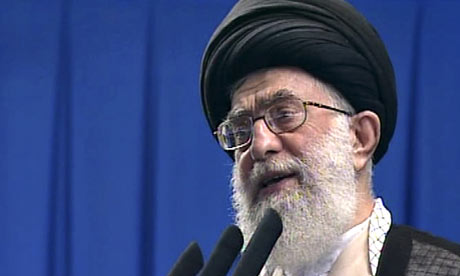
In the aftermath of Iran’s Presidential Elections, Khamenei positioned himself in line with the hardliners. He probably linked his fate to that of Ahmadinejad and flamed on the protests.
Now he just turned his back on the hardliners and denied any foreign hand behind the leaders of the opposition and left them just as involuntary puppets of a long orchestrated charade of the West.
So, what now? The main accusation against the dozens of detained that are now under trails is of being agents from foreign powers -specially Britain and the USA- acting in Iranian soil to destabilize the country. If the Supreme leader diminishes those charges, what about those detainees that recognised under detention they were acting for foreign agencies? What made them say that?
Torture, anyone?
Photo: Reuters TV/REUTERS
All posts on the Iran Presidential Elections 2009 published in Worldwide, here.
I’m not too eager of stopping working for long (journalism is more a lifestyle than a business, although others may have a different opinion). But sometimes it’s good to take a break. And that’s what I’m going to do from today.
Meanwhile, here are the main issues to follow during the next two weeks:
- Iraq: No more multi-national task force in Iraq. Instead, from today on, it will be just a sole force of one country, exclusively American.
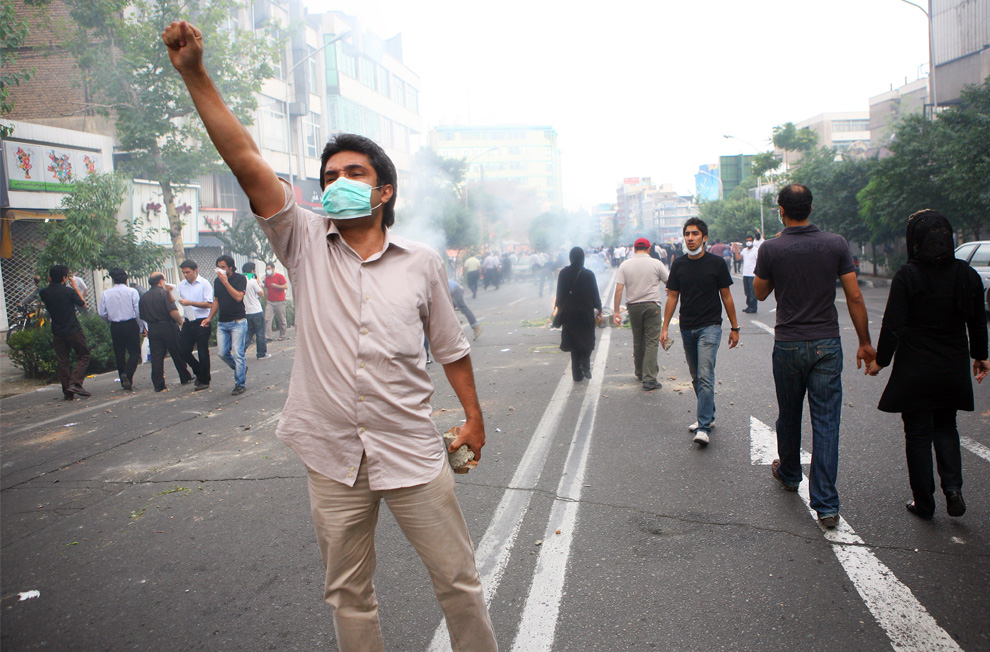
- Iran: Yesterday was the 40th day anniversary of Neda Soltan’s death. Tehran saw again thousands in the streets mourning those killed in the repression by the government forces. And the Basiji, again, fought them back violently. At least 20 people died during last month post-electoral clashes.
But the scars are still fresh. An Iranian court urged the police to present charges against those detained (hundreds of them) and finally around two dozens will be prosecuted. Another prominent reformist was moved from his cell to a government house where he will be under house arrest.
It’s to expect a surge in the clashes again for the next weeks.
- Afghanistan/Pakistan: Helmand offensive still goes on. Yesterday, two British soldiers were killed and the casualty report doesn’t make anything but grow. The near Presidential election, due the 20th of August, promises a few busy weeks ahead. Karzai will win again, almost for sure, but his popularity is decreasing. The Talibans have already called for a boycott of the polls.
Meanwhile, in the southern country the drone wars go on. A recent attack killed, according to the CIA, one of Osama bin Laden’s son. The operations in Swat valley, carried on by Pakistani militaries with assistance from the Americans, have allowed thousands of refugees to go back to their homes, avoiding what could have been the worst refugee crisis since Rwanda.
But the Taliban menace persists. Pakistan signed yesterday a deal with Tajikistan to secure the region, cooperate in security matters and blahblahblah. So beautiful; the ‘Stans fighting together...
And just in case the Taliban weren’t enough trouble, a separatist group from Balochistan started to attack foreign aid workers in the area.
- China: The Uighur revolt still is on the frontpages. China revealed last week official numbers for killed and detainees. Detentions that today are still going on.
Also abroad. While the Chinese government was exchanging opinions with Obama and messages with Taiwan -both signs of aperture of the regime-, it was angrily criticizing the words of the Uighur exile leader and the projection of an Uighur documentary in a movie festival in Australia.
Australia, by the way, is engaged in another nasty diplomatic clash with China regarding a few wallabie employees of Rio Tinto detained in a spy case. The problem for those employees is that they revealed data from Chinese companies to their partners abroad. Data that is open source in China. This puts over the edge hundreds of consultants. What to do now? Where is the limit about what to publish and what not?
And if they survive that, still can be themselves into a collective illnes inside their company.
- Horn of Africa: With the comeback of somalian pirates, the region should have enough. There is even a new videogame about it. But this is Africa. There is never enough trouble.
Knowing that -or maybe collaborating to that- the USA has intensified his pressure over Eritrea and his support for the Islamist groups operating in Somalia. Yet a hypothetic deal sounds like a far dream.
Meanwhile, America plays a wild card strongening his presence in the area through the semi-autonomus region of South Sudan. Members of the newly created South Sudanese Air Force -no planes yet- were training this week in the USA. South Sudan is undergoing through a rearming process as the recent images of Faina’s tanks found in the region prove it.
- Rest of Africa: In Nigeria, clashes between Islamist militias and government forces in the north of the country left 150 deaths. The ambushes are still taken place.
In South Africa, newly elected President Zuma has abruptly ended his honeymoon with his voters. A massive strike shook the country during this week.
Meanwhile, a new campaign has been launched by a Namibian NGO. “Lords of bling” tries to remind the African leaders their promise to spend at least a 15% of the money in healthcare, a measure long forgotten by most of the African Union signers of it. The signer Akon has designed this song to remind that fact to the African presidents.
- Israel/Palestine: The settlements center the debate. International pressure grows as the US envoy to the region increases the talks too. Netanyahu agreed yesterday to destroy 900 houses in an East Jerusalem colony.
Inside Israel sensibilities around this are also changing. Some analysts consider Israel’s image abroad is being heavily damaged by the settlements (smart guy). Some settlers even are speaking out and admit they would leave in exchange for the money spent in their homes and similar conditions somewhere else inside Israel. Some others, not so.
What doesn’t change is Netanyahu’s hawkish government. The last idea is askdemand the Netherlands and the UK to stop giving funds to the NGO Breaking the Silence, who has done some research of alleged Human Rights violations in Gaza by the IDF. Next will be to point European governments how they should spend their money.
And meanwhile the Netanyahu’s government asks Holland and the UK to stop funding pro-Human Rights NGOs, their allies from the far right ask the IDF soldiers to cover up for the abuses committed in the West Bank.
On the northside, the IDF has been put on alert after Lebanon forces were movilized too. However, Israelí officials consider unlikely a reedition of 2006 Hezbollah-Israel war, specially now with so many international forces in the zone.
On the other hand, in Gaza, Hamas starts to apply their particular vision of government. Up until now, Palestinian women could consider themselves lucky. I was actually talking about this recently with a Palestinian friend. While Saudi Arabian women cannot drive a car or meet with strangers, Palestinian women can do that and even wear trousers, the head uncovered or -if they want, and also the men- buy alcohol.
All that could be about to change. A judge has ordered in Gaza to all the female lawyers to wear a head scarf. It is just an example of many more that are showing Hamas’ Islamist hand in Gaza. Like restrictions with alcohol or the new religious police. Here an Al Jazeera video on it:
- Latinamerica: Honduras’ political turmoil doesn’t look well. But at least negotiations are moving up. Slower than a sloth, but moving up. Zelaya is in Nicaragua’s border from where he visits periodically his supporters. Meanwhile the interim government is more and more in lack of support. Abroad, the USA revoked several diplomatic visas. Internally, the Army admitted the predisposition to accept a unity government with Zelaya in front. Last word is Micheletti’s.
Further to the south, Colombia and Venezuela are again fighting. This time, a few Swedish grenade launchers were the detonant of the diplomatic turmoil. The weapons, sold by Sweden to Venezuela, ended up being discovered in a FARC’s camp. After that, the usual crossfire between governments and Hugo Chavez’s usual recall of ambassadors.
And basically that’s all. Add some narco fights in Mexico and a political fight in Burma (Google this, I’m tired of linking news today) and you have enough to be busy for these two weeks I’ll be out.
So, until then... Be good, have fun, and don’t do anything I wouldn’t.
- India gets into the selected club of Navies with indigenous built nuclear submarines. It’s just the frontline of what’s still to come, an improvement of the Indian Navy that will include an increase from the actual 140 vessels to the 170 planned. That includes two more nuclear subs and two indigenous carriers.
- Korea continues playing; now they accept to talk about their nuclear program.
- Sarko collapses while jogging. Did he saw a hot chick jogging besides him? Fortunately, it was all just a scarce.
- Obama starts pushing for a deal in the Middle East. Meanwhile, back at home, Sarah Palin resigns; but not without a fight.
- Iranian courts are pushing in favor of the detainees: their future must be decided within a week or be released. Ahmadinejad, may be busy for the last days of his government. Unless he has to quit over a confidence vote from the Parliament.
Just after a month of Neda’s death, Iranians came to the streets again. And again, the Basijis and the detentions were there too.
It’s not gonna be the biggest demonstration in the next few days. Probably, in a week and a half (when it will be the end of the duel period), in two Fridays, it will be bigger. But this, at least, shows Khamenei that his words are everyday less and less important to the people and Ahmadinejad that his reign won’t be easy.
Up until now, protesters had developed an underground boycott. Like the blackout of last night between 20.55 and 21.00 (local time) to remember Neda. Or the (unsuccessful) attempt to make a public blackout by connecting at the same time all the high consuming electronic items.
It has also continued -even though the house arrests and the house intimidations- with the night shouting from the roofs. Only that the initial “Allahu Akbar” (God is great) has become “Death to the dictator” and "Freedom".
But Ahmadinejad and Khamenei live so far away from their people that they don’t hear their scream. And that could be their end, specially for the latter.
Rafsanjani finally spoke. Ando f course, Iranian opposition has seen the street light again. Rafsanjani is considered the biggest support for Mousavi and, although in Friday’s speech he didn’t attack directly the elite or the government -in fact he talked more about unity- he did leave a few words for them.
He praised, for example, for the immediate freedom for the detainees, the end of the prosecutions and the acceptance of the “doubts” emerged in a part of the Iranian society after the elections. Nothing new, it is what many influential people like the Parliament speaker Ali Larijani have been asking for for weeks. Supporters of a full scale revolution will be disappointed.
But the important issue here is the own Rafsanjani. It’s been the first time HE said it. Up until now, all was about rumors: maybe he was in Qom collecting supporters, maybe he was uniting the clergy against Ahmadinejad -or Khamenei-; but all those were only rumors.
Until this Friday. In his speech, Rafsanjani charged against the bad atmosphere lived in the country, without naming out anyone specifically. He didn’t need to name anyone, however; as it was clear who was the receiver of his message. And he couldn’t charge against the system itself, because in the end, he is just another piece of the puzzle -in fact, some analysts think he is just preparing himself for the Supreme Leader chair.
His speech, however, settles that he cannot live without the system but Iranian system cannot live without him. The place where he gave his speech -the same where Ayatollah Khamenei gave his after the election-, in the University, and the fact itself of him giving the speech proves it.
But although maybe the system cannot live without Rafsanjani, the Government can. Normally, the Friday speech is live broadcasted by the state TV. Last Friday, however, none of the five channels did it.
It really didn’t matter. Rafsanjani’s public wasn’t at home in front of the TV, but in the streets. Several times he had to stop his speech because of the chants -some against the current leader, some acclaiming him as leader. His words were the sparkle that ignited again the protests in Tehran to show Ahmadinejad their detractors may be more silent but still they are.
Of course, Khamenei also still is and he warned again against the opposition to expect consequences if the demonstrations continue. But his warnings sound every day more like a desperate call to keep the chair rather than the calming words of a beloved father and leader of the country. Specially inside Iran.
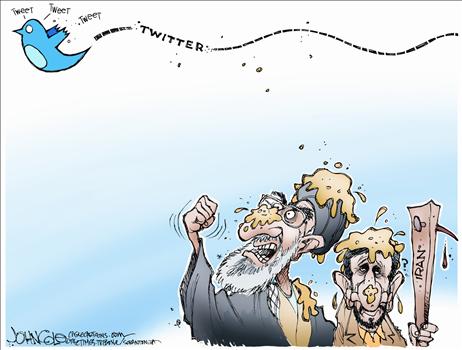
When you don’t have eyes to see what happens somewhere, you try to guess what’s going on by observing the outcome. After more than two weeks of unrest from the opposition in Iran, tweets and online info is declining now.
For the past few weeks, the trend #iranelection in Twitter only backed down after Michael Jackson’s death and after the shocking victory of the USA soccer team over Spain, world’s top ranked team. Now, however, is way down in the list.
According to the CNN, the arrests and the repression is a key player in the decrease of cyber-activity from Iran opposition. Well, it may be, but I think there is another factor more important than that into the equation.
As I have stated here before, long after the CNN, the BBC and the Western media leave their attention for Iran behind, in the Persian country still will be mourning for Neda and the opposition. But not now.
The reason is the 40 days of duel that states Islamic faith. For the duration of that month, few won’t be aware of the outrage. With the dimension of the repression, the dozens of deaths and the detentions still going on, the cycle is just refuelling to fire back later.
Another goal to the CNN from Internet and Jon Stewart? Maybe.
All posts on the Iran Presidential Elections 2009 published in Worldwide, here.
While half the world was mourning Michael Jackson’s death, two of the most solid politicians at the moment sent a message to Ahmadinejad: Go f**k yourself.
In a news conference in Washington, hosted by American president, Barack Obama, and his German counterpart, Angela Merkel, Mr. Obama rejected a call from Iranian president for an apology on his last statement about election’s aftermath in the Gulf country:
"I don't take Mr Ahmadinejad's statements seriously about apologies, particularly given the fact that the United States has gone out of its way not to interfere with the election process in Iran".
"I would suggest that Mr. Ahmadinejad think carefully about the obligations he owes to his own people [...] He might want to consider looking at the families of those who have been beaten or shot or detained”.
Obama also added that the events to come could affect the new talks ahead. Ms. Merkel went the extra mile supporting her host by saying:
"Iran cannot count on the world turning a blind eye".
This comes as a response from a claim from Iranian president, Mahmoud Ahmadinejad, saying that Mr. Obama was acting just like his predecessor, George W. Bush; pronounced during a victory party yesterday. A ceremony that ignored over a hundred MPs, including Ali Larijani, the Parliament’s speaker.
Meanwhile Iran continues the repression. The hard line calls for the “execution” of the protesters while the country reaches the top of the list jailing journalists.
But the biggest question now starts to be, where is Mousavi? The man who started all this remains isolated and unseen since last week's Thursday. With the violence escalating in Tehran streets and the absence of his leader, the opposition is thinking on going underground. The regime is succeeding in repressing the uproar but it may win the first battle to lose the war.
All posts on the Iran Presidential Elections 2009 published in Worldwide, here.
When Ayatollah Khamenei aligned himself with Ahmadinejad’s claims, he did much more than that. He put his own career in the line of fire. Now, after a week and a half of clashes with the police, riots, deaths and detentions, there is no comeback possible for him. He has to stick with the decision of not recounting the votes and not having another election process.
This has led into deception and disappointment among many Iranians. Combined with the extreme violence lived in the demonstrations, including shocking Neda Soltan’s death, the link between Iranian elites and their citizens seems to be endangered if not broken. Cracks are all around, even between the clergy. The unthinkable, defy the Supreme Leader’s word -almost as powerful as law- is a broken taboo today.
As I said in a previous post, what started as a solely political claim had evolved into something personal. The “Where is my vote?” slogan from the beginning has changed into “Death to the dictator”, personalizing the blame for all this in Khamenei himself. In fact, Ahmadinejad and the elections have been bypassed and people now charge against the head of the state.
Trust on the institutions is lost. Even if Khamenei survives this, his position has been weakened. Doubts about his suitability for the job surrounded him from the beginning and this test only contributed to add more wood to the fire of the debate. Many experts see a big mistake in Khamenei’s attitude, a fail to act as an equal father of the state, acting instead by taking part into the fight rather than calming down. That may lead in a greater debate, even over Khamenei himself: about Iran's need of a Supreme Leader 30 years after the Revolution.
Meanwhile the repression goes on in a nasty way. And it only worsens people’s response. In Tehran, outrage expands as new news are known. Ban the funerals and intimidate students in their apartments was just the beginning. Make them pay for the bullets that are killing their relatives is the last one.
It’s known that Basij members have threatened the families of those dead in the demonstrations. They are not allowed to show duel and many of them have disappeared, including Neda Soltan’s family. What the regime is trying to avoid is a public display of duel that can fuel a cycle which could lead into a new revolution, like in 1979.
1979’s revolution wasn’t made in just a few weeks. It took more than a year to come to the light, a year full of blood and detentions. New guys in charge look too blind to see that this is exactly what they are replicating: what led them into power 30 years ago.
In a Shiite society like the Iranian, where martyrdom acquires a relevant meaning, deaths like Neda’s will be still resounding loudly after the 40 days of duel, after the CNN, the BBC, the West and this blog will forget about Iran and the Iranians. And Neda won’t be the last one.
That’s why Ahmadinejad government tries to identify the demonstrators as traitors or spies. According to Islam, no Muslim is allowed to kill or order to kill another brother in faith. Downgrading detainees to foreign agents opens a door for repression.
Externally the Government continues to blame Europe (specially the UK) and the USA, arguing that the protesters are being financed by foreign secret services. Even if that may be true in some cases, it’s not enough to explain the massive response from Iranians. And it doesn’t account that Ahmadinejad has as well an unusual, weird and powerful supporter, Netanyahu’s Israel, which could be acting too in Iranian soil with the Mossad the same as Western services could be.
Until now the West tried to stay aside and leave it as an Iranian internal affair. The meaningless speech could be seen as an anti-Iran opinion, something that especially Obama wanted to avoid. Neda’s death changed that, Obama escalated the rhetoric of his words and Ahmadinejad hasn’t doubt to use again the anti-Iran card.
But the toughest battle is and will be at home. With a divided elite and breaks everywhere, the stakes are high. And the bet is on the table. Khamenei and Ahmadinejad share now the same fate -for good or bad- and the hour of the truth will come when everyone else from the West had already left. And for what we can see up to now, they are not prepared to face that.
All posts on the Iran Presidential Elections 2009 published in Worldwide, here.
There are many ways to be unpopular among your citizens, but Iranian Government seems to be determined to accomplish it in all of those ways. Including the bad taste.
According to information appeared today in Haaretz newspapers -who quotes the Wall Street Journal-, Ahmadinejad Government charged slain man's family $3,000 for the bullets that killed him. That is just another one of the many measures going on in Tehran to intimidate the opposition. As if with clubs and bullets it wasn’t enough.
Different reports and tweets indicate that Iranian authorities are banning the families of the deaths from mourning their relatives. All mosques in Tehran have been prohibited from holding memorials or publicly mourning the deaths of the riot victims.
It won’t be so easy. Despite the attempt to provoke a media blackout by expelling foreign correspondents, Internet has become a useful tool for Iranian citizens to display their disregards. Maybe nobody will be able to attend Neda’s funeral, but the video footage of her death has travel the world and in yesterday’s demonstrations, her image was at the top of the protesters.
Three of the four candidates called for the annulation of the elections, but in the streets it’s becoming a more personal matter since the riot police started to tear gas them and shoot them down. Political issues still are underneath, but the recent deaths have given a different angle to the protests. Moussavi -and other candidates’- supporters not only claim for democracy, but also for justice and human rights now.
Neda’s death, a martyr as the candidate Kharoubi said of her, can mean a huge impact on Iran. In a country of Shiite faith, a faith founded on the idea of self-sacrifice for greater purposes, it could mean an angrier response from the people, as it is happening now. It wouldn’t be the first time. During 1979 Revolution, the death of protesters fueled a cycle of outrage that led into the Shah overthrow.
The official Government, however, doesn’t get the message and continues in the hard line. Khomeini, the Supreme Leader, warned last Friday about a bloodshed; the Basij militias warned with a bloody response if protests continue; the Assembly of Experts recognized irregularities but didn’t agree on a general recount or a new election process, so Ahmadinejad will be sworn as President in August.
Meanwhile, five European citizens were detained today suspected of being “spies”, as so called by the regime. Europe has actively supported since almost the beginning the claims of the protesters. On Monday they announced they will open the gates of their embassies to Iranian citizens to protect them in the clashes with riot police forces. The answer from Tehran was think about calling back their ambassador in London.
Photo: AP
All posts on the Iran Presidential Elections 2009 in Worldwide, here.
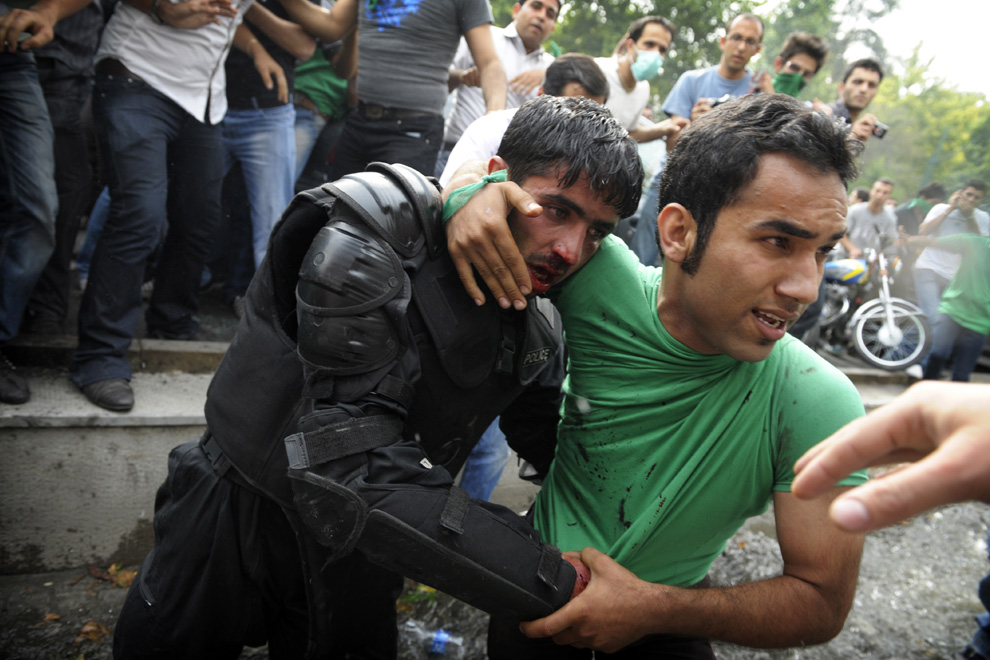
During last weekend demonstrations at least 10 people died in the clashes with the Government forces. The death toll is up to 19 in the week of protests. Plus 450 detained. But all those figures are unclear, as they are based only on the official Iranian press’ reports. Very little independent information is coming out of Iran, and although the official TV is opening themselves, they are still under the control of Ahmadinejad’s government.
Very little independent information is coming out from Iran. Foreign reporters are banned from going to the streets. The CNN, Newsweek, Al Arabiya and the BBC correspondents have already even been either detained or expelled from the country and their press authorizations revoked. Enemies for the press are not only inside Iran, however. In Bahrain, an important newspaper was closed down after publishing a critic article on Iranian elections.
But despite the censorship, Iranians still are being able to leak information to the outside world. Twitter has become a major point of information for both Iranians and outsiders and both inside and outside Iran. As noted in the NYT, it’s not the first time this happens. Other Internet sites like Facebook or Google have also started to actively help Iranian reformist with small but significant gestures, like adding the Farsi language versions of their websites.
Moussavi himself is actively using the Internet to spread the word. Always with a moderated language -and always, as the official line, invoking the name of Islam- but firmly, has uploaded several messages on his own personal website. For now, that website survives the Government censorship. For now.
YouTube has also arise as a great way to widespread the words of the opposition. In fact, a shocking video[WARNING: Contains extremely graphic violence] of Neda, a woman covered in blood after being shot to death in one of the demonstrations this weekend, and Neda herself have become the new motto for Mr. Moussavi’s supporters. Karoubi, a supporter of Mr. Moussavi who appeared besides him in the last demonstrations, has called to honor Neda in the following protests. She has become a martyr of the new revolution.
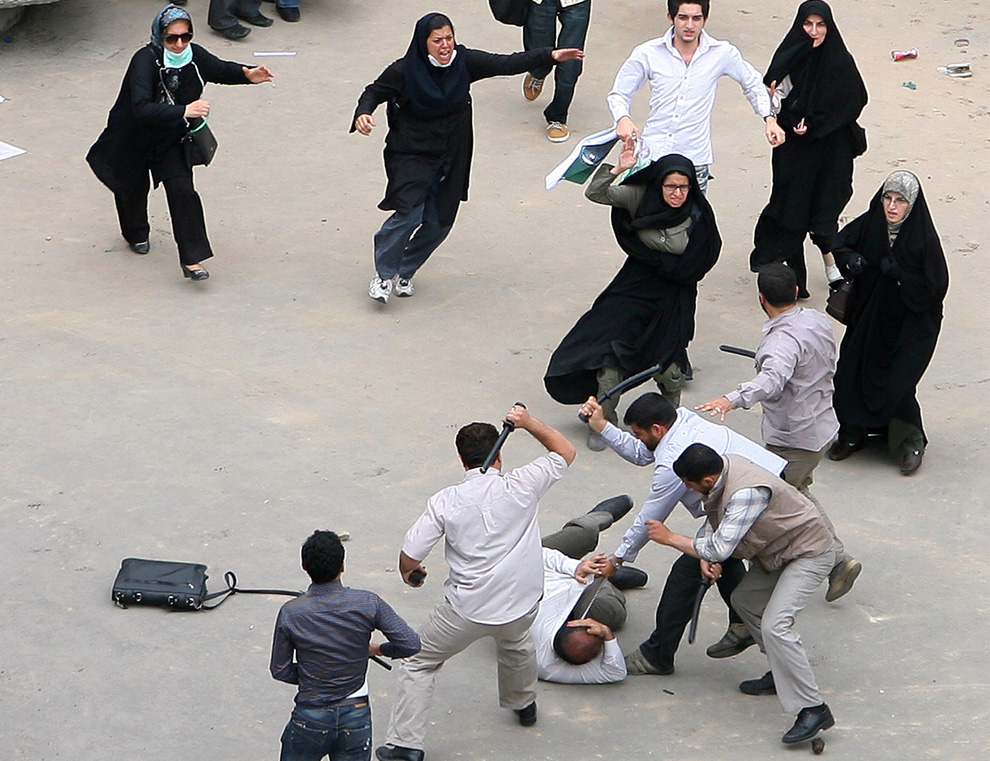
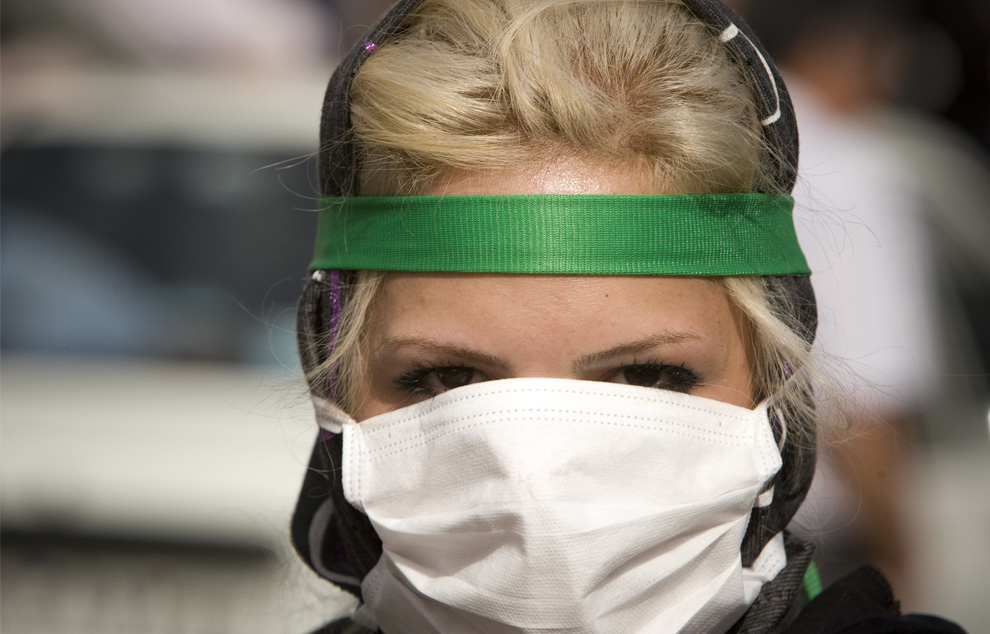
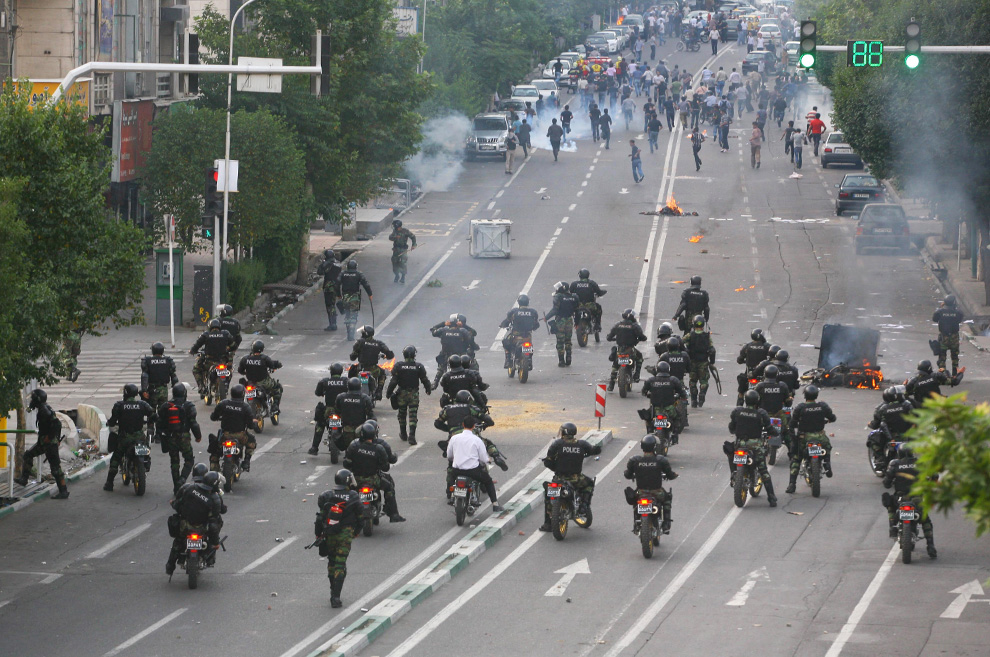
The Government reaction has been tough. Basij militias had a letter of marquee to act. That led into them breaking into reformist students’ apartments to intimidate or even beat them. The streets, however, and the reformist movement are not backing down. In fact, that’s giving them more reasons to face fiercely the police forces, as shown in this video.
Every inch gained to the anti-riot police, every recognition of their rights from a Government official, is a small victory for Moussavi’s supporters. But probably the biggest one up to now has been the resolution from the Council of Guardians revealed today, that admitted irregularities in 50 cities. According to the report, at least in those 50 cities more than a 100% voted in the elections. The London think tank group Chatham House, agrees with it.
The Government argues it is because some people voted in places where they are not registered, although they are living there. In the Yadz province, for example, in the city of Taft the participation was of 141%. Official argument claims it was because of the “great weather”. The opposition on the other hand maintains that those irregularities happened in at least 100 cities.
Stakes are getting higher in Tehran. Last weekend violence threatens to shake up the country into a real full scale revolution. The political discrepancies that had been going on underway the apparent unitary leadership for years had arisen.
The opposition has already more heroes and echoes of the movement don’t only return with Moussavi’s name. Two people from a very different background are the new names in the mouths of Tehran reformists: Rafsanjani and Neda.
Ali Akbar Hashemi Rafsanjani is a former president of the Iranian Islamic Republic, father of the revolution of 1979 and the head of two important organs of the Republic, the Assembly of Experts and the Expediency Council. The second one mediates between the Parliament and the Guardian Council; the first one appoints the Supreme Leader and is even capable of oversee him, although that’s an unlikely possibility.
All that, however, didn’t save his family of being prosecuted as many other Iranians are being today. His own daughter Faezeh and several more members of his close familiar circle were detained -and shortly after freed again- in the personification of the fear that many parents have in Tehran. They suffered the repression during the previous revolution and don’t want their children to suffer the same pain. Their children, however, are up to the challenge. That's exactly what Faezeh's brother said when they detained his sister: their own father was in jail for 5 years; they are "prepared" to take whatever it takes for their revolution. Even if it's jail.
Mr. Rafsanjani, however, hasn’t been seen on public since the elections’ results arose. He is supposedly negotiating secretly in Qom with the rest of the 86 members of the Assembly of Experts, gaining support to get the elections annulled. So far now, according to a report (not confirmed) Mr Rafsanjani could have won at least 40 Experts to his cause. If that’s true, it would be the clearest sign of the deep division inside the political elites in Iran.
Each day appears a new break in the Government wall. Last one was Ali Larijani, president of the Parliament. Mr. Larijani was one of the fastest to congratulate Mahmoud Ahmadinejad after the elections for his victory. However, in an interview in the official Iranian press, Mr. Larijani admitted that “a majority of Iranians doubts the officially announced election results” and “that their views should be respected”.
But still the supreme leader and the Government stand their grounds. Khamenei’s unusual speech of last Friday (he only gives speeches in the end of the Ramadan and the anniversary of 1979’s revolution) puts Mr. Moussavi in a position virtually inexistent until today in Iran: the opposition. He also warned the protesters that they will be responsible of the bloodshed that wourld come from more protests. From the Government, the response has been more violent. The Basij had a letter of marquee to use tear gas, clubs and bullets to repress by force the demonstrations. But that violence maybe could be a fireback for them.
Moussavi won’t back down. Ahmadinejad can throw into him the gates of hell, in the shape of a police charge, but Moussavi and his supporters are standing their ground.
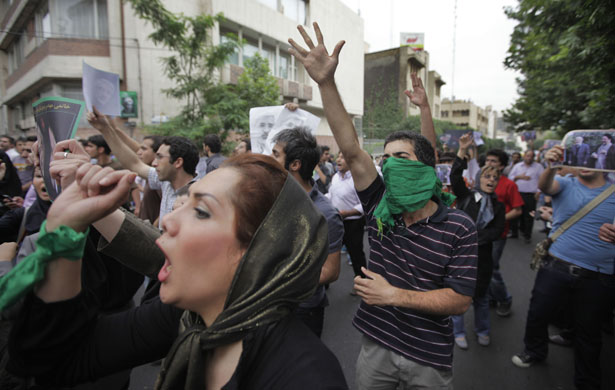
Today, protests were still going on in Tehran streets. But there was a new element in them. For the first time since the aftermath of the elections, the opposition leader, Moussavi, was inside one of those marches. He can end up in a prison, but it is that or losing the faith and the trust from all the young reformist voters that are backing him.
They needed it. They needed to know that Moussavi was, at least, behind them too. A letter sent last weekend to the people wasn’t enough. He had to show up. When he has done so, he was protected by tens of thousands of supporters.
After a week of clashes with the police forces, being hit and shot by them and dispersed with gas, finally a march has gone without -major- problems and police forces didn't do anything. Were they too many for a few officers or is it that the images of the police beaten the people is embarrassing them? Even local state controlled media is switching sides.
Too good to be true. In the end, rumors news point to shootings and at least, one dead by Basij, the pro-Government militia that kept Moussavi two days under house arrest.
Now it’s the turn for the high spheres of power. A popular showdown like this is difficult to ignore. Khamenei has already ordered to investigate the electoral fraud. There are some facts that simply don’t add up. Like Moussavi losing in his own town, in his own region. As Karim Sadjadpour of the Carnegie Endowment for International Peace stated yesterday night on C-Span, it is “the equivalent of Barack Obama losing the African-American vote to John McCain in 2008. It just doesn’t add up.”
Meanwhile, Ahmadinejad is not alone celebrating his “victory”. Israel too is happy for the Persian neocon triumph. Something must be wrong when Ahmadinejad and Netanyahu cheer together. It just doesn’t add up.
Video: BBC
Keep up to date on Iran election's aftermath here.
Half of the world was pending on the results from Iranian elections during the last weekend. From those results will overcome half of the answer to the region’s stability during the next few years. The other half came from Israel a few months ago.
Three candidates, all of them moderated or reformists, faced the current president, Mahmoud Ahmadinejad. It wasn’t difficult to be more moderated than Ahmadinejad, in the end, he is the closest thing to a neocon in Iran.
The best positioned to challenge his position of power was Mir Hossein Mousavi. Mousavi is a moderated reformist. Painter, architect and former Prime Minister from 1981 to 1989, when the charge was abolished. He disappeared from the political scene until now. It was believed he will face Ahmadinejad supremacy in one of the most disputed polls in Iran in many years, but the end showed us something completely different.
It’s, however, not the victory of Ahmadinejad what surprises the West, it’s the dimension of it. The Iranian president won the reelection by a margin of 30 points. That’s at least suspicious coming from an election initially due to be decided in a second round. And of course, Moussavi’s supporters saw it as a corruption scandal and reacted violently.
The facts are there. There is enough raw material to suspect about a fraud. But the truth is that, even if it has been orchested from the Government, after the supreme leader, Khatami, announced Ahmadinejad’s victory, there is not much left to do. Opposition faces a dilemma. Either they don’t accept the results and are condemned to a brutal repression or they accept it and are condemned to lose the trust of the reformist people who trusted on them for this election. For now, they stand their ground, but it's unclear for how long they will.
Many of those reformists protesters are young students from Tehran, sons and daughters of the students that developed the revolution. A colleague who was working in Iran a few years ago told me that these parents are afraid of their children facing the same prosecution they suffered, even if they agree with them, and are overprotecting them.
Indeed, those fears aren’t unreal. Just after the election, the country started to move its weapons. Not literally, but in a manner resembling to China, Iran detained reformist politicians, banned text messages and access to some Internet sites as Facebook from its soil; so they ran into Twitter. Foreign media also was affected by this, as claimed by the BBC and others. Al Arabiya even was forced to cease reporting at all.
This is what Iran less needs right now. And I’m not only talking about the election but the president itself. The system applied to their citizens applies too to foreign countries. He doesn’t want to speak or let others speak, and that may doom Iran into international isolation. That’s a dangerous place to stay, a place where only another country of the region is now: Israel.
If Ahmadinejad is brave enough to face Obama’s challenge and embraces dialogue, that could leave Israel alone and without arguments in his war against everybody. They could isolate Israel internationally and hit him severely.
But with Ahmadinejad that won’t happen. That’s why Israel didn’t wanted Moussavi to win and is more than happy with Ahmadinejad. The policy of fear is more useful with wolfs than lambs, even if those lambs are wolfs inside. Ahmadinejad, however, is a pure wolf. And Israel didn’t miss a minute to continue calling wolf after the results were known.


 8/27/2009
 Ehiztari









 Twitter
 Facebook
 Flickr
 Posts
Posts


