Any questions? Contact us.

Showing posts with label Low intensity conflicts. Show all posts

Friday, June 21, 2013

Turkey and Brazil: the connections and the mismatches

Miles apart, they don’t share language, culture, religion or a common colonial past. But despite that, both Brazil and Turkey are under unrest at the moment. Citizen movements that mirror on the Occupy movement and the Arab Spring have flourished and are gaining momentum from Rio to Istanbul. But what makes them different and what do they share?

Differences

Where they come from and where they go to
Brazil and Turkey were never in the spotlight. They always have been important regional powerhouses, but they lacked the support of an important global player like the EU. However, in the past decade both countries have gained relevance and economical power of their own and now can fight as equals with the EU (Turkey) or even in a global scene (Brazil).

However, while Brazil is much more independent to act, Turkey must look closely its actions if it wants to join the EU. The backlash against the protests has not improved the prospects of accession to the Union for the Turks.

The flame and the spark that ignited the flame
In Brazil it always has been about money. It all started with a 10-cent hike in public transport prices. But soon it grew to cope with the widespread frustration over a whole set of economic issues, from high taxes to wasteful expenses for two major sporting events (2014 World Cup and 2016 Olympics).

CS Gas canister; made in Brazil, used in Turkey
In Turkey it always was about defending secularism. Sure, the spark of the unrest was the proposal to uproot some trees to redevelop the area into a mall -or a mosque. But deep within the protesters demands is the fear of a Islamisation of Erdogan’s government. Recent laws passed with restrictions on the sale and advertising of alcohol and an attempt to limit women's access to abortion are deeper roots into the protests than the roots of the trees in Taksim. 

In both cases, however, the initial spark that ignited the unrest was a mere catalyst of a reaction years in the making.

The countries’ leaders
The Turkish PM Recep Tayyip Erdogan has become the target of the ire of the protesters. They blame him and his party for his policies. The response from Erdogan has been a stronger crackdown on the protesters. It is now a very public struggle: Erdogan and his party against a myriad of other groups that include ecologists, LGBT rights supporters and Kurdish independentists among others.

On the other hand, Dilma Rousseff, a former leftist guerrillera who was imprisoned and tortured during Brazil's 1964-85 dictatorship, hailed the protests for raising questions and strengthening Brazil's democracy. Unlike Turkey's leader, Rousseff remains popular among many of the protesters.

Epicenter vs. dispersion.
Turkey has a clear HQ for its unrest: Taksim square. In Brazil it is a bit more distributed. Sao Paulo and Rio have held multitudinous demonstrations that travelled through the city. In the case of Turkey, it has been a fight -and a proper one- for the control of Taksim square, the symbol of the protest and where it all started.

Similarities
The protests started outside the capital
All the previous revolutions started and took shape in the country’s capitals. Tehran, Cairo, Athens, Madrid… Both Brazil and Turkey have administrative capitals that aren’t the main city in the country. And for both of them, it wasn’t in the capitals but in those others main cities where it all started. Rio and Sao Paulo in Brazil and Istanbul in Turkey have been from the beginning the beachheads for their countries revolutions.

A growing middle-class…
The fast growing economies in Brazil and Turkey have created a new middle-class that previously was really small. This new middle-class is better educated, better informed and more ambitious. The problem is that the upper tiers in the Turkish and Brazilian societies have won much more purchasing power than the middle-classes; thus widening the gap. This is the opposite to the case of Spain and Greece, where no one has won purchasing power (there it is a case of the middle-classes losing more than the upper tiers).

…but also growing inequality
Despite the economic growth, the gini index has gotten bigger for both of them. This shows the increasing inequality that the population in both Turkey and Brazil are facing. The gap between the top and the bottom is getting wider, and the scale is stretching so much that the space in between for the middle-class is endangered.

The police crackdown on protesters
Both unrests have been met with equal hard measures. Batons, water cannons, rubber bullets and gas canisters have been used by both governments to suppress the demonstrations. In an episode of twisted irony, protesters in Turkey discovered that the CS gas canisters used by the Turkish police were made in Brazil.


Both police forces have been also strongly criticized for the use of excessive force. In Turkey, the police union said that at least six policemen had committed suicide due to the stress that they were being put under. In Brazil, the video of a cop refusing to crack down on protesters and being fired on the spot by his superior has gone viral on YouTube.
Tuesday, April 16, 2013

The silenced genocide


It's our fault, the media’s fault. We are experts at making huge deals of a sand grain while failing to realize about the huge mountain in front of us. While everyone -including us- is looking to Pyongyang, silence prevails in other parts of Asia such as Burma.

In Korea there has not been yet a single shot, a single death, nor more refugees or displaced in fifty years. Nevertheless, hundreds of foreign correspondents have traveled to the area to tell that absolutely nothing has happened. In the meantime, the Rohingya suffer a very real conflict that gets silenced.
Burma's case is especially flagrant. There are currently several active conflicts against various ethnic minorities in the country. The Karen, Shan, Kachin and Rohingya are just four of the groups that are currently fighting the government in Yangon.

The Karen are an ethnic group divided between Thailand and Burma. Since 1976 they have been fighting for their own state or, more recently, at least greater self-government. Relationships are clearly better than a few years ago and last week both sides sat down to negotiate. That doesn’t mean they are in good terms.

The Shan’s situation is slightly better. They have some degree of autonomy and its own army, but they are subject to the central government. However, both the Shan and the neighboring Kachin have been abused by the majority Bamar that governs Burma. Unlike with the Karen, tension with these two groups has increased in recent weeks.

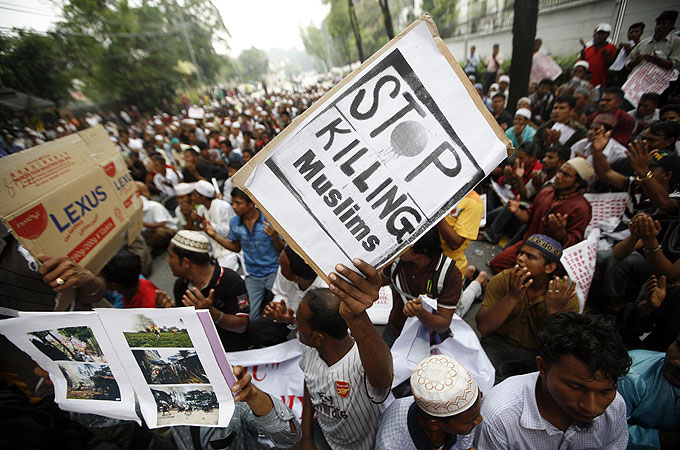
But the most significant case is that of the Rohingya. Not only they are different ethnically, as the rest of the other groups, but also on the religious level. The Rohingya, mostly Muslims, have suffered all sorts of attacks against their properties and their people for years by the country's Buddhist majority.

In 2012 these attacks increased exponentially. And they do not respect anything or anyone. In early April, a school with 70 children burned down in what appears to be an unprovoked attack. Thirteen of the children died in the fire.

The seriousness of the issue has led some to declare that what is occurring in Burma is nothing less than ethnic cleansing. However, little or no response has been made by the international community.


It is particularly striking that the Nobel Peace Prize Aung San Suu Kyi has not said anything about it. If we take into consideration how the international media are usually always listening to everything she says, her silence is the more disturbing. The once ardent defender of human rights in Burma seems to prefer silence and turn a blind eye in the case of the conflict with the Rohingya.

The Burmese central government has called the Buddhist New Year celebrations to demand national unity. But in the current situation that is more of an utopia than reality. The main concern for Yangon is to prevent the ethnic conflicts to endanger the much needed flow of foreign investment.

What will happen to the country’s ethnic minorities is secondary. Problems endemic to the region, such as amputees by landmines, forced labor with refugees and sex tourism are already threatening the Shan, Karen, Kachin and Rohingya. And no one seems to care about it.

Friday, September 18, 2009

Heating up the Gulf (of Aden)

At least nine peacekeepers of the African Union (AU) were killed yesterday in a double explosion in their Mogadishu’s headquarters. Among the victims is the Burundian deputy commander. Another top commander, Ugandan General Nathan Mugisha, was also lightly wounded.

The attack has been claimed by the Islamist group al-Sahbab. The rebels suffered a big hit this week after a US raid killed one of their top commanders. Immediately, the group vowed for revenge and it has come in the way of two suicide attacks. Apparently, the rebels infiltrated the compound in two stolen UN cars and detonated them once inside.

This only comes to show once again the delicate situation in Somalia. In between the multiple war clans, sub-clans and war-lords in the region, the Islamists have taken an empty slot to finishing configuring a complex board. Somalian government is incapable of controlling more than a few quarters in Mogadishu, and that thanks to the heavy presence of international forces.

In fact, the situation is so bad for the central Government that it was themselves the ones who begged asked neighbor nations to invade them. However, they are not the only ones asking for reinforcements. The Islamists have called too on a Jihad to support the Somalian brothers in their struggle.

Al-Sahbab is making of Somalia a local hub for Islamists. Somalia is too remote, too isolated and too xenophobic to become a haven like Afghanistan was. But thanks to the lack of government of any kind, they are like at home. One of al-Qaeda’s most prominent militants, Abu Mansour al-Amriki (the American), lives there and from there has released his latest hits. Including a Jihad hip-hop song.

They feel at home, and they start to rule as if they were at home. Last month, al-Shabab was successful kidnapping two French intelligence agents that were training Somali forces. One of the escaped, but the other one remains in captivity. Now, the Islamists have released their demands for the freedom of the French agent. And they include the usual al-Qaeda cocktail: stop supporting the weak UN-backed government and hail the anti-piracy patrols.

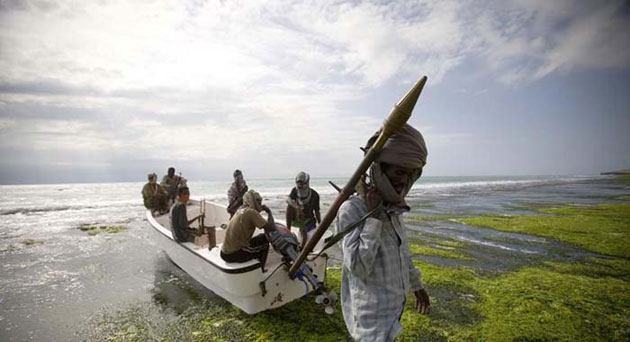
In fact, this unruled land is the same that hosts the pirates that day after day chase the ships sailing in the Gulf of Aden. Situation is getting worse, instead of improving. It’s clear that Somalia’s inexistent navy cannot face the pirates. Actually, their navy is just starting to be built up and consists basically of a bunch of ships. Sorry, skiffs.

So, with this situation in mind, Western governments are going further. The US has started taking seriously the threat on land, as the raid previously mentioned states. Others, like the Spanish government, in cooperation with the Basque government, has authorized for the first time the hiring of private contractors and the use of long range firearms aboard Spanish and Basque ships in an attempt to deter pirates of seizing them.

The French are going ahead with another front and are proposing a stupidity tax to those who had to be rescued from pirates' hands. Makes sense as so far they have been the bussiest guys around. Three rescues in two years means there are many stupids playing in cruises in the area.

But the best improvement have come from the shipping companies. New measures have reduced the number of assaults dramatically.

Not that all that it’s going to make any change. According to Andrew Scutro, Somali pirates have attacked even military ships. The translator cited by Scutro says that pirates are dumb enough to not distinguish between a military vessel and a freighter. A more frightening version would be, however, if they indeed know what they are attacking.

Ugandan AU Peacekeepers
Photo: Reuters


Did you like it? Share it Delicious

Friday, July 31, 2009

Holidays round

I’m not too eager of stopping working for long (journalism is more a lifestyle than a business, although others may have a different opinion). But sometimes it’s good to take a break. And that’s what I’m going to do from today.

Meanwhile, here are the main issues to follow during the next two weeks:

- Iraq: No more multi-national task force in Iraq. Instead, from today on, it will be just a sole force of one country, exclusively American.

- Iran: Yesterday was the 40th day anniversary of Neda Soltan’s death. Tehran saw again thousands in the streets mourning those killed in the repression by the government forces. And the Basiji, again, fought them back violently. At least 20 people died during last month post-electoral clashes.

But the scars are still fresh. An Iranian court urged the police to present charges against those detained (hundreds of them) and finally around two dozens will be prosecuted. Another prominent reformist was moved from his cell to a government house where he will be under house arrest.

It’s to expect a surge in the clashes again for the next weeks.

- Afghanistan/Pakistan: Helmand offensive still goes on. Yesterday, two British soldiers were killed and the casualty report doesn’t make anything but grow. The near Presidential election, due the 20th of August, promises a few busy weeks ahead. Karzai will win again, almost for sure, but his popularity is decreasing. The Talibans have already called for a boycott of the polls.

Meanwhile, in the southern country the drone wars go on. A recent attack killed, according to the CIA, one of Osama bin Laden’s son. The operations in Swat valley, carried on by Pakistani militaries with assistance from the Americans, have allowed thousands of refugees to go back to their homes, avoiding what could have been the worst refugee crisis since Rwanda.

But the Taliban menace persists. Pakistan signed yesterday a deal with Tajikistan to secure the region, cooperate in security matters and blahblahblah. So beautiful; the ‘Stans fighting together...

And just in case the Taliban weren’t enough trouble, a separatist group from Balochistan started to attack foreign aid workers in the area.

- China: The Uighur revolt still is on the frontpages. China revealed last week official numbers for killed and detainees. Detentions that today are still going on.

Also abroad. While the Chinese government was exchanging opinions with Obama and messages with Taiwan -both signs of aperture of the regime-, it was angrily criticizing the words of the Uighur exile leader and the projection of an Uighur documentary in a movie festival in Australia.

Australia, by the way, is engaged in another nasty diplomatic clash with China regarding a few wallabie employees of Rio Tinto detained in a spy case. The problem for those employees is that they revealed data from Chinese companies to their partners abroad. Data that is open source in China. This puts over the edge hundreds of consultants. What to do now? Where is the limit about what to publish and what not?

And if they survive that, still can be themselves into a collective illnes inside their company.

- Horn of Africa: With the comeback of somalian pirates, the region should have enough. There is even a new videogame about it. But this is Africa. There is never enough trouble.

Knowing that -or maybe collaborating to that- the USA has intensified his pressure over Eritrea and his support for the Islamist groups operating in Somalia. Yet a hypothetic deal sounds like a far dream.

Meanwhile, America plays a wild card strongening his presence in the area through the semi-autonomus region of South Sudan. Members of the newly created South Sudanese Air Force -no planes yet- were training this week in the USA. South Sudan is undergoing through a rearming process as the recent images of Faina’s tanks found in the region prove it.

- Rest of Africa: In Nigeria, clashes between Islamist militias and government forces in the north of the country left 150 deaths. The ambushes are still taken place.

In South Africa, newly elected President Zuma has abruptly ended his honeymoon with his voters. A massive strike shook the country during this week.

Meanwhile, a new campaign has been launched by a Namibian NGO. “Lords of bling” tries to remind the African leaders their promise to spend at least a 15% of the money in healthcare, a measure long forgotten by most of the African Union signers of it. The signer Akon has designed this song to remind that fact to the African presidents.


- Israel/Palestine: The settlements center the debate. International pressure grows as the US envoy to the region increases the talks too. Netanyahu agreed yesterday to destroy 900 houses in an East Jerusalem colony.

Inside Israel sensibilities around this are also changing. Some analysts consider Israel’s image abroad is being heavily damaged by the settlements (smart guy). Some settlers even are speaking out and admit they would leave in exchange for the money spent in their homes and similar conditions somewhere else inside Israel. Some others, not so.

What doesn’t change is Netanyahu’s hawkish government. The last idea is ask demand the Netherlands and the UK to stop giving funds to the NGO Breaking the Silence, who has done some research of alleged Human Rights violations in Gaza by the IDF. Next will be to point European governments how they should spend their money.

And meanwhile the Netanyahu’s government asks Holland and the UK to stop funding pro-Human Rights NGOs, their allies from the far right ask the IDF soldiers to cover up for the abuses committed in the West Bank.

On the northside, the IDF has been put on alert after Lebanon forces were movilized too. However, IsraelĆ­ officials consider unlikely a reedition of 2006 Hezbollah-Israel war, specially now with so many international forces in the zone.

On the other hand, in Gaza, Hamas starts to apply their particular vision of government. Up until now, Palestinian women could consider themselves lucky. I was actually talking about this recently with a Palestinian friend. While Saudi Arabian women cannot drive a car or meet with strangers, Palestinian women can do that and even wear trousers, the head uncovered or -if they want, and also the men- buy alcohol.

All that could be about to change. A judge has ordered in Gaza to all the female lawyers to wear a head scarf. It is just an example of many more that are showing Hamas’ Islamist hand in Gaza. Like restrictions with alcohol or the new religious police. Here an Al Jazeera video on it:


- Latinamerica: Honduras’ political turmoil doesn’t look well. But at least negotiations are moving up. Slower than a sloth, but moving up. Zelaya is in Nicaragua’s border from where he visits periodically his supporters. Meanwhile the interim government is more and more in lack of support. Abroad, the USA revoked several diplomatic visas. Internally, the Army admitted the predisposition to accept a unity government with Zelaya in front. Last word is Micheletti’s.

Further to the south, Colombia and Venezuela are again fighting. This time, a few Swedish grenade launchers were the detonant of the diplomatic turmoil. The weapons, sold by Sweden to Venezuela, ended up being discovered in a FARC’s camp. After that, the usual crossfire between governments and Hugo Chavez’s usual recall of ambassadors.


And basically that’s all. Add some narco fights in Mexico and a political fight in Burma (Google this, I’m tired of linking news today) and you have enough to be busy for these two weeks I’ll be out.

So, until then... Be good, have fun, and don’t do anything I wouldn’t.


Did you like it? Share it Delicious

Tuesday, July 28, 2009

Pirates are businessmen

An excellent interview from Scott Carney appeared in Wired magazine's Danger Room throws some light on the piracy business. Just a couple of examples of the great work done by Scott:

"The financiers are the most important since they organize and plan the big shot operations and are able to pay running cost[s]. Financiers always need to forge deals with traders, land cruiser owners, translators, business people to keep the supplies flowing during operations and manage the logistics. There is a long supply chain involved in every hijacking".


"Hostages — especially Westerners — are our only assets, so we try our best to avoid killing them. It only comes to that if they refuse to contact the ship’s owners or agencies. Or if they attack us and we need to defend ourselves".


"Every government in the world is off our coasts. What is left for us? Nine years ago everyone in this town was stable and earn[ed] enough income from fishing. Now there is nothing. We have no way to make a living. We had to defend ourselves. We became watchmen of our coasts and took up our duty to protect the country. Don’t call us pirates. We are protectors".


The complete interview, here.


Did you like it? Share it Delicious

Wednesday, July 15, 2009

Somalia’s return

During the past few months the international fleet that protects -just a way of speaking- Somalia’s coasts, have been really happy and proud of their job. “Assaults have been reduced”, they said. Even they made it to zero assaults for a month. But it was all an illusion. When the cash starts to be needed again and, most important, the monsoon disappears, pirates are back in business.

Nor the incident with Capt. Phillips, nor a greater military deployment were a match for the skiffs. Only bad weather could stop them. But with the clouds out of the horizon, pirates are free to sail again.

Back in land, the situation isn’t better either. Yesterday we knew that two French agents had been kidnapped by Islamic militias in the Sahafi Hotel. At first it was though they were journalists, but later it was told they are intelligence analysts training their Somali counterparts.

That Somali Army, however, is something more like a project than a real deal. After every coup, war, skirmish or change of power in Mogadishu, that army had to be remade. The only permanent competent force in Somalia assisting the Government, are the African Union (AU) peacekeepers. They control the Presidential Palace, a few Government buildings and what keeps the keepers alive: the port and airport, where they got the international aid and weapons.

In the clan war -or even sub-clan war sometimes- of Somalia, the AU soldiers have developed a slightly good job. Their biggest foe is the Al Shabab Islamic militias. The peacekeeper forces have, however, the fire power on their side. Compared to the American army they are very poor equipped but against the Al Shabab, they are freakin’ Stormtroopers.

One of the most important pieces of their arsenal are two old T-55 Soviet tanks. According to David Axe, captain Paddy Ankunda of the AU forces, told him two years ago that even if they never used them, having them there was always welcomed. Not for being used, but for let the people know they could use them.

Until now. This weekend, the peacekeepers were surrounded and they needed the tanks. The inclusion of the tanks itself is a great deal and a symptom of the escalation in the war in Somalia. In the end, it is a no-man’s land with hundreds of weapons running free around and nobody knows what will be the next movement on any side. Somalia is a land of guns, just an augmented mirror of what happens in the rest of Sub-Saharan Africa.

In fact, recently were discovered satellite images suggesting that Faina freighter’s tanks, which was seized by Somali pirates half a year ago (do you remember it?) and later released after a ransom payment, ended up in South Sudan Army. The same one who is in the edge of a war with Chad over Darfur, a region full of refugees (do you remember it?). And part of the country whose head of state is Omar Bashir, wanted for The Hague International Court (do you remember it?) under the accusation of sponsoring Islamic militias among other charges. The same Islamic militias Ethiopia and Somalian governments try to fight back at home. And the same Governments unable to put an end to piracy on their costs.

Everything is connected in this annoying Africa.


Photo: AP

Did you like it? Share it Delicious

Monday, July 06, 2009

DejavĆŗ

Nobody talks about it now, but Darfur is a hot spot. Really hot.

After months -we could even say years- of clashes between Chad and Sudan, the Darfur area is full of refugees living in camps. They are under the protection of the UN and they are a -relative- oasis in the middle of a desert of battles. Everyone fights everyone else here. Irregular militias against the governmental forces, between themselves and Chad and Sudan armies to each other.

The main contingent in the area correspond to peacekeepers from the African Union, who yesterday denied again the warrant over Omar Bashir, the Sudanese president and one of the key actors in this mess.

Yesterday too, that contingent got a hard knock out after it was known that their commander in chief, the Nigerian General Martin Luther Agwai, had been “invited” to resign. The reason was lying at home, where apparently his wife was involved in a corruption case.

David Axe asks himself up until which point it is a logical decision to make a good General, who was making a great job, to step down due to a problem of corruption, even when is not directly linked to him and we are talking about Africa:

Does possible corruption (emphasis on “possible”), on the home-front, diminish Agwai’s value as a commander? Consider how corrupt recently-deceased Gabonese president Omar Bongo was — and the many decades of peace and relative prosperity he brought to his country.

Corruption is as African as sunshine. How do you balance the need for a less corrupt future society, with the pressing demands of today’s missions, which beg for today’s corrupt leaders?


Because the AU forces in the area are not in a good position to prescind of one of their best assets. Outnumbered and under equipped, the troops limit themselves to self protection duties and to protect the refugee camps the best they can. But that’s a delicate balance. If things go worse, they won’t be able to maintain the position anymore.

They struggle right now to control a region the size of Texas, when only skirmishes are taking place. If a full scale war starts, a possibility closer every day, the only solution will be a withdraw.

Behind we left a lot of proposals like the creation of a no-fly zone over Sudan, like the one in Iraq after the Gulf war. Or the supports in Chad of several European nations, with troops on the ground from even those you don’t see easily abroad, like Ireland. Behind is too the warrant over Bashir, which won’t be obey by any Muslim or African country.

There are only left the refugee camps, thousands of people fled from their homes, an open war menace more clear every day and a surrounded peacekeeping force unable to even guarantee their own security.

I think I just had a deja-vĆŗ. If that rings a bell in anyone, raise your hands.

Here is a clue: Rwanda.


Photo: AP


Did you like it? Share it Delicious

Wednesday, July 01, 2009

Friendly fire 01/07/09 (Honduras edition)

- Zelaya will address the General Assembly of the UN and then will go back to Honduras backed by several Latin American leaders. In Tegucigalpa, they warn over an armed resistance against any international action against them while announce that without those actions Zelaya won’t be reinstated, but detained instead.

- Spain recalls their ambassador from Honduras. It’s the first time they do it in seven years.

- The OAS demands the immediate restitution of Zelaya as president in three days.

- An interesting article from Gustavo Duch Guillot: "Que nada pueda cambiar". (Spanish)

- The cold war between Chavez and Obama takes place over Honduras.


Did you like it? Share it Delicious

Honduras 2009: naivety and utopias

The following article is the first collaboration to Worldwide (and let’s hope, more to follow) from BenjamĆ­n Blanco Abarca, journalist at the International desk in the newspaper La Tercera from Chile.


BenjamĆ­n Blanco Abarca, SANTIAGO DE CHILE

What happened these weeks in Honduras show us the ingenuity of the leaders in the central Latin American country, one of the poorest in the continent.

On one side we have a democratically elected president, JosƩ Manuel Zelaya Rosales, who was trying a reform to the Constitution without the support from the Congress, the military or the judges. A utopia.

On the other side there are the powers named before, who made a coup without the political scoop to be aware of the outcome of their actions, including that neither international organization nor any country would recognize them as a legitimate government. Honduras is right now a pariah state, as they were 20 years ago South Africa, Chile, Israel or Taiwan. Today, when all the region’s countries have democratically elected governments, pretend a coup is a utopia too.

Zelaya, a politician from the right wing Liberal party, was sworn in 2006. He ruled the country for two years under the parameters of his collectivity. But after getting closer to Hugo Chavez and master himself in the Bolivarian Alliance for the Americas (ALBA for its acronym in Spanish) sponsored by the Venezuelan president, Zelaya made a 180 degrees turn in accordance to the Administrations close to Chavez, including proposing a constitutional reform to be reelected.

The coup supporters argue now that attitude of Zelaya, close to Mr. Chavez, to justify the coup itself, that with a series of tricks, they call “constitutional succession”.

However, is vital to take Hugo Chavez out from the equation

What Zelaya pretended to make last Sunday was a non-binding referendum on the possibility of, in next December’s elections, having another box where people could express themselves about the question of a possible modification in the Constitution. Taking into account that the elections are due at the end of 2009, and letting aside the hypothetical results of the query that never was made, they were still six months until the elections. Time more than enough to discuss these issues with Zelaya and seek a negotiated solution to the troubles Zelaya was getting the country into. Even JosĆ© Miguel Insulza, General Secretary of the Organization of American States (OAS), was traveling to Tegucigalpa to mediate in these affairs.

Not to mention about the execution of the coup itself. Decades of history and stories about coups in Latin America apparently haven’t teached anything to the ones now in power in Honduras.

In the midnight of last Sunday, shots between the presidential guard and elite troops from the army woke up Zelaya. He was detained under the effect of a warrant from the Supreme Court who blames him of disrespect to the Constitution. But he is not detained, as it should had been if that order really existed, he is brought into an airport and sent out of the country. Costa Rica, by far the most democratic country in the region, assists Mr. Zelaya in quality of “guest”.

Later the tanks invade the streets, electricity supply is cut and there is a media blackout. Only Radio America transmits, in favor of the coup, informing every half an hour about the election of Roberto Micheletti, speaker of the Congress and also from the Liberal party, as new president of the country. Meanwhile, all the countries around the world, from Russia to the USA, going through Brazil, Chile, Mexico and Argentina, condemn the coup.

Later in the afternoon, the military and the coup supporters release a letter in which Zelaya allegedly certifies his resignation (why then detain him if he resigned?). But that night they say Zelaya was pretending to dissolve the Congress after the referendum.

But if there is something clear in all this is that this is new for America as a continent. Never before the USA had been against a coup in his backyard and never before had been such unanimity in the rejection of the coup.

What will happen now? Any scenario will be new and will set a precedent. The most plausible one can make the coup supporters to back down while Zelaya will return to the country and will announce elections in the next months.

However, Honduras will lose its credibility and unsuspected figures can take benefit from their actions during this crisis. For sure Insulza, Costa Rican president Oscar Arias, Nicaraguan president Daniel Ortega and of course, Obama, will be in the winning side (whatever happens in Honduras).

In Honduras, however, everyone will pay a high price for their naivety.


Photo: Orlando Sierra/AFP/Getty


Did you like it? Share it Delicious

Monday, April 27, 2009

Friendly fire 28/04/09

- The surviving pirate from Maersk Alabama incident, being judge in NY. And according to his smile, not very sad for it.

- A Predator drone down in Afghanistan. It is the third one.

- The F-35, hacked, and the future of American air power in the hands of... these models? Definitely, it is not what it used to be...

- Berlusconi second act. After suggesting their own people affected by a earthquake to take it as a “camping holidays”, now il cavaglieri encourages them to “buy in IKEA”.

- Russian Police Forces: about water throwing trucks and efficiency (second try).


.

Friday, April 24, 2009

Honey, get over it (Updated)

A week ago, John Kerry -the former next president of America- said that the USA really lacks of a clear strategy for Pakistan. Oh, thanks. That’s perfect, just what we needed. And to make it worse, it comes from a holy cow of the Democrats. Great!

But however, maybe there is something going on in the US. Here in Worldwide we have been saying it for a long time. To solve A’stan you need to focus on Pakistan, and to solve that you need to keep an eye on India.

Well, apparently in Washington offices they are also realizing this. Do they read us? General Petraeus went this week to the Pakistanis and said the damn “We need to talk” sentence. At the end, he shouted clearly: “Honey, get over it. It’s over”.

“The biggest of the big ideas with respect to Pakistan is that the existential threat to the country is the internal extremist threat, not the Indians — and that is a pretty big idea,” Petraeus said. “It is an intellectually dislocating idea for the institutions of Pakistan, for the military, for others that have spent — just as we spent decades faced off against the Warsaw Pact and were almost comfortable with that.”


Of course, it won’t be easy for Pakistan to get rid of the “comfort” of having an enemy easy to hate. Indians are culturally different and have another religion; they are “the others”. But start fighting someone you see as your brother in your eternal struggle against your biggest foe, that ain’t easy.

But Petraeus is right. If Pakistan doesn’t handle the indigenous extremists, the former friends can easily become dangerous insurgency foes. The US knows well about this.

Pakistani Talibans have shown several times their capability. A growing capability, by the way. The blasts are daily. And nobody is safe. Not even something as sacred in the area as cricket. In fact, the attack suffered by the Sri Lankan national team forced to suspend the World Cup of 2011 in Pakistan (and will take place in India instead).

Talibans have been able to strike even in India. The trial for the Mumbai attacks that started this week is a painful remainder of what was a dangerous incident that could destabilize the region.

Of course, the US have played a key role on that too. Maybe they should listen to Kerry and do something about their strategy in Pakistan too. Obama’s Administration recognizes that there is a threat, but doesn’t want to get dirt in Pakistani soil. So they attack with drones, what ends in attacks and terror over the population more than over the Talibans. A great recruitment claim for future terrorists.

Pakistani military isn’t happy either. They want the drones attacking the insurgency (not officially), but they want them under their control. Unlikely to happen. With an army not fully trusted by the Americans and a weak and lackluster political class, there aren’t the ideal conditions for a power handover.

Meanwhile the ones in green will continue ruling the country in the shadows, focusing on India. From the American aid to Pakistan, most of the money went into frigates, jets, missiles, subs and AAAs. Great to fight another conventional army (let’s say... India!) but completely useless for asymmetrical warfare.

What remains clear is that Pakistan is the clue of the region stability. Petraeus said in the same conference named above that Afghanistan "is going to get worse before it gets better". If in between we also lose Pakistan -or even worse, it falls on the hands of extremists-, that could be fatal. Just remember, Pakistan has nukes.


Photo: Matt Bors.

UPDATE: Gates warns Pakistan too: Handle your bad kids or forget American help.


.

Monday, April 20, 2009

Friendly fire 20/04/09

- No-one is surprised by Human Rights Watch report's appreciation: Hamas too used Gaza war to apply justice. Their way.

- Beware, Scottish criminals. Here comes the Jedi (Police) Force.

- The outlaw country no-man’s land of Somalia adopts the Sharia. Well, at least it’s something... On the other hand, the only theological country in the world (the Vatican) condemns Belgium condemn of the Pope words in Africa about condoms. But everybody is cool if they are the ones trying to affect other country’s policy.

- Being a journalist today sucks. Being a journalist in Israel sucks even more. Being a journalist in Israel being paid by a Spanish news agency; better find something else. Being an Indian journalist having to write about the inferior masculinity of the Indians; that’s better if you kill yourself.

- The video (click here) that made me stop hating Lindsay Lohan. At least the girl has humor sense.


.

Matryoshka wars

So in the end Russia is leaving Chechnya. Great, isn’t it? It’s Medvedev the new Russian Obama? Well, not so fast.

After more than ten years of wars, the Russian National Committee for Anti-terrorism has decreted Chechnya as an area free of “antiterrorist operations”. This effectively means that Russia will leave the Republic and won’t consider it anymore a threat.

Maybe the conflict is over -for now-, but the subjacent cause is still there. In fact, all the region is a great threat.

And in this dangerous area, will remain on top the present Chechen President, Ramzan Kadyrov. Probably, he is the worst one for the job. Kadyrov has gained a reputation of sadism and despotism, and his presidency has plenty of examples of disappearing members of the opposition -just to be found later already dead. Russia, leaving him on charge now, just makes him good for the job. And that’s what makes this region even more instable.

But the problem is not only in Chechnya. Have a look on the map. Who is south? Georgia.

To the war the two countries had last summer we have to add now more discrepancies. According to some, that’s just Russia trying to provoke NATO. There are for example troop movements on the borders that talk of a possible incursion inside Georgia. In fact, there are even troops inside Georgia, against what was signed last summer after the ceasefires.

Of course, NATO isn’t either helping. Making some joint exercises in Russian backyard isn’t precisely diplomatic. And just to add more tension, the inside opposition to pro-Western president Saakashvili is highlyagitated.

But let’s give them an opportunity. At least, they have started talking again. Will it be worth? The answer, this summer on your screens.


Photo: English Russian

Saturday, April 18, 2009

Aye captain, no end on sight!


Asymmetrical warfare is the new black in international armed conflicts. Obviously, the seas weren’t going to be indifferent to this fashion.

The problem of the Somali pirates is starting to become too big to be handled by traditional Navies. And its aftermath will be sensitive for the Western countries. Already in an economic downturn, it specially affects the Europeans, that can see the consumer goods’ prices climbing too much. For Americans and Russians the problem is not so bad: neither their commerce is directly affected nor their ships use those routes.

That’s why only last week we had the first seizure on an American freighter: the odds are against the European and Asian ships just for a matter of numbers; they are many more. For the rest, the area where pirates operate is key for the maritime commerce lines between Asia and Europe. The Gulf of Aden sees every year more than 20,000 ships going through it. Add to those number the intense fishing business (mostly Europeans, again) and make the maths of people sailing around.

In fact, this latter issue was the one that triggered the piracy in the region. Just 20 years ago, the now sea bandits were just fishermen. The big European ships, using big trawling nets, decimated the fish on the waters. The local industry couldn’t compete with the big boats of the foreigners. So they organize themselves against them to render a “fine” for fishing around.

What started as a revolutionary fee imposed to foreign fishermen operating in the area turned into something bigger and more organized. Being a pirate today is highly profitable, compared to the risks. And what’s more ironical, piracy is finally achieving its starting goal. According to the magazine Warship International Fleet Review, the tuna hauls of foreign fishing companies in the region has been cut in half.

All this could have been avoided with the presence of a strong central government in Somalia. But for years, there hasn’t been anything at all. The fall of the State in 1991 and the forwarding waves of armed conflicts (USA, Al Qaeda, Ethiopia) left a broad zone of the Horn of Africa alone with a huge arsenal at their own. Somalia is not a failed state, because there isn’t even a state. The official Government controls only a few blocks of the capital, Mogadishu. The rest, is just a no man’s land between their neighbors and the sea.


There are no easy solutions to the problem. Noah Sachtman, from Danger Room, proposes some. Some, like sending in the Navy (in fact, they are already there) and kill the pirates who seize freighters (like in captain Phillips’ incident), seem to be in line with the vision from a 72% of Americans, who want a tougher approach.

But it doesn’t look easy to coordinate a dozen navies and twice that number of warships. And in fact, it doesn’t seem to be having much effect on the pirates either. It is true that during the first months of 2009 the Joint Task Force had a relative success. The attacks were cut and all appeared to be a bad nightmare from the past. But it was just a mere illusion. As soon as the spring sun started to shine and good weather come back, pirates started to sail again, stronger than before.

And about the possibility of killing the pirates, the possible revenges against other ships make that option very unattractive for the crews. And the non-lethal weapons, only have worked so far once. Sailors, in general, prefer their shipowners to throw ransoms rather than bullets. And that’s why stopping the payments won’t work either. There will be always someone who will pay and will destabilize the general strategy.

Other options suggested by Noah include make convoys or give guns to the crews, but neither of them are welcomed by the shipowners. Convoys worked during WWI, but the delays forming them would result in millionaire losses for the companies. On the other hand, the option of arming the crews, apart from sounding impossible to some kind of ships (no firearms at all onboard tankers, for example) is hardly against the will of the sailors. They are the first one that doesn’t want any guns onboard.

So, if we don’t send in the military (that also, is not prepared for this kind of warfare) and don’t arm the crews, there is only one option: mercenaries to protect the ships. In this way goes Ron Paul’s proposal. The former Republican candidate to the presidency suggests giving “letters of marquee” to modern privateers.

The professionals like Blackwater Xe, already are on the market, since last year. Shipowners, though, are not so happy with the idea. They cannot afford the bills that the USA pays in Afghanistan and Iraq.

The US Navy Admirals are considering another option that lies in between the contractors and the armies. This would be to pay pirates to attack their brothers. This is, copy the tactic used in Mesopotamia with the “Sons of Iraq” to apply it in open seas.


But probably, the only good, solid and stable exit to the problem would be to implement a strong Government in Somalia and attack the pirates on shore. Barbery wars were only solved when pirates’ refuge in Algiers was taken by the French. And the UN has already authorized raids in Somalia’s soil to prosecute the sea bandits.

The problem is that not many countries are willing to take part in an operation in the Horn of Africa with boots on the ground. Ethiopia did it because it was in their own good, to avoid an Islamist nightmare in their backyard. Maybe Kenya could be convinced to intervene for the same reason, but they are already with too many problems at home. For the rest of the countries, that’s unlikely to happen.

The United States are already involved in three asymmetrical wars in Iraq, Pakistan and Afghanistan. Getting into more trouble may be considered, but after “Black Hawk Down” it is unlikely to see American troops getting alone in a serious operation on Somali soil. Only, maybe, France could get along the US in this adventure. The French have launched nine operations against the pirates, one of them, a helicopter-borne commandos infiltration on shore.

For the rest, nothing is expected. The EU created a task force and was the first one in the area, but lacks of the logistics to get involved in an asymmetrical war in Africa being already engaged in Iraq and with the Talibans in Afghanistan, what is their priority right now. China, India, Japan and other Asian countries have done more than enough. At least, to the light of their public opinions, that is what counts. Russia? Don’t expect the Russians in this game.

However, Secretary of Defense Robert Gates is willing to create something like a state in Somalia. This position collides with UN decision last December to pull out of the country and end its mission there. Obama bets too for tough hand against the pirates. And Secretary of State Hillary Clinton has also elaborated a few proposals in this way.

Clinton comes with the already said ideas of increasing the coordination between the navies, modernize freighters’ passive defensive systems, make some government building and, the most original idea, freeze the assets of the pirates. A great idea if it wasn’t because it is really hard to bring into a safe port.

First, there is no State in Somalia who controls the banks. There aren’t even banks. And then, there is the issue of the money. Pirates doesn’t use online accounts transfers to get the ransoms. They want cash, preferably in sport bags handled over by hand or launched into an area in land or the sea from helicopters. And after they got the money, they don’t save it into Swiss accounts like AIG executives.


For now, some as Abu Muqawama see signs in Obama’s policy that show they may be preparing an intervention soon. But until then, the Horn of Africa will be the most dangerous place on Earth.

And it's getting worse.

Somalia’s Prime Minister, Omar Abdirashid Ali Sharmake, says that with the money from the ransoms -a huge amount in the last months- pirates are now able to buy more weapons, more equipment and more contacts.

Until now, they always attacked small preys near the coastline armed with cheap weapons like RPGs and old Kalashnikovs. And more important, they lacked from logistic and information.

But as David Axe suggests, now, thanks to their GPS devices and a wide net of spies -made up of money- that includes port authorities and custom officers form Port Said to Mombasa and Dubai, pirates know exactly which ships are where, when, what are carrying and if they are able to attack them or not. And the beginning of seizures after the dark increases the worries about the pirates acquiring night vision tech.

That’s why Sharmake asks for guns to fight them back. But introduce more weapons in a country already riddled with them seems very risky. Last time that happened, thousands of Somali soldiers deserted with their uniforms and their guns. And even if they don’t do so this time, the Somali army has only less than 5,000 really loyal boots.

Of course, in the end, the Somalis will have to become a solid country with a strong state, but as for today, they aren’t still up for the job. And getting more weapons without control won’t help.

Meanwhile, as the Economist states, the best ally for the freighters in the Indic will be bad weather. The monsoon starts at the end of May and lasts until August. Let’s hope this year will be a bit longer.


Photos: EPA / Veronique de Viguerie / Reuters / Jehad Nga

Thursday, April 16, 2009

World leadership without a leader

Kofi Annan. Hands up who remember him. Of course you do. Just having watched TV for a while sometime in the past ten years you have known a thing or two related to him. He made of his time in the UN General Secretary office a valuable period. Maybe he wasn’t as successful as he should have been, but it was more because of having in front a super-villain like Bush Jr. rather than for lack of effort. Somewhat like why Larry Bird wasn’t as bright as he should have been: because he had in front of him two people like Magic Johnson and Michael Jordan.

But, anyone knows the current UN General Secretary?

Ban Ki-Moon -that’s his name- is a complete unknown person for most of the general public. In fact, in an occasion talking with Korean friends, they were surprised that I actually knew of the existence of him. Well, maybe that’s not so important. In the end, many of the common people like you or me never will give a shit of what is done in NY’s UN HQ. But what is more worrying is that not even in the diplomatic circle is he well known.

Just as a starter: his internal circle is really close to outsiders. The decision group surrounding him is made up of close collaborators of Ki-Moon. Like Kim Won-soo, an old friend from his time as Foreign Minister in South Korea and the visible head of the corps guards constantly around him. Going down the organization, it doesn’t get better. The General Secretary tries to manage the UN as if it was his old Korean portfolio (homogen and uniform) when it is something completely different (heterogen and complex).

From the old employees of the floor 38 of the UN building in NY (the floor of the General Secretary office), just a few survived after Annan left. As an African diplomat said to John Carlin in this article their substitutes lack, generally, of the experience and abilities of those under Annan management.

To make things worse, he has betted since the beginning for a discrete diplomacy. Indeed. Ban Ki-Moon’s inactivity has been a constant since his first day in office. He then started his first test by standing in a passive attitude against the sentence against Saddam Hussein in Iraq, just the opposite to the general attitude from the UN office against death penalty.

Then, the inactivity or late responses have been going on crisis after crisis. In Sudan (for now, his only victory, and it was just temporary and partial) he convinced al-Bashir to let international NGOs operate in Darfur. But a few months after, he didn’t have any problem to meet him FACE to FACE in the Arab summit in Doha, even Bashir was under an arrest warrant from the ICC

In the African Great Lakes, in Georgia and in Gaza, Ban Ki-Moon arrived late and show. Very late, in fact, In the case of Gaza, he only started to speak when the death toll was already on 600, even some UN offices had been already attacked before and will be again in the days after.

Now, we have to add to the list the Western Sahara. According to a report from his office, and against the opinion of the UN’s envoy to the area, Chris Ross, and some NGOs, Ban Ki-Moon considers that the MINURSO mission should finish. Well, in fact this shouldn’t be so shocking. He did the same in Somalia last December, leaving them alone.

But if DPRK launches a missile, then three days are enough to make a condemn resolution.

Of course, China, Russia and the USA are really happy with him, unlike they were with Kofi Annan. In the end, Ban Ki-Moon is a good boy and doesn’t give them too much trouble.


Photo: AP

Monday, April 13, 2009

US Navy 1 - Pirates 0 (Updated)

Finally. Captain Richard Phillips, kidnapped by Somali pirates since Wednesday in the Indic Ocean waters, was freed yesterday by the US Navy SEALS.

Details from the operation are coming out quietly. We know for sure that Obama approved at least twice similar operations to liberate Phillips –for those angry Republicans accusing him of not doing anything. In fact, last Friday the Navy tried to reach the lifeboat of the pirates, but they were repeled with fire.

At the end, Navy snipers took their chance when one of the pirates was onboard the USS Bainbridge negotiating the fate of Captain Phillips. They shot down the other three in an intense but short sniper fire. 3 bullets, 3 dead pirates. The remaining pirate waits in the American ship to know what Hill be his future, but he faces a life in prison in the US. Captain Phillips is free, alive and healthy.

But 24 hours alter the rescue operation we still don’t know for sure how it was. Apparently it all started when Phillips was pointed by one of the pirates with his AK-47 and the USS Bainbridge captain ordered to neutralize them. But it is unclear if Phillips jumped into the water when the shoot-out started or if it was before -and then the SEAL’s snipers started to make their job.

Anyway, the point is that at least Captain Phillips is alive. And now he become a new nacional hero (sorry Sully, your time is over)

It is not the first time pirates are taken down by firearms, but it is the first time the Americans are involved. This incident will mark an inflexion point and probably, from now on, we will be immersed in new maritime guerrilla warfare. For now on, pirates have promised retaliation.


Photo: AP Photo/US Navy

Update: Well, they promised retaliation... Indeed. Just this morning, an American Congressman took off in Mogadishu under mortar fire.

Monday, April 06, 2009

Thinking holidays?

Still no ideas about what to do this summer holidays? Here go our suggestions:

- Would you like to go to an exotic place? Do you like exploring places where no-one else has been before and had come back to tell about it? Are you a nostalgic of the commie era? Then we have what you were looking for: North Korean holidays. Now booking for our August tours. First line seats for missile launches not included. Please, journalists and other informers refrain from apply.

- If you prefer instead the three S (Sun, sand and sea) then you are made specifically for Cuba. Come to our special resort in Guantanamo Bay. Individual rooms with excellent views to the ocean. Special offers for groups of Muslims. Special discounts for Afghan nationals. We promise a hell of fun. Miss Universe (not included in the pack) said that it was a wonderful place and lots of fun! Includes rap classes to sing after your holidays.

- I bet you always wanted to be Nemo traveling the seven seas in your submarine under the waves. Then this is specially created for you! A holiday in a Royal Navy submarine. You will be in the first line of incredible survival adventures! Also available flights with the Spanish Air Force.

- Do you like adventure and risk? Then join us in our tour to Afghanistan under the NATO umbrella. Now with discounts to groups traveling from Germany, Poland and Spain.

Tuesday, March 31, 2009

The real Korean threat

OMG! OMG, Koreans are about to launch (maybe) an ICBM (Intercontinental Ballistic Missile)! But, is it really so worrying?

Just before the G20 summit, the NATO summit and the first face-to-face between Obama and Medvedev and European leaders, Kim Jong-Il just did the unthinkable: stealing the protagonism to the American president.

Some will say that what the North Korean president wants is just that, more relevance. A long illness drove him outside the media for several weeks, awakening all kind of rumors. Together with the successful launch of an Iranian communications satellite in February, that should have turned green of envy the red commie.

First, facts. PRDK plans to launch sometime between the 4th and the 8th of April what Pyongyang says is a communications satellite. Second, reactions: USA, Japan and South Korea don’t believe that and think it is instead a ballistic missile test. China and Russia... well, they don’t really mind much about it.

The usual high-testosterone talk of these situations is already on the air. The US has said from Ms. Clinton lips that a launch from the Koreans would be seen in Washington as a “provocation”. The Americans have talked - a lot- about shooting down the rocket. The have even deployed in the region two warships capable of intercepting incoming ICBMs, including the USS McCain, that was already in the area practicing joint operations with the South Koreans.

Japan also has activated his defense lines with two more warships capable of tracking and shooting down missiles. Both the Japanese and American vessels have onboard the AEGIS system and SM-3 missiles (Standard Missile-3). This system received a PR boost last year when it shot down an orbiting satellite. The AEGIS system has been successful in seven of the nine tests up to date, some of the in joint operations with the Japanese ships. Not like his terrestrial counterpart, the Ground Based Midcourse Defense.

North Korea has responded to this threats by saying that any attempt to shoot down the launch will be considered as an “act of war”. They also have warned the UN against any resolution aimed to ban the launching, saying they will start again with their plutonium enrichment program is that happens.

Meanwhile, Japan and the US insist they will only intercept the rocket is it posses a direct threat to themselves. In the case of Japan, it is expected that the first and second stages of the propeller will fall over the west and east sides of the island respectively, in the sea. Japan says they will only shot down any debris about to fall over Japan mainland.

Americans, on the other hand, are worried that if it is an ICBM test, it could be aimed in the future to Alaska or California. But, would it be possible of such? How dangerous are North Koreans?

David Wright, from the pro-disarmament NGO Union of Concerned Scientists, considers that starting from the basis that the deployment unit will be a Taepodong-2 missile (Scud derivate), the North Koreans could be able to launch “a 1,000 kilograms warhead over 12,000 kilometers over the pole”. Geoffrey Forden, from MIT, has arrived to a very close conclusion.

So, with those data on our hands, we can assure that North Korea is pretty much a threat. And one more serious than the Iranians. That distance is enough to reach Japan (of course) and the western states of the US. And the Koreans have nukes, while the mullahs don’t (yet). So it is a bit worrying.

Or maybe not?

We have to say that, up to date, all Taepodong-2 tests have result in failures. Last one, in 2006, ended up with the missile landing not nicely in the sea 45 seconds after launching.

And even if it goes well and it is indeed an attack against the US, the USAF and the Navy would have still plenty of time to neutralize the threat. The initial trajectories of an ICBM and an orbital launch are different both in angle, speed and momentum. In less than three minutes, the warships in the region could identify and track what kina of launching is and, if necessary, shot it down or warn the batteries deployed in Alaska, Hawaii and California.

Not to mention that the launch won’t be all a surprise. First stage of the Taepodong-2 needs liquid fuel that is needed to load with several hours in advance. We are talking of days. Up to now, the fueling of the tanks haven’t even started, although the rocket is already on its launching site. With that early warning, Dennis Gates acknowledges that the Americans can downgrade any threat from North Korea quite easily.

Maybe because of that, Gates said yesterday that the US won’t shoot down the rocket. Main message to the world: take it easy, dudes.


Photo: Jane's Intelligence Review/DigitalGlobe
.

Thursday, March 26, 2009

The most moral army in the world

Sometimes you just have to shut up. At least on public and with the cameras pointing at you. Not Gabi Askhenazi, chief of the Israeli Defense Forces (IDF). In an event with new recruits, Askhenazi said:

"I can say that the IDF is the most moral army in the world".


Really? Well, without digging too much in the dirt, it is quite easy to find just in the last two weeks examples of the opposite.

Like last weekend, when Haaretz newspaper uncovered the story about supposed irregularities in the rules of engagement, lax moral and arbitrariety -even cruelty- in the behavior of the troops involved in Cast Lead operation in Gaza. From the lips of the own soldiers.

One of the squad commanders of that so moral army, being asked why an old woman was shot dead by a sniper even she was unarmed, a civilian and didn’t represent a threat, answered this:

“What’s great about Gaza — you see a person on a path, he doesn’t have to be armed, you can simply shoot him”.


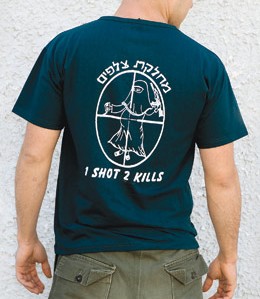
Those snipers have been as well this week in the media for another worrying issue. Apparently, a unit of the IDF has been purchasing T-shirts with claims, at best, offensive. In one of them we can appreciate an Arab pregnant woman inside a rifle scoop over the sentence “One shot, two kills”. IDF fashion items for this summer.

Apparently this doesn’t worry the IDF a lot. But hey, when it comes to a Chinese awards whose logo reminds kinda vaguely to that of the Hitler’s SS, then, Israel’s embassy in Beijing starts to claim for revenge under the anti-Semitism shield. Even though they recognize that anti-Semitism in China is something quite unlikely.

Back to the IDF actions, to the protests from various international groups, the UN and the report from Amnesty International regarding the use of White Phosphorus (WP) by Israel in the Operation Cast Lead, now we have to add another one from Human Rights Watch that confirms that matter. According to the New York-based lobby, Israel (and Hamas in a lesser way) used white phosphorus at least once illegally in Gaza.

White phosphorus is a permitted weapon used under determinate circumstances. Those include the use of it to make smoke columns as way of screening movements or aiming to deactivate booby traps and mines; but never used as an incendiary weapon against people or buildings, never against civilians and never in populated areas..

Marc Garlasco, the senior analyst who has made the report for Human Rights Watch, describes that Israelis used this weapon in three different ways. First, the shot it in open rural areas, maybe to deactivate mines and hidden explosives. Then, in cities’ outskirts, probably to screen their movements and hide themselves to Hamas. Anything illegal there.

Trouble comes with the third use, with air-burst WP sprout in crowded urban areas. Everytime soldiers though they had seen a Hamas’ compound, they sent in a rain of white phosphorus. That’s how a school, a hospital and an UN building were hit. For Mr. Garlasco, this was a tactic destinated to burn down the buildings.

The problem came with the civilians in between. Reports from doctors on the ground, like the head of Sifa Hospital’s burnt unit, Dr. Nafez Abu Shaban, confirm this.

But what it was even more problematic, according to Mr. Garlasco -former chief of High Value Targeting on the Joint Chiefs of Staff- is that he doesn’t find any explanation to why Israel used the WP this way. Air-burst WP minimizes the effect of the smoke while maximizes the incendiary effects. And the buildings attacked where too big for the WP to be able to deactivate hidden explosives or mines inside..

Garlasco adds:

“It still boggles my mind, what the military utility was”.


Of course, many of the brutalities in Gaza went directly from the commanders. And not only from those on the ground. Radicalization in Israeli society is a fact -shown in the latest elections-, the same way Gaza war has radicalized the Palestinians.

As the Palestinians have thrown themselves on the Islamists’ arms, the IDF has thrown itself on rabbis’ arms. In fact, many religious men called for a holy war in Gaza during Cast Lead operation.

Whit somehow less drama, also this week, soldiers from the IDF also targeted another dangerous threat: kids with balloons. The Israeli police banned the celebrations around the Arab Day 2009, hosted this year in Jerusalem -which was a de facto boycott to the event itself. When some kids where celebrating it in a schoolyard, letting free red, white, green and black (for the Palestinian flag) balloons into the air, soldiers form the IDF run into the school and “shot down” the rest of the balloons.

And that’s just from the last week. Not taking into consideration these other news appeared on the media in the last month:

- Israeli Army Now Less Careful About Civilian Deaths?
- Witnesses say white flags didn't keep Israeli troops from firing at and killing Palestinians.
- Final Gaza toll shows 960 civilians killed.
- Gazans say Israeli troops forced them into battle zones.
- Israeli troops killed Gaza children carrying white flag, witnesses say.

What does the IDF do meanwhile? Uhm... Oh, yes; it is busy celebrating the election of one of his corporals as Miss Israel 2009 and preparing the trip to Bahamas. Oh, and living morality lessons!


PS. This time it's worthy, even more than usually, to click on the links.


Photos: AP, Getty Images, IDF.


Are you afraid? Well, this works in that way. First you do what scares you and it's later when you get the courage
Twitter Delicious Facebook Digg Stumbleupon Favorites More

 
Worldwide blog©, WGMreports© and the texts included here are copyright of Javier Garcia Marcos.
All the pictures used in this blog are property of their respective owners. Any innappropiate use of them is unintentioned. Any image or link used without permission will be removed.
Powered by Blogger