Any questions? Contact us.

Showing posts with label UN. Show all posts

Sunday, June 09, 2013

The living hell of the displaced


Last year set a new record in terms of people internally displaced (IDP) by violence. In total 28.8 million people have had to leave their homes around the world fleeing from armed conflicts. Syria and Congo top the list.

The IDP’s situation is even worse than that of refugees. For starters, the number of IDPs doubles that of refugees. Unlike the refugees who leave their country of origin, the IDPs remain in it.

However, this causes many more problems for the internally displaced. For starters, their situation is more precarious.

If it is a civil war, such as in Syria, they are in danger of being caught by the same horror of fleeing and relive the hell of having to escape again. Or in a crossfire.

In addition, refugees enjoy international protection while the internally displaced people lack of it.

Of the nearly 29 million internally displaced people, one-fifth (6.5 million) are newly displaced in the last last. The rest were from before 2012.

Syria takes the brunt in terms of newly displaced. From a total of more than 3 million Syrians internally displaced, two and a half were new from 2012.

The data gives a new dimension to the words of Antonio Guterres, UN High Commissioner for the Refugees, which has described the Syrian conflict as the greatest humanitarian catastrophe since the end of the Cold War.

In terms of total numbers, Colombia is the country with the highest number of internally displaced persons, most of them long term, followed by the aforementioned Syria and the Democratic Republic of Congo.
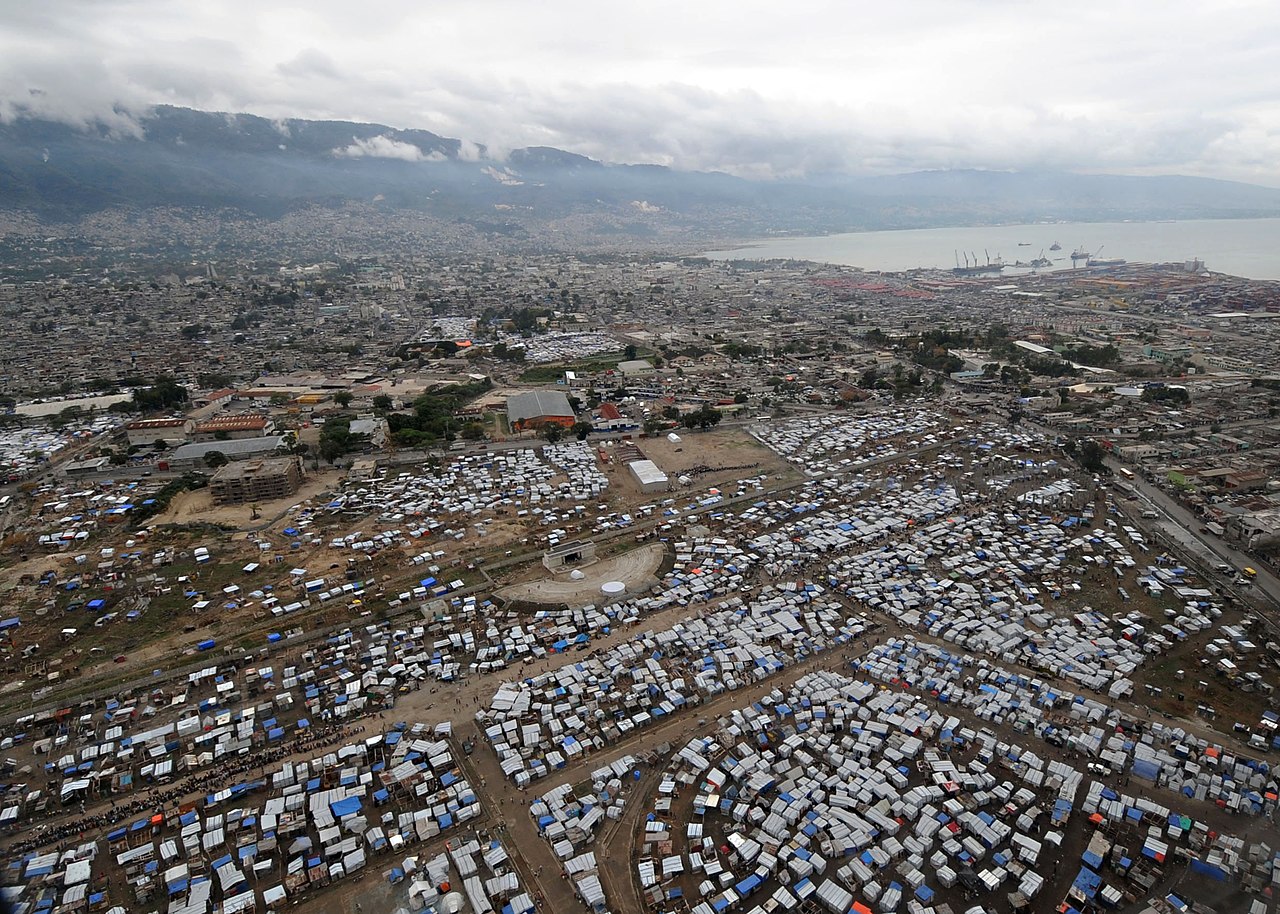
Photo US Navy
In fact, the Sub-Saharan region, with over 10 million displaced, is the hardest hit area of ​​the world. Only in November 2012, more than 140,000 people left the Congolese city of Goma after the rebel group M23 attacked the city.

No wonder, therefore, that Africa is a pioneer trying to solve the problem of the displaced. In December last year, 37 of the 53 countries that make up the African Union signed the Kampala Convention. Some of them, however, still have to ratify it.

The document contains several basic rights of internally displaced persons and urges governments to work to return them to their homes or reunite families divided by conflicts among other things.

There is still much to be done, however, as evidenced by the drama of the IDPs and refugees from South Sudan. After surviving the horrors of war, when they tried to return home they have been found living in conditions even worse than those they had in the refugee camps.
Friday, March 29, 2013

France in trouble


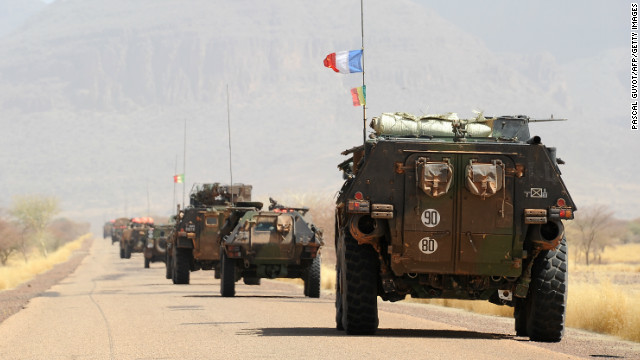
France knew it was stirring a hornets’ nest when it invaded Mali earlier this year. So did the USA and the EU. Yet they pushed through and eventually, together with several African nations’ troops, managed to achieve victory. FranƧois Hollande even went to Mali to get a photo-op on the trail of that moment.

But that photo and that victory are as close to reality as George W. Bush’s photo aboard a US carrier with the “Mission Accomplished” banner behind him. To be honest, the difference is that this time they know it. And they fear it.

Winning is easy. Keeping the spoils of war is much more difficult. Ask the Americans in Iraq. That is precisely what France is trying to avoid, getting into another Vietnam -yes, they have the same example in their history books too.

Even for the invasion, France had to stretch its forces. It needed the support of the USA and other European allies if only to fill auxiliary roles. Holding the ground, even just leading a coalition of African forces, is proving more challenging.

The land to patrol is vast -as demonstrated by the attack on the gas refinery in Algeria. The Islamists are also well armed; these are not Syrian rebels. They have powerful friends and some of them were armed by Gadaffi to fight against the same French and Americans they are fighting now just a few months ago.

Even the fighting is not over yet, as demonstrated by the recent deaths of African and French soldiers in combat missions. Not in ambushes, combat missions. And even a really weak al-Qaeda is being able to maintain a guerrilla war.

French convoy in Mali/Reuters
That is why France wants out. And they want it fast. Hollande’s Government is pushing the UN to create a rapid reaction 10,000-strong multinational force, heavy armed and under French leadership if needed. But under the UN flag and with bigger contributions from other nations.

However, those other nations are likely to be African or Asian. The US, the UK and other European countries pledged only support aid. Canada has already ruled out combat roles for its forces. A picture that sounds all too familiar.

Tuesday, February 05, 2013

Asia and Africa dwarf Europe and America in peacekeeping missions


How the US, the UK and France spend most of their forces in private wars

After several weeks of war in Mali, the United Nations has decided to discuss the possibility of sending a contingent of peacekeepers to the African country. France, which has so far led the offensive, has been willing to actively participate in a hypothetical multinational force whose mission would be to keep the peace in the region.

That is not the norm. According to the latest UN report on peacekeeping missions, none of the G8 countries are among the top contributors of personnel. They are the biggest money donors, as several of them must endow an extra amount for being on the UN Security Council -which approves and oversees all missions. But soldiers from other countries, mainly from Africa and Asia, are the ones that put their lives at risk on the ground.

The first strong economy on the list appears at number 11 and it is Brazil, which contributes nearly 2,200 soldiers. In the 15th position we find the first member of the Security Council (China, contributing 1,869 soldiers). We need to dig until the 20th position to find the first member of the G8, Italy (1,127 soldiers). Behind the Italians are France in the 26th (968 soldiers) and way behind the United Kingdom in 45th place (283 soldiers) and the U.S. in 57th place (128 soldiers).

One of the main reasons for the lack of Western troops as peacekeepers at the UN is that the organization always tries to implement local solutions to local problems. For example, most of the peacekeepers in Somalia right now are African, while in the missions from the 90’s and 2000’s in the Balkans, European troops were the core of the contingent.

Photo: AP
However Pakistan and Bangladesh, the two biggest net contributors for armed personnel, are present far away from their area of ​​influence. More precisely they are present in Africa -in the Ivory Coast, Liberia, Darfur (Sudan) and Congo- despite having a serious problem close to home with neighboring Afghanistan and tensions with India (another top contributor). Nepal, also in the top 10, has nearly a quarter of its troops in Lebanon, a country with which it shares no cultural, religious or historical ties or even a similar climate.

Meanwhile, European countries seem to have a predilection for the Middle East. 98% of Italian troops at the UN, 97% of Spain’s, 91% of France’s and 77% of Germany’s are in the UNIFIL mission in Lebanon. 97% of British blue berets are deployed in Cyprus. On the other hand, the Americans have 67% of their staff in Haiti.

These figures contrast with the number of troops that all these countries have deployed in Afghanistan. Even after sending home 33,000 soldiers in 2011, the U.S. has 68,000 troops still on Afghan soil, two thirds of the total of peacekeepers deployed by the UN worldwide.

France has deployed around 2,500 troops in Mali. Along with more than the 500 it has in Afghanistan, they make a total of three times the number of boots that the country dedicates to peacekeeping missions. Both Mali and Afghanistan are considered scenarios on the global war on terror against al-Qaeda and its affiliates.

In fact, the countries with the largest contingents in the so-called war on terror (the US, the UK, Germany, Italy, France and Spain), have a total of about 90,000 soldiers fighting in a frontline that stretches from Afghanistan to Mali and Somalia. That number does not include some personnel that do not appear on the books, as the pilots of American drones. Furthermore, none of these operations is supported by the UN, but by NATO.

The total number of UN peacekeepers is a similar figure of 94,090. However, between the six countries mentioned before (the US, the UK, Germany, Italy, France and Spain) they only add 3,400 soldiers to the UN-led operations -less than 3.5% of the total. They provide, however, 59% of the funds for peacekeeping missions, without which none of these operations would be possible. A formula -the world powers pay the bill; let others do the fighting- reminiscent of certain aspects of the theory of dependency and colonialism.

In the event that finally a UN mission to Mali is approved, and providing France finally gets a prominent place, it would be a significant change of policy for the big countries. France would become the only country that currently forms part of the G8, the UN Security Council and a significant contributor of troops to the UN.

Friday, November 30, 2012

What after Palestine-194?


Jehad’s birthday is on the 30th of November. As a Palestinian living in the UK, the news of Palestine being recognized as a state arrived from America just on time to celebrate his birthday. At that moment, the UN was voting in favor of granting Palestine recognition as a non-member state and a seat as an observer state at the UN.

His fellow nationals back across the West Bank and Gaza were as well celebrating. It is indeed a huge step forward for the Palestinians towards a two state solution and an upgrade to their situation, at least internationally.

Photo: AP/Seth Wenig
Upgrades, however, are as good as the originals they are based on and this one is not an exception. If the base is not good enough, the upgrade probably will fall on the short side. The change of status may be a small victory but the real repercussions are few and not all of them satisfactory for the Palestinians.

When Palestinians sobered up from the UN vote, Israeli settlers were still building, the checkpoints were still there, the wall was still present and the blockade in Gaza was still in effect. Even back at the UN, the Palestinians’ seat will remain at the same place where it has been since 1974, besides the Holy See’s.

The benefits are widely diplomatic more than on-the-ground results and they will take time to become real. For starters, this would give the Palestinian Liberation Organization (PLO) more weight in their negotiations with Israel.

The most talked about benefit is the possibility for the PLO to apply for access to the InternationalCriminal Court (ICC) and prosecute Israeli citizens. However, even this move could turn into a double edged sword because it would allow as well Israel to prosecute Hamas militants after a rocket attack kills Israeli civilians.

Furthermore, the Palestinians don’t need to use the ICC. Several processes open in European countries -specially in the UK and Spain- have proven effective bringing Israeli leaders to a courtroom or, at least, limiting their travel freedom.

Photo: Anna Day/Instagram 
The one effect this UN bid has gotten is clearly propagandistic. Fatah is the biggest winner and they needed it. Hamas was growing in popularity not only in Gaza but also in the West Bank and this gives the PLO some air to breathe. As journalist Mikel AyestarĆ”n commented from Ramallah, in the celebrations on the street you could see “more Yellow (PLO) flags than Palestinian flags”.

On the other hand, the vote shows how Israel has gotten yet even more isolated internationally. 138 countries voted in favor of the Palestinians for only nine against. 41 abstained.

Out of the nine that voted against, four were Pacific island micro-states; the rest being one European (Czech Republic), three American (the US, Canada and Panama) and, obviously, Israel. Among the European countries, after being unable to agree on a common position, Germany, Netherlands and the UK abstained while France, Spain, Ireland and Italy voted yes.

But this international isolation is something Israel is used to. They actually expected it and the vote maybe comes just as the realization that they have “lost Europe”. The only country whose swift would actually mean something for Israel would be the US, and they have a strong ally in there.

Monday, December 07, 2009

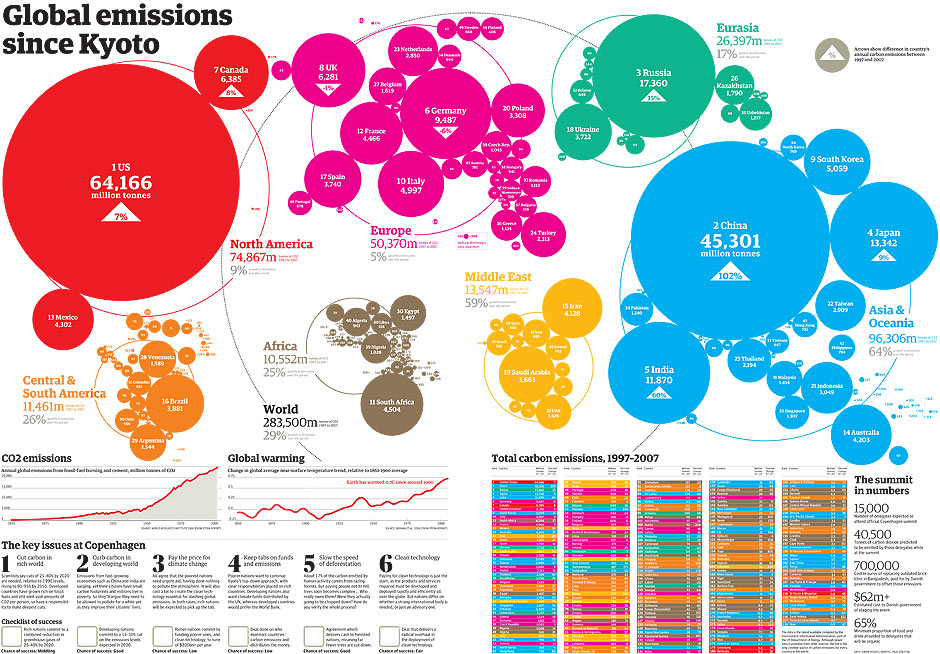
What's at stake in Copenhagen?

This.


Did you like it? Share it Delicious

Ahead of Copenhagen summit...

Some really useful data and graphics on carbon emissions by country since the 80's. Data published by the Guardian Data Blog.


Did you like it? Share it Delicious

Copenhagen challenges

The Danish capital will host from today and for two weeks a UN summit to tackle some action on carbon emissions. A total of 192 countries will attend a meeting that rises as much hope and expectations as doubts and questions.

With Kyoto protocol formally dead for everyone -some because consider it too few; some because never even started working on it- Copenhagen looks like the perfect opportunity to encourage a new green deal worldwide. But the meeting comes just after a conference in Barcelona that didn’t resolve anything. To that we need to add the questions rose following the leak of several email correspondence between some investigators that undermined the results of the global warming studies -and therefore, the whole thing around it.

But hope comes by the hand of the main actors -including Obama. Brazil, the US, China and India have promised each important CO2 emission cuts from now to 2020. Australia, Russia, Japan, Canada and other developed countries have followed them. Europe is the A student, ahead of everyone else, and has promised a further reduction by 30%.

But all those promises are worthless without action, as Kyoto has shown. Only Europe has achieved the agreed goals, and with internal differences. Italy, Spain and, surprisingly, the host country of this summit, Denmark, have struggled to meet the requirements and are not likely to do it in a near future.

In general, developed countries offer cuts between an 8% and 14% of the CO2 emissions. Even that is not enough. Most scientists claim for a need to meet a reduction of a 25% to 40% in the developed countries to avoid any serious problems by half this century. And those weak compromises not only are not enough, but also will be difficult to agree.

Everyone seems to agree on major issues. Maldives’ cabinet, an archipelago nation seriously endangered by the rise of sea levels, held a meeting under the sea in October to illustrate the urgency of the matter. Last week, the Nepalese government did the same in Mount Everest, helped with winter clothes and oxygen, to rise awareness over the glacial meltdown.

But it is something to agree on the obvious and something different to act in deep to avoid it. When the details about what to do appear is when discrepancies come to the surface too. The countries of the so called Umbrella group (USA, Australia, New Zealand, Canada and Russia) are asking for more compromises from the developing countries, something the latter and the EU oppose to.

Even in the way of controlling the emissions are disagreements. Some countries, like the US, want a carbon market where countries or even companies can trade over a fixed total of allowed emissions. This way, if a country -or company- doesn’t pollute as much as it’s allowed to do, it could sell that extra allowance to another country in need to pollute more; never over passing the total already fixed. For the EU, however, this is too complex and difficult to control and regulate, so they are opting for a carbon tax.

But as if only with internal disputes wasn’t enough, there are also some countries that don’t even agree to cut the dependency from fossil fuels. Not at least for free. The OPEC countries -oil producers- are asking for a compensation for the revenues they will lose if a new green deal is reached to cut carbon emissions. Some may say it is selfish to think that way, but for many of the OPEC countries, oil is the biggest contributor to their GDP, counting as much as for half of it -or even more- in some cases.

Anyway, whatever happens in the end in Copenhagen, leaders meeting there should have something clear in their minds: as Kyoto teached us, promises are nothing without action. Whatever they agree to do must be done, doesn’t matter how few it is. The world cannot afford another failed protocol.


Did you like it? Share it Delicious

Friday, December 04, 2009

Say "cheeeese"!


This past September, when nearly all the world’s leaders were in New York for a meeting of the United Nations, Platon, a staff photographer for the New Yorker, set up a tiny studio off the floor of the General Assembly, and tried to hustle as many of them in front of his lens as possible. The project involved months of work. While immersed on it, some as Israeli Prime Minister Binyamin Netanyahu fell on the main rule that rulers have asked their photographers and painters for centuries: “Make me look good”.

Results finally are here. I don’t know if Mr. Netanyahu will be pleased with his picture, but there are indeed a few interesting points in the poster. Like for example, seeing together Gordon Brown (UK) and Brian Cowen (Ireland), who look like brothers. And in fact, even their political careers are very similar: both are in a shaky chair after substituting a troubled former leader, and coming from managing the Economics portfolio.

Standing with Cowen, just below is the Czech president VĆ”clav Klaus. Surprisingly, it’s not the only time the Czech has been behind Cowen; he signed the Lisbon Treaty -introduced the past Tuesday- only after Ireland passed it. The third one in the mess of Lisbon, Polish President Lech Kaczynski, is also around close to them.

But that’s not the only funny relationship. Ahmadinejad (Iran) and ChĆ”vez (Venezuela) are really close too. The same as Netanyahu (Israel), who is on the right of Obama (USA); left for us seeing the poster. Of course, Berlusconi is in the area where all the women in the collage are. Odinga (Kenya) on the other hand, is more reluctant of Kagame (Rwanda), who he observes with caution. And finally, JosĆ© Luis RodrĆ­guez Zapatero (Spain) only needs a beret with a red star on his head to look like ‘Che’ Guevara.

The original poster with more info, here.


Did you like it? Share it Delicious

Friday, October 30, 2009

Friendly fire 30/10/09

- Iraq wants to get into the nuclear club. Yeah, that’s right. Not Iran this time, Iraq.

- Micheletti and Zelaya achieve an agreement for an exit to Honduras coup.

- The EU gets an only strong voice against climate change. Well, sorta.

- Israeli envoy to the UN says that the Human Rights council has give its back to the same values it defends. I think it’s something about Goldstone report, but not in the same way as everyone else aknowledges it.

- Medvedev opposes to the rehabilitation of uncle Joe. Traitor! He should be executed…


Did you like it? Share it Delicious

Non stop

Last 48 hours chaos reigned again in Afghanistan and Pakistan. In the north, an attack on a UN guest house in the centric Sherpur neighbourhood of Kabul ended up with at least 13 casualties, six of them workers of the organization.

The incident affected too several near embassies, among them the Spanish embassy, where some bullets got into the staff rooms. This is just another brick on the wall that makes more nervous American allies. Public opinions at home are more and more difficult to please. In the last NATO meeting, European members pledged to hang on there, but any increase of troops was took out of the table. “Guarantees of stability”, ask sarkozy and Merkel before committing with more soldiers. And of course, the fact of Karzai’s brother being as corrupt as his relative, plus a drug lord and in the CIA payroll is not a stability proof.

Pakistan, continues the push against the Taliban in South Waziristan at the same time that a bomb exploded in the middle of Peepal Mandi market. It was the worst terrorist attack since 2007 with more than 90 casualties and over 200 wounded.

The attack, by the way, was a few hours after American Secretary of State, Hillary Clinton landed in Islamabad to hold several meetings with local authorities. She insisted once again Pakistan is not alone in this fight. In fact, this week we knew via LA Times that American drones are helping the Pakistani army in their offensive in South Waziristan. Of course, both the US and Pakistani governments quickly denied that. And reasons for it are clear.

Since the beginning of the drone wars, the US and Pakistan have had a don’t ask-don’t tell policy. This way, Pakistani government could criticize occasionally the Americans in a wash up over the Americans in order to maintain the precarious balance inside the country.

But everything has its limits, and that same population is starting to grow tired of the Predators. They have good reasons. Since 2006, it’s calculated that around 350 civilians have dead in drone attacks. Some other numbers are higher, as much as double that. It’s anyway a high amount. Even just one could be a lot. Ask a tribal clan leader, and he could tell you this.

Now, maybe international legality will be on their side too. The UN has warned that drone attacks may be out of the frame of humanitarian rights. Of course, that’s only a warning from the UN, and all of us know the effect of that. Plus I unsure who would be more benefited from a halt in the drone attacks, the US or the Taliban. Both desire to continue it. For America, is a great way of fighting without risking lives or having to extend a complex network inside Pakistan. For the Taliban, is the perfect propaganda weapon and a great recruitment method.

Predator drone
Photo: Doug Pritchard


Did you like it? Share it Delicious

Friday, September 18, 2009

Heating up the Gulf (of Aden)

At least nine peacekeepers of the African Union (AU) were killed yesterday in a double explosion in their Mogadishu’s headquarters. Among the victims is the Burundian deputy commander. Another top commander, Ugandan General Nathan Mugisha, was also lightly wounded.

The attack has been claimed by the Islamist group al-Sahbab. The rebels suffered a big hit this week after a US raid killed one of their top commanders. Immediately, the group vowed for revenge and it has come in the way of two suicide attacks. Apparently, the rebels infiltrated the compound in two stolen UN cars and detonated them once inside.

This only comes to show once again the delicate situation in Somalia. In between the multiple war clans, sub-clans and war-lords in the region, the Islamists have taken an empty slot to finishing configuring a complex board. Somalian government is incapable of controlling more than a few quarters in Mogadishu, and that thanks to the heavy presence of international forces.

In fact, the situation is so bad for the central Government that it was themselves the ones who begged asked neighbor nations to invade them. However, they are not the only ones asking for reinforcements. The Islamists have called too on a Jihad to support the Somalian brothers in their struggle.

Al-Sahbab is making of Somalia a local hub for Islamists. Somalia is too remote, too isolated and too xenophobic to become a haven like Afghanistan was. But thanks to the lack of government of any kind, they are like at home. One of al-Qaeda’s most prominent militants, Abu Mansour al-Amriki (the American), lives there and from there has released his latest hits. Including a Jihad hip-hop song.

They feel at home, and they start to rule as if they were at home. Last month, al-Shabab was successful kidnapping two French intelligence agents that were training Somali forces. One of the escaped, but the other one remains in captivity. Now, the Islamists have released their demands for the freedom of the French agent. And they include the usual al-Qaeda cocktail: stop supporting the weak UN-backed government and hail the anti-piracy patrols.

In fact, this unruled land is the same that hosts the pirates that day after day chase the ships sailing in the Gulf of Aden. Situation is getting worse, instead of improving. It’s clear that Somalia’s inexistent navy cannot face the pirates. Actually, their navy is just starting to be built up and consists basically of a bunch of ships. Sorry, skiffs.

So, with this situation in mind, Western governments are going further. The US has started taking seriously the threat on land, as the raid previously mentioned states. Others, like the Spanish government, in cooperation with the Basque government, has authorized for the first time the hiring of private contractors and the use of long range firearms aboard Spanish and Basque ships in an attempt to deter pirates of seizing them.

The French are going ahead with another front and are proposing a stupidity tax to those who had to be rescued from pirates' hands. Makes sense as so far they have been the bussiest guys around. Three rescues in two years means there are many stupids playing in cruises in the area.

But the best improvement have come from the shipping companies. New measures have reduced the number of assaults dramatically.

Not that all that it’s going to make any change. According to Andrew Scutro, Somali pirates have attacked even military ships. The translator cited by Scutro says that pirates are dumb enough to not distinguish between a military vessel and a freighter. A more frightening version would be, however, if they indeed know what they are attacking.

Ugandan AU Peacekeepers
Photo: Reuters


Did you like it? Share it Delicious

Thursday, September 17, 2009

Israel against the world

Finally the UN has released his report on the alleged war crimes that Israel may have incurred during Operation Cast Lead. The report states that Israel, among other charges, “terrorized” the population of Gaza and reckons the role played by the Israeli blockade of the strip before the war to trigger Hamas into rocketing Israel. It also recognizes that Hamas rockets over civilian populated areas might be considered as well as war crimes.

However, the Jewish country criticized the report even before it came into the light and the fact of it blaming both sides -Hamas too- of war crimes in Gaza is not changing that. Quite the contrary, Israel is taking the 575 pages report as a declaration of war. From the UN? And after bombing UN compounds and killing UN workers in Lebanon and Gaza? Really?

Truth is that some indicators say Israeli diplomats can be scared. There is obviously the real danger of having more Doron Almog cases widespreading through the small and cyclic diplomatic-political field in Israel. Or even worse, having to face the ICC.

In Yedioth Aharanoth, commentator Eitan Haber warns that the image of Israel being built with these reports can isolate the Israelis in the international arena. More voices inside Israel want a critical insight on the country’s own armed forces and procedures.

But for now, the response has been the usual. The anti-Semitism trigger is easy to pull for Israeli politicians. Race card is already being played. In Israel Today, Dan Margalit called the report, prepared by a team led by the Jewish, South African jurist Richard Goldstone, classic anti-Semitism. In fact, Goldstone hand actually softened the report, which could have been way worse for Israel.

Once again, it’s the Jews against the world, standing alone. Amira Hass reckons that “like the Serbs of yore, we Israelis continue thinking it's the world that is wrong, and only we who are right”.

Ari Shavit, in Haaretz, even calls for Obama -and other NATO countries like Germany, Britain, France, Spain, the Netherlands, Belgium and Norway- being charged too for the civilian casualties in Afghanistan and Iraq. The tu quoque it’s clearly a way easier argument than being critic with oneself.

Indeed, Israel is moving on in an offensive to try to discredit the report from UN and the UN itself. But they are not the only ones. Just this week, it was known that Human Rights Watch’s senior military analyst Marc Garlasco, who reported the use of white phosphorus by Israel in Gaza, is a private collector of Nazi medals, gear and uniforms. Weather if Garlasco’s hobby is an unusual hobby, a fetish, or a sign of anti-Semitic, Israel prefers to stick with the last option and use it to discredit Garlasco’s work and, by extension, Human Rights Watch’s work.

However, Israel rejections of the report and allegations against Garlasco don’t change the facts. And most importantly, they make more complicated another attack from Israel to a foreign country -let's say... Iran- on the eyes of the world. Does Israel care about that? Well, that's another different question.

Photo: IDF


Did you like it? Share it Delicious


Are you afraid? Well, this works in that way. First you do what scares you and it's later when you get the courage
Twitter Delicious Facebook Digg Stumbleupon Favorites More

 
Worldwide blog©, WGMreports© and the texts included here are copyright of Javier Garcia Marcos.
All the pictures used in this blog are property of their respective owners. Any innappropiate use of them is unintentioned. Any image or link used without permission will be removed.
Powered by Blogger