Over 12% of the Money spent
in rebuilding Iraq has been wasted. That is the conclusion reached by the
latest enquiry on the matter by the USA. And it could be worse.
Nothing is more
painful for Americans than paying taxes. That is why the “taxpayer’s money” is
scrutinised so closely. And the quantity wasted this time is considerable: more
than $8b.
An estimation, by the
way, that could be short. Stuart Bowen, head of the committee redacting the
document, told Wired
that the total could be much more because they only could audit superficially
the account. An account that only includes money spent on reconstruction, not
the overall military operation cost which ascends to $800b.
To the 12% of the $60b
for rebuilding Iraq, we should add the unknown amount wasted in Afghanistan
already. Last year an independent investigation by the BBC revealed that a “significant
portion” of the $400m invested in 2011 alone was going to be lost.
Photo: US Army
One thing you can’t
deny them is creativity when it comes to useless spending. Sometimes it was in
the form of unfinished projects. Sometimes by paying contractors that then didn’t
meet the requirements. There is even a case of a school that wanted $10,000 for
refurbishment works and got $70,000 without knowing well why.
Probably the case of
the “Sons of Iraq” program is especially relevant. It was seen as a
expense to avoid expenses. Planned
by the now villain Gen. Petraeus it focused on paying of Sunni groups in Iraq
to work for the Americans instead of against them. Bribe them, one could say.
Those bribes added up to $370m between 2007 and 2008. But worst of all, without
being clear if it was a success, they exported the system to Afghanistan.
It is impossible not
to think other uses that money could have had. $8b is a lot of money. Enough,
for example, to pay for five more missions of the space shuttle. Or for almost
a whole year of the Environmental Agency’s budget. Instead they are collecting
dust in some warehouse in the middle of the desert. Published first on Iniciativa Abierta in Spanish
President Obama announced yesterday he’s determined to “finish the job” in Afghanistan. Cool. Now, just define what means “job” and “finish” and then all that will worth something. Until then, it’s all words but strategy in Afghanistan is, so far, sinking fast. And in the lack of ideas, the White House is going back to the traditional solution: more force.
Next Tuesday Obama is expected to unveil -for the first time in prime time- a new boost to the troops on the ground in Afghanistan. The place to announce it will be perfect: West Point military academy. In fact, hours and hours of study and discussions are behind Obama’s decision. The options were between 15,000 and 40,000 extra soldiers. Finally, after several weeks of guessing, almost everyone has narrowed down that number to something between 30,000 and 35,000.
What doesn’t seem to change is the strategy for the war. Even Gen. Stanley McChrystal already warned about that in his timid report from August, little has been done. Karzai is still in the chair and, despite his promises to tackle corruption, it’s unlikely that will happen in his term, let alone in one year as McChrystal would have desired.
But yet, more troops are also needed. But what for? According to McClatchy papers, 23,000 soldiers would go to combat and support operations; 7,000 to develop, strengthen and co-ordinate the southern headquarters; with the rest 4,000 effectives destined to train the Afghan army and police. This increase of troops in Central Asia would mean, according to Spencer Ackerman, the deployment of almost every available battalion in operative theaters, leaving just a few back at home available for duty (see links below).
According to another report from The Washington Independent, in December 2009, a total of 50,600 soldiers and 24,000 National Guards will be available for deployment. The rest will be either in Iraq or Afghanistan or resting back from a tour in a combat zone. In January, those numbers would drop to 12,400 -of which most of them from heavy units (cavalry and tanks)- boots available to deploy in case there is a problem in, let’s say, Korea.
However, it seems yet insufficient, especially regarding the number of trainers. If NATO wants to accomplish its promise of doubling the numbers of the Afghan army, from the present 94,000 effectives to 250,000; the General in charge of the training mission -Lt. Gen Bill Caldwell- will need much more than 4,000 trainers.
As for the rest of the thirty-something thousand troops, the New York Times suggests that 10,000 soldiers could be deployed to Kandahar; 5,000 to Helmand and another 5,000 to the east of the country. His job won’t be easy.
Main target will be to stabilize the south and, once that’s done, recover the control of the rest of the country. Time for that, just until next year’s autumn. McCrhystal warns of it clearly in his August report: “Failure to gain the initiative and reverse insurgent momentum in the near-term (next 12 months) -while Afghan security capacity matures- risks an outcome where defeating the insurgency is no longer possible”.
As if those guys didn’t have enough pressure over their shoulders already.
(Available units from the National Guard and the Army now and in the close-mid term)
Afghan National Army soldiers practice firing during a NATO training. Photo: U.S. Army Sgt. Matthew Moeller, 5th Mobile Public Affairs Detachment
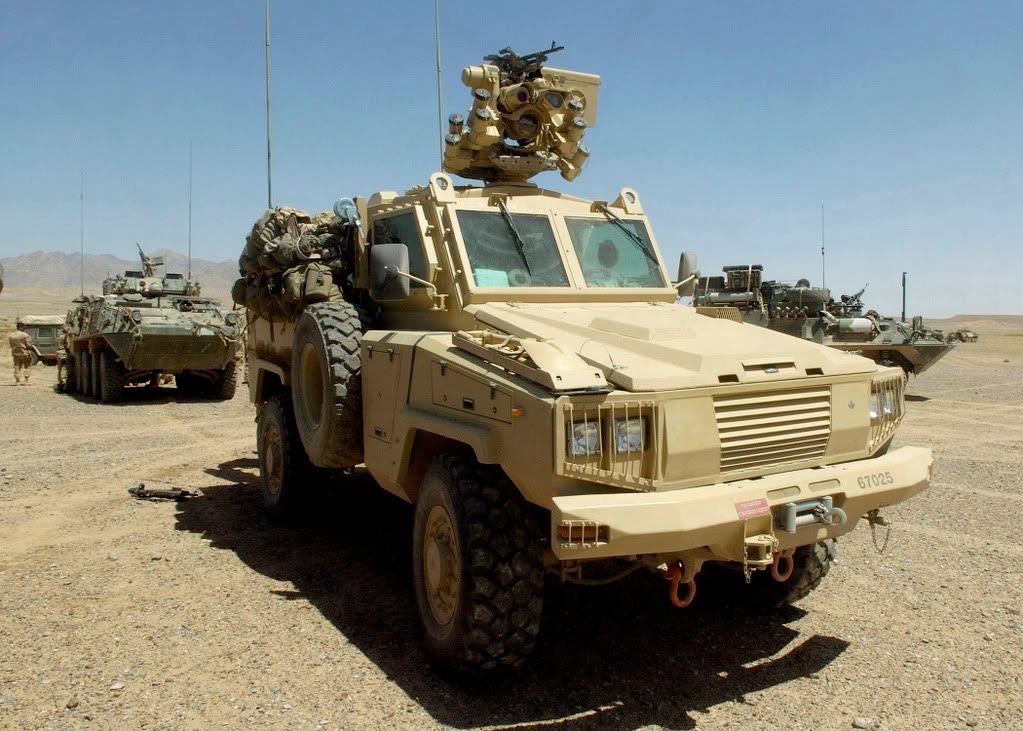
The Spanish MP of Defense, Carme Chacón, presented today the new RG-31 Nyala that will equip Spanish soldiers in Afghanistan. The armored truck arrives late but at least arrives. It’s more than what British soldiers can say. The handling of the first vehicles was delayed for several months while a huge internal debate grew up in the public opinion surrounding the security of the troops the country has deployed in Central Asia.
In fact, the RG-31 is an old demand from Spanish officials. The BMR used until now, although heavily modernized, have three decades behind are all but inefficient against the IEDs used by the Taliban. The Nyala (gazelle in Afrikaans), however, is able to resist the impact of two anti-tank mines’ simultaneous explosion.
But that doesn’t equals to Ms. Chacón’s words, describing the RG-31 as the “most modern and safer” vehicle in the ISAF mission. Sure, the modifications added by the Israeli company Rafael (an automated firing turret) gives it some advantage, but the most difficult operational issue on these vehicles is the driving, as they are really easy to overturn. And if practice is required, then the Americans, Canadians and Dutch are way ahead of the Spaniards.
As for them, their first Nyalas arrived during the last month in Quala-i-Now, where they will operate. Last weekend two new vehicles completed the first unit. However, few less are expected for now. Only 20 more will arrive until the end of the year. The rest of the 61 total RG-31 that Spain will deploy will arrive in March, with the refreshment troops.
Of course, with the deployment of these vehicles, all together with the increase of the forces up to 1,000 soldiers, will become a greater responsibility. Americans, British, Canadian and Dutch soldiers were having until now the biggest weight in combat operations. The rest of the ISAF members -including Spain- did few more than reconstruction missions and hardly patrolled far away from their bases. However, the expansion of the insurgency to areas before considered safe (like the north and the west; ask the Germans about this) will make these nations to rethink the strategy.
The trucks will come then in the perfect timing for the Spanish troops. Of course, the PR operation sending now a few of the vehicles is not either casual. It’s expected that during the winter, insurgency will decrease near to zero. Is not that the Taliban are granting a ceasefire to the ISAF, but that Afghan roads, difficult to transit in summer, become impossible to drive in winter.
Up until the spring, we will heard press releases from NATO HQs praising for how well is working the new McChrystal’s strategy and -in Spain- how good is the new equipment and how well protects Spanish soldiers. Until the snow will melt and attacks will begin again. We will see then that few has changed. Not even Spanish politicians addressing the war in Afghanistan as what it is: a war.
Last 48 hours chaos reigned again in Afghanistan and Pakistan. In the north, an attack on a UN guest house in the centric Sherpur neighbourhood of Kabul ended up with at least 13 casualties, six of them workers of the organization.
The incident affected too several near embassies, among them the Spanish embassy, where some bullets got into the staff rooms. This is just another brick on the wall that makes more nervous American allies. Public opinions at home are more and more difficult to please. In the last NATO meeting, European members pledged to hang on there, but any increase of troops was took out of the table. “Guarantees of stability”, ask sarkozy and Merkel before committing with more soldiers. And of course, the fact of Karzai’s brother being as corrupt as his relative, plus a drug lord and in the CIA payroll is not a stability proof.
Pakistan, continues the push against the Taliban in South Waziristan at the same time that a bomb exploded in the middle of Peepal Mandi market. It was the worst terrorist attack since 2007 with more than 90 casualties and over 200 wounded.
The attack, by the way, was a few hours after American Secretary of State, Hillary Clinton landed in Islamabad to hold several meetings with local authorities. She insisted once again Pakistan is not alone in this fight. In fact, this week we knew via LA Times that American drones are helping the Pakistani army in their offensive in South Waziristan. Of course, both the US and Pakistani governments quickly denied that. And reasons for it are clear.
Since the beginning of the drone wars, the US and Pakistan have had a don’t ask-don’t tell policy. This way, Pakistani government could criticize occasionally the Americans in a wash up over the Americans in order to maintain the precarious balance inside the country.
But everything has its limits, and that same population is starting to grow tired of the Predators. They have good reasons. Since 2006, it’s calculated that around 350 civilians have dead in drone attacks. Some other numbers are higher, as much as double that. It’s anyway a high amount. Even just one could be a lot. Ask a tribal clan leader, and he could tell you this.
Now, maybe international legality will be on their side too. The UN has warned that drone attacks may be out of the frame of humanitarian rights. Of course, that’s only a warning from the UN, and all of us know the effect of that. Plus I unsure who would be more benefited from a halt in the drone attacks, the US or the Taliban. Both desire to continue it. For America, is a great way of fighting without risking lives or having to extend a complex network inside Pakistan. For the Taliban, is the perfect propaganda weapon and a great recruitment method.
In the end, there will be a second round in Afghanistan. First one has been the slowest counting in the world. Two months, to be precise, since last 20th of August the Afghans voted. And yet, we don’t know for sure what will happen next.
All the actors playing on the stage performed as it was expected from them in the big day. The UN even was standing besides Hamid Karzai until almost the very end, when they couldn’t cover anymore the fraud. Because it was huge. Almost a quarter of Karzai’s votes were finally declared null, and it looks like if they were still just a few of the total.
In the end, this is all makeup. No one wanted a second round. Nor in Kabul, nor in Washington. It’s just make it longer. The now official results are as false as the first ones or as the ones we will get if a coalition government doesn’t avoid a second poll. Karzai’s opponent, Abdullah Abdullah has already offered for that, knowing he has no chance to win.
Because in fact, this elapsed ending isn’t a solution for the Afghans or the governments in muddy waters in Central Asia. It is just a play for the public opinion. The problem is that, once decided that a new rerun will take place, there are a few things to be sorted out now. Like how to do it. I’m talking about logistics.
At first, the hypothetical second round was planned for the 7th of November. That’s in three weeks. And after the endless recount process, achieve that agenda looks impossible. The preparations for the first round were going along for months, and that with the benefit of a good (or at least better) weather. Afghan roads are difficult to transit in summer, even more during the winter. At least, if the Taliban follow the same modus operandis as previous years, we won’t have to worry about their attacks. In winter they simply hibernate.
Someone who seems to be hibernating too is Obama. He’s been thinking about sending more troops to Afghanistan for six weeks now. Meanwhile, the casualties are given by the local allies. Pakistan started an offensive in Swat valley last weekend that has already claimed two dozen soldiers’ lives.
But as usual, the ones suffering most are the civilians on both sides of the Af-Pak border. Even from the hands of their liberators. On Monday, a new report released offered numbers of civilian casualties in Pakistan for the drone wars. They are an estimated 320. It’s a third of the total. The Pentagon estimates that drones have killed between 750 and 1,000 people since 2006; 20 of them top Al Qaeda and Taliban militants. The rest are militant soldiers and civilians. Make the maths. And that’s only for the southern neighbour.
This weekend has been tough for Pakistan. Tougher than usual, I mean. Several attacks resulted in the death of dozens of civilians. Probably the worst one was the suicide car bomber who targeted a market in Alpuri, near the Swat valley. At least 40 people died.
The attack reminds us that the Swat valley is far from recovered. In fact, the TTP is still able to hit hard and spread quickly. That’s why some analysts are suggesting that however tempting might sound to overhand the control from American contractors to local ones, it is not a wise move for now.
However, as tragic as 40 bodies can be, it’s even more worrying the sensation of insecurity that this brings. Alpuri is supposed to be a safe area under Pakistani control, the place from where the assault on the Swat valley was launched. But truth shows us something radically different. Not only last weekend. Two years ago, the Taliban made an offensive and gained the control of Alpuri police station, for Pakistan’s Army’s shame.
But if it is about shame on the Pakistani Army, then it cannot get bigger than an almost successful assault on their general headquarters in Rawalpindi. During the one-day siege of Pakistan’s “Pentagon”, 19 people died and some other 40 were held hostages for several hours until they were freed in a raid. The attack, apparently, was supposed to be just a diversion to relief the Taliban fighters in the Swat Valley.
The problem in Pakistan is far from solved and it won’t get a solution anytime soon. In fact, it threatens to spread through the region. Israel embassy has issued a warning to all its citizens to avoid travelling into India, for the increasing risk of Mumbai-style bombings.
And let’s face it, early warning the Taliban that the army is about to attack them won’t deter them either.
Like if anything else was necessary to elevate Obama to the heavens, now he has been awarded with the Nobel Peace Prize. The coronation of his Highness Obama has had more to do with the canonization of a (laic) saint than with the recognition to his achievements. That’s why everybody is asking why. And why now.
Because let’s face it. Obama may have promised a new world, but little of that has been unveiled for now. The White House has done small gestures to break with their precedent. It has been, for example, the first time the US has condemned a coup de état made by the right and the army in Latin America. Also, tortures and Guantanamo issues are slowly getting better. But as for the rest, all we have are just promises. The general opinion is that the committee in Oslo has decided it betting for his future achievements. But how easy will he get it?
Obama has promised a cut in the nukes, and this is probably the easiest task of all. The Russians are willing to do it, especially because they have already problems to maintain their current stock. But a hypothetical reduction of the two superpowers arsenals wouldn’t have an immediate effect on the world’s stability, quite the contrary: everything would be the same, with more countries like China, closer to equalize the power of Russia and the USA.
The American president has also promised too a new era for the Middle East, but so far the achievements are minimum. His speeches were great, no doubt to that. But far from freezing the settlement construction in the West Bank, he might have to counter a peak in the hostilities. The increasing clashes in Jerusalem plus the outrage after PA’s decision to postpone the vote on Goldstone report -suspectedly in exchange for a permit to Wattaniya mobile operator to start in business- have made the situation way worse than what it was in 2008. Some Israeli media are even predicting a new Intifada.
But the biggest problem for Obama will be Afghanistan. Leaving already Iraq, the now known as the “Obama war” will take yet too much blood and sweat from the ISFOR to develop results. And that outcome will be most likely what will measure Obama’s performance in office back in History. But for now, he has nothing.
His speech writer, however, should have been awarded with the Literature Nobel Prize.
We had already seen the Britons in action in Afghanistan. Now it’s time for the Marines. And for Obama’s worst nightmare: finally, he’s got a war on his own. Afghanistan is, finally, Obama’s war.
Afghan elections votes have been casted, have been counted and have given the victory to Mr. Hamid Karzai, the current president. But nobody still gives him the victory officially. Even with the allegations of fraud behind, Karzai has achieved only a 54.6 percent of the votes according to the first full results to be released. His opponent, Abdullah Abdullah won a 27.7 percent of the votes.
However, still nothing is already sold.
The EU independent observers monitoring the elections have made allegations on 1.5m votes. That’s as much as a quarter of all votes casted. Three in four of those -maybe- fraudulent votes, are for Mr. Karzai. If finally all or some of those votes are casted out, that could lead into a second round. Indeed, preparations for it are already underway.
Of course, Karzai’s team hasn’t received well this. They accuse the independent observers of interfering in Afghan matters and of being “partial, irresponsible and in contradiction with Afghanistan's constitution”. Not that it surprises me. For most of the process Afghan officials didn’t even try to hide corruption and fraud; it was highly unlikely to start seeing them acting like a democratic western politician.
But there is another important number in the final -for now- results: the turnout. 38.7 percent, which for western standards might seem low, but for what we saw on the election day it might be quite high. Almost utopical.
Meanwhile, controversy and debate continues in the home front, especially in Europe. In the eight years of war, the US and the UK have been the biggest contributors to losses in the battlefields but many other countries have lost soldiers too in Afghanistan. However, until now it was only due to occasional encounters with the Taliban or accidents. 2009 brought a shift into that.
The surge of the Taliban in areas before under control of the ISAF, the loss of key areas in the south, the stalled positions for the alliance for years and the civilian casualties all led into the erosion of the support for the “good war” -in contraposition to Iraq- both in Europe and America. As for the first ones, Gordon Brown, Angela Merkel, José Luis Rodríguez Zapatero and Nicolas Sarkozy have pledged for a withdraw before 2012. Canada as well voted for that date in the Parliament. The Poles will do the same soon.
It is so, the same old song for the Americans. Like in Iraq, everyone starts to be tired of shooting an invisible foe. Generals are asking for more troops. Many Senators -mostly Republicans- back that option. Former Presidential candidate John McCain admits that more boots on the ground maybe won’t solve the problem, but definitely it cannot be solved without them.
Obama, however, is thinking in a switch for Afghan strategy. Those days from the beginning where he pledged for more troops to the please of the military are gone. In the mind of many Democrats -and maybe even Obama- flies the ghost of Vietnam. Public opinion is already eroding. As with the Southeastern Asian country, lose the home front and you’ll lose the war.
In order to change that, measures are taking place. Home opinion is much linked to abroad performance, and it’s linked to Afghan public opinion. To gain the Afghan’s hearths, tighter rules of engagements are on to tackle on the Taliban and more non-lethal gear is being deployed to minimize casualties among civilians.
But most dangerous than that is letting Afghanistan have on the Democrats the effect Iraq had on the Republicans. Afghanistan is already seen as the “Obama war”. If the identification prevails, he better win it or he will lose more than a war abroad.
- Kidnapped British journo freed in Afghanistan. Local translator and British commando, dead. Debateover releasing information of kidnapped people, heating up.
- Report: Most Gazans killed in Cast Lead war were civilians. Nothing to worry: Israel gains support in Europe, even in the anti-semite Spain.
After killing more than 100 people (many of them civilians) in an air strike last week, Germany’s Armed Forces are going under a huge turmoil, both internally and externally.
The attack ended up being the bloodiest action for the Bundeswerh since World War II and it’s drawing attention from all fronts inside an already sensibilized country. Prosecutors in Postdam are already investigating whether charges should be brought against the commander who ordered the attack in.
But probably the biggest damage (internally) has been done to the public opinion.
Germany’s people shares the views on Afghanistan with many European countries like Spain. Their citizens believe their troops are there doing nothing much but acting as a police force, as they did in the Balkans back in the late ‘90s. In that line Carme Chacon, Spain’s MoD, has referred to the Talibans as “criminals”, “drug dealers”, “organized bands”, “insurgency” or even “common suspects”... Anything but Talibans, insurgency or terrorists, what they really are. It’s not as radical as that in Germany, but lies lie on the same grounds.
However, holding up after that premise is hard after the aftermath of this attack. A hundred dead bodies are not easy to hide to the public opinion and the issue stinks. So the official line of the German troops acting as peacekeepers has been questioned once again this week. And Merkel (as Carme Chacon) is getting nervous and wants to get out of there as soon as possible.
Externally the reaction is being not the expected. There was a rift between the US and Germany around the attack. McChrystal directives state that air attacks can be used only as a last resource and only if the lifes of the soldiers are under threat. However, German soldiers aren’t known in Afghanistan for putting their lifes in the line.
Kinda the opposite, actually. Apparently, this time two tanker trucks were stolen by the Taliban and later on spotted by a guy in a small town. Sending a patrol to confirm it would have been way dangerous for the Germans so they decided instead to bomb it. After that, sending a patrol to see the results would have been (still) way dangerous for the Germans, so they decided instead to send an UAV -a few hours later. But by then, all the corpses had been removed...
So basically, after this chain of mistakes, McChrystal decided to punish the Germans with what they will miss most: their beer. So far, drinking bigger amounts of beer than anyone else is the only achievement Germany has gotten in Afghanistan.
That’s gonna hurt.
Bundswehr soldier in Kunduz province Photo: Reuters
It seems like if the shit is about to hit the fan in Afghanistan. If it haven’t, yet. Problems, problems and more problems is the only thing on sight for the Western coalition and their Afghan allies.
Day after day allegations for fraud on the last presidential elections grow exponentially. Hamid Karzai needs right now only a 1.2% plus one vote more to be elected president without a second round. That’s however a false impression. According to the numbers of the Independent Electoral Commission, around 150,000 votes may be part of the fraud, so far. It’s an important amount, as much as a 4.3% of the total votes.
It doesn’t matter. As Monica Bernabe reports for El Mundo, the Independent Electoral Commission is taking them into account anyway. They are doing the same for the votes of many districts were the turnout was over 90% favourable to Karzai. According to the Electoral rules in Afghanistan, any result over the 90% favourable to an only candidate must be put on hold until investigated for fraud. Not this time.
It’s not the only allegations coming out. There are also many votes for nine previous candidates that dropped from the final lists, but whose names were in the ballots already printed. These votes are valid, however, but the Electoral Commission hasn’t got the same opinion. In the end, one less vote counted is also one less vote needed for Karzai to proclaim himself winner, as the absolute majority needed for it is achieved against the total number of votes. Less votes counted, less votes needed to be president.
However, a ridged election is not the worse of the problems for NATO. Gordon Brown and other Western figures have already praised the victory of democracy in Afghanistan (sic), but Afghanistan’s war won’t be won in the polls or the battlegrounds, but by winning people’s hearts.
As for that, it was a huge slap for NATO forces the mistake from last weekend in where dozens of civilians died when a coalition jet bombed a tanker truck surrounded by Afghans. Gen. McChrystal has been developing a tougher approach on close air support and harder rules for bombing missions, while focusing the attention in a softer handle of the situation and engaging in talks with the Taliban to support Obama’s strategy. He has even issued a handbook for commander on the ground with the new directives, including stopping driving as crazy guys in an Alabama highroad and encouraging the “human terrain” attitude.
All that, however, won’t be of any good if mistakes as the one from last weekend are to be repeated. The fireball from the tanker truck is a more vivid propaganda for the good of the Taliban than any sense of virtual security that Americans and their allies can provide. In fact, zones controlled before by American local allies are now boiling under Taliban control and their influence is spreading.
Even worse. The incident is starting to create cracks inside the Alliance. The attack was ordered in to protect some German soldiers, against McChrystal direct orders, and this is widening a rift between the US and Germany. A rift that the US has had since the beginning with all the participants in the NATO-led coalition but Britain, Canada and the Dutch. Apart from them, the presence of the rest is almost symbolical or they don't engage in combats.
With no protection nor real democracy to offer, the Western economic aid is their only argument. But if they want their aid to be of any use, better start getting rid of all that corruption. Right now, it's suspected an 85% of the money spent in Afghanistan end up directly or indirectly into Taliban hands. Not only the money, also the gear. No wonder why many in Afghanistan like a war state. It's much more profitable. And no wonder either back at the home front moral is as low as never before.
U.S. Soldiers conduct a key leader engagement at Shabow-Kheyl, Afghanistan on April 8, 2009. Photo: UPI Photo/Christopher T. Sneed/U.S. Army
- How to win a forged election. And a great way to follow forged results in Google maps. Notice this: Karzai’s dominated regions are in the Taliban dominated regions. Coincidence?
- Ireland plans to create an Iraq likewise situation in the north... in 1969.
First provisional results on the Afghan elections will be published tomorrow (if we are lucky enough), but some polls are already showing an impressive win for the current president Hamid Karzai. A comfortable difference of 50 points (Karzai, 72% of the votes; Abdullah Abdullah, the closest competitor, 23%) that would make unnecessary a second round. Still, two million votes have to be counted, but are from zones supposed to be Karzai strongholds.
The election day, by the way, was relaxed and calmed. Few reports leaked about problems caused by road devices, the Talibans or bombs. Indeed, Karzai’s government was trying to minimize the impact of Western media, but truth seemed to be that news were that there weren’t any news.
So, the Afghan elections are over, you’d think... Well, not yet. Now is when the party starts and truth comes out.
Despite the fact that Karzai's government lacks of the control of half of Afghanistan (here the map that illustrates it), apparently the votes casted in the other half under their control may not have been as clean as they should.
Abdullah Abdullah has already alleged fraud in millions of votes. Maybe he’s right. Like with Ahmadinejad in the neighbour Iran, Karzai was the winning horse. But the difference in votes between the first one and the runner up is, at best, suspicious.
Millions of votes appear to be casted magically. Everyone has voted in Afghanistan. Even Britney Spears.
Tom Coughlan, from The Times, reports from the town of Pul-e-Charki, near Kabul. At 8am, an hour after the polls opened, several polling stations across the country (including the one where Coughlan was) were empty of voters. According to the officials there, it was because an hour before everyone came to cast their votes.
The result of a frenetic hour of enthusiastic voting by Afghan nomads was a total of 5,530 votes casted. Surprisingly, each box had uniformly between 500 and 510 votes. Even more surprisingly, 3,025 (54%) of those votes were from women. Coughlan makes the maths:
“Assuming that the last voter disappeared at least two minutes before the Times arrived at 7.55am, the staff working on the 12 separate ballot boxes at the site must have been processing at least 100 voters per minute since polling began”.
Quite impressive. Specially taking into account that only a few hours later, after the arrival of another truck loaded with voters…
“As the thirty voters each made their way to the ballot box it became evident that the staff were able to process a maximum four voters every three minutes, or at best 80 voters per ballot box per hour, or 960 for the entire polling centre per hour. How was it possible then to process 5,530 in an hour, The Times wondered. Did the election officials suspect any sort of fraud?”
Fraud? Sure not.
Coughlan is not the only one reporting this kind of incidents. Jason Reich, from War is Boring, reports from Nerkh, a remote American outpost in Afghanistan, over the phone that all the success claimed by the EU, the Americans, Afghan officials and the UN is just bullshit, a "joke":
“My sources tell me that two people voted and there is very, very heavy fighting”.
In fact, the fights didn’t stop at all during all the previous week to the election’s day. It actually increased ahead of the elections. And now we know even more after the Taliban released a video in YouTube that shows how voters were indeed prosecuted.
Maybe I have to revise my notes, but this doesn’t look at all like democracy and freedom.
I’m not too eager of stopping working for long (journalism is more a lifestyle than a business, although others may have a different opinion). But sometimes it’s good to take a break. And that’s what I’m going to do from today.
Meanwhile, here are the main issues to follow during the next two weeks:
- Iraq: No more multi-national task force in Iraq. Instead, from today on, it will be just a sole force of one country, exclusively American.
- Iran: Yesterday was the 40th day anniversary of Neda Soltan’s death. Tehran saw again thousands in the streets mourning those killed in the repression by the government forces. And the Basiji, again, fought them back violently. At least 20 people died during last month post-electoral clashes.
But the scars are still fresh. An Iranian court urged the police to present charges against those detained (hundreds of them) and finally around two dozens will be prosecuted. Another prominent reformist was moved from his cell to a government house where he will be under house arrest.
It’s to expect a surge in the clashes again for the next weeks.
- Afghanistan/Pakistan: Helmand offensive still goes on. Yesterday, two British soldiers were killed and the casualty report doesn’t make anything but grow. The near Presidential election, due the 20th of August, promises a few busy weeks ahead. Karzai will win again, almost for sure, but his popularity is decreasing. The Talibans have already called for a boycott of the polls.
Meanwhile, in the southern country the drone wars go on. A recent attack killed, according to the CIA, one of Osama bin Laden’s son. The operations in Swat valley, carried on by Pakistani militaries with assistance from the Americans, have allowed thousands of refugees to go back to their homes, avoiding what could have been the worst refugee crisis since Rwanda.
But the Taliban menace persists. Pakistan signed yesterday a deal with Tajikistan to secure the region, cooperate in security matters and blahblahblah. So beautiful; the ‘Stans fighting together...
And just in case the Taliban weren’t enough trouble, a separatist group from Balochistan started to attack foreign aid workers in the area.
- China: The Uighur revolt still is on the frontpages. China revealed last week official numbers for killed and detainees. Detentions that today are still going on.
Also abroad. While the Chinese government was exchanging opinions with Obama and messages with Taiwan -both signs of aperture of the regime-, it was angrily criticizing the words of the Uighur exile leader and the projection of an Uighur documentary in a movie festival in Australia.
Australia, by the way, is engaged in another nasty diplomatic clash with China regarding a few wallabie employees of Rio Tinto detained in a spy case. The problem for those employees is that they revealed data from Chinese companies to their partners abroad. Data that is open source in China. This puts over the edge hundreds of consultants. What to do now? Where is the limit about what to publish and what not?
And if they survive that, still can be themselves into a collective illnes inside their company.
- Horn of Africa: With the comeback of somalian pirates, the region should have enough. There is even a new videogame about it. But this is Africa. There is never enough trouble.
Knowing that -or maybe collaborating to that- the USA has intensified his pressure over Eritrea and his support for the Islamist groups operating in Somalia. Yet a hypothetic deal sounds like a far dream.
Meanwhile, America plays a wild card strongening his presence in the area through the semi-autonomus region of South Sudan. Members of the newly created South Sudanese Air Force -no planes yet- were training this week in the USA. South Sudan is undergoing through a rearming process as the recent images of Faina’s tanks found in the region prove it.
- Rest of Africa: In Nigeria, clashes between Islamist militias and government forces in the north of the country left 150 deaths. The ambushes are still taken place.
In South Africa, newly elected President Zuma has abruptly ended his honeymoon with his voters. A massive strike shook the country during this week.
Meanwhile, a new campaign has been launched by a Namibian NGO. “Lords of bling” tries to remind the African leaders their promise to spend at least a 15% of the money in healthcare, a measure long forgotten by most of the African Union signers of it. The signer Akon has designed this song to remind that fact to the African presidents.
- Israel/Palestine: The settlements center the debate. International pressure grows as the US envoy to the region increases the talks too. Netanyahu agreed yesterday to destroy 900 houses in an East Jerusalem colony.
Inside Israel sensibilities around this are also changing. Some analysts consider Israel’s image abroad is being heavily damaged by the settlements (smart guy). Some settlers even are speaking out and admit they would leave in exchange for the money spent in their homes and similar conditions somewhere else inside Israel. Some others, not so.
What doesn’t change is Netanyahu’s hawkish government. The last idea is askdemand the Netherlands and the UK to stop giving funds to the NGO Breaking the Silence, who has done some research of alleged Human Rights violations in Gaza by the IDF. Next will be to point European governments how they should spend their money.
And meanwhile the Netanyahu’s government asks Holland and the UK to stop funding pro-Human Rights NGOs, their allies from the far right ask the IDF soldiers to cover up for the abuses committed in the West Bank.
On the northside, the IDF has been put on alert after Lebanon forces were movilized too. However, Israelí officials consider unlikely a reedition of 2006 Hezbollah-Israel war, specially now with so many international forces in the zone.
On the other hand, in Gaza, Hamas starts to apply their particular vision of government. Up until now, Palestinian women could consider themselves lucky. I was actually talking about this recently with a Palestinian friend. While Saudi Arabian women cannot drive a car or meet with strangers, Palestinian women can do that and even wear trousers, the head uncovered or -if they want, and also the men- buy alcohol.
All that could be about to change. A judge has ordered in Gaza to all the female lawyers to wear a head scarf. It is just an example of many more that are showing Hamas’ Islamist hand in Gaza. Like restrictions with alcohol or the new religious police. Here an Al Jazeera video on it:
- Latinamerica: Honduras’ political turmoil doesn’t look well. But at least negotiations are moving up. Slower than a sloth, but moving up. Zelaya is in Nicaragua’s border from where he visits periodically his supporters. Meanwhile the interim government is more and more in lack of support. Abroad, the USA revoked several diplomatic visas. Internally, the Army admitted the predisposition to accept a unity government with Zelaya in front. Last word is Micheletti’s.
Further to the south, Colombia and Venezuela are again fighting. This time, a few Swedish grenade launchers were the detonant of the diplomatic turmoil. The weapons, sold by Sweden to Venezuela, ended up being discovered in a FARC’s camp. After that, the usual crossfire between governments and Hugo Chavez’s usual recall of ambassadors.
And basically that’s all. Add some narco fights in Mexico and a political fight in Burma (Google this, I’m tired of linking news today) and you have enough to be busy for these two weeks I’ll be out.
So, until then... Be good, have fun, and don’t do anything I wouldn’t.
Major operations to control Afghanistan have ended, and they have been a success. At least that’s what David Miliband, the head of British diplomacy, said. But you know, journalist have learned to take carefully politicians’ words when they talk about “the end of major operations”.
The ongoing offensive in Helmand province tries to clean the Taliban strongholds from the cities and secure them ahead next month’s Presidential polls. It’s a mirror-shaped operation of the battle of Fallujah, in Iraq, who led the resistance out of the city. And like then, casualties have rocketed to a record-hit since 2001 invasion.
The truth is that in Helmand combats are still taking place between NATO forces and the Taliban. However, in Badghis, a remote province close to the Iranian border, a truce has been reached with the help of the region’s elders. It’s a strategy that Gen. McChrystal wants to spread to other provinces.
Let’s hope that the outcome is not the same as in Badghis. There, only hours after the truce was signed, Afghan police forces went under fire from the Taliban. Badghis province had been a quiet place until last year, when the Taliban surge increased significantly. The Spaniards are about to boost their deployed force with an extra 450 boots -almost a 50% more of what they have there now-, but it is only a temporary solution while the elections are taking place next August 20.
There will be needed more commitment than that if NATO forces are to control, at least, the urban areas of the country -which even now the West struggles to accomplish. And not only more boots in the ground, but also more gear. Britain knows the pain of the lack of choppers.
Sometimes, however, the lack of gear is beneficial for the troops. As Danger Roomreports, the lack of phones and Internet in an isolated US military outpost makes the soldiers stay more focused in their job, which is translated into less casualties and more interaction with the locals. And in fact, that’s the definitive way to win this war: by gaining the local hearts.
Both sides are engaged in a war behind the scenes aimed to gain people’s trust. The Americans announced today that in a shift in their policies, they won’t be publishing anymore the number of insurgents and Taliban they kill in their attacks. According to Rear Adm. Gregory Smith, it only contributes to “extend the time it takes to bring about an end to the insurgency”.
On the other side, Al Jazeera reported today on a book laying a code of conduct for Taliban fighters written possibly by Mullah Omar. Apart from a determination to centralise the power in just one commander -himself-, Omar draws some ethic lines for all Taliban commanders in order to gain popularity, or at least not lose it, among civilians.
The book includes guidelines on suicide bombers’ attacks, keeping them from being used against “lower and useless targets” and ordering commanders to put an extra effort “to avoid civilian casualties”. Those directions include also how to treat the prisoners, stating that “whenever any official, soldier, contractor or worker of the slave government is captured, these prisoners cannot be attacked or harmed” and banning any ransom payment.
But the clear aim of the book comes out to light when it describes the way a mujahideen must behave:
“The mujahideen have to behave well and show proper treatment to the nation, in order to bring the hearts of civilian Muslims closer to them. The mujahideen must avoid discrimination based on tribal roots, language or geographic background.”
Those are practically the same words that were in a recent release from NATO alliance, aiming to decrease the number of civilian casualties in order to win the heart of the people.
Yet NATO attacks left more civilian casualties last year than the Taliban, and here is where the war is being lost by the West. Late changes from Gen. McChrystal and the Pentagon aimed to shift that trend and probably, of the success of that strategy shift -already applied in Iraq- depends the future of this war.
July is already the bloodiest month for NATO troops in Afghanistan since the invasion of 2001. Until now there are 52 the casualties of the coalition, counting just the military. Far from the previous record of 46 deaths in August last year. And we still haven’t finish July yet.
The increase on casualties is understandable if we focus on the big picture. First, this month a new offensive was launched in Helmand province, to secure it before next month’s elections. And second, the policy for air strikes have become tighter, limiting the use of these tactics.
House by house combats and the necessity to be sure 100% before calling the air cavalry in may have lowered the amount of civilian casualties, but they also increase the risk for our soldiers. And our own casualties.
Not only boots on the ground have been hit, also the skies. This week, and American F-15E Strike Eagle crashed in the south of Afghanistan causing the death of his two airmen. It’s almost impossible to have been shot down by enemy fire, but it’s a valuable loss.
Few planes have been lost in Afghanistan -although this month two more, another Strike Eagle and a British Tornado, crashed too- where Western jets reign on the skies. Something apart are choppers.
The previous week a contractor chopper was shot down by the Talibans. It was a Mi-26, the biggest military helicopter in Afghanistan, operated by Ukrainian crew and under a Moldovan flag company.
It is not the first of these kinds of incidents to happen. Choppers aren’t as well protected as jets, and civil choppers are even more vulnerable to RPGs. They rarely have missile alert systems, electronic countermeasures, chaffs or flares; and if they have them, they have to be activated by a civilian crew not as well prepared as a military crew.
However, contractor helicopters aren’t the only ones to suffer casualties. This week, a military chopper had to make an emergency landing after being attacked. In all the cases cited, the official version states that they were deploying humanitarian aid to the population. But the operations being carried on in the region may suggest that they were supporting the troops on the ground instead.
Just in case, the UK has taken a safety distance from those incidents. They already have too much to worry about. But truth is that British choppers are now in the center of the debate. The opposition is charging hard against Gordon Brown with this.
David Cameron has accused the Premier of being using just 30 of the over 500 choppers the UK has, endangering troops life in the ground. The UK indeed has many unused choppers, but lacks of pilots and crews for them. But that doesn’t matter too much for the partisan fights back at home. Cameron’s voice joined that of many militaries and that of the Defense MPs’ committee.
Americans are dealing too with a big problem at home and on the ground, but their lack is not of equipment but moral. A great punch from the Taliban came when it was known that an American soldier, Private Bowe Bergdahl, has been kidnapped and the Islamists warned with assassinate him if the operations continued. The US Army has distributed leaflets among the Afghans with the hope to find him.
However, back at home, some are letting him down. A journalist argued that Bergdahl may have deserted and called for the execution of the American soldier to save some paperwork when he’s back. It’s, by the way, the same journalist that asked for a marquee letter for the army to shoot on those journalists not embedded with the American policy or methods.
All this give a bit pessimistic view on Afghanistan. Truth is that security has improved. Insurgency is still strong out of Kabul and Taliban’s propaganda still works, specially after the deadly drone attacks. But the presence of more troops on the ground and the sense of a bit more freedom is awakening the Afghans slowly and sometimes they are even confronting the Talibans.
But it is still in the air a sensation of this war being made on the move, with no planning. Still more soldiers are deployed in Iraq than Afghanistan. Maybe when this changes situation will improve, but for now it’s to expect more sacrifices for the NATO troops.


 3/13/2013
 Ehiztari




 Twitter
 Facebook
 Flickr
 Posts
Posts


