Who said that Iraq was
pacified? This week, a massive jailbreak in the infamous Abu Ghraib prison has freed
more
than 500 prisoners, many of them from Al Qaeda in Iraq. The word massive falls
short to describe an operation that dwarfs others attempted by Al Qaeda in
Afghanistan or Iraq.
The confusion in the
Iraqi government has been massive too. They knew that something was coming to get
them. Every year during the Ramadan month, terrorist attacks increase. That
reminds me of the modus operandi of ETA, which used to carry out attacks on
weekends and holidays.
Returning to the
subject, I was saying that the Iraqi government suspected something was
brewing. They weren’t sure what exactly but just in case, they had prepared a
special police operation to deal with the unexpected.
Well, it
didn’t work. According to the latest information available, some of the
guards of the prison itself helped the prisoners to escape. In fact, Iraqi
officials are talking of an inside
job that has released many of the leaders of Al Qaeda in Iraq, including
some who were arrested by U.S. troops.
But if it had been
just a matter of a mass jailbreak –just a huge escape after all- it would not
be so worrying. Worrying, but not as worrying as the other stuff going on in
Iraq. The really serious problem is that the death toll continues to rise. So
much for a country that is supposed to be stable.
Photo: Channelstv.com
It was too much to ask
for that for once Iraq enjoyed a peaceful Ramadan. So far in July, 450 people
have died in a country that is accustomed to high numbers of deaths on a daily
basis. Last Saturday, in one day alone, 80 people were killed in various
attacks around the country.
To get an idea of the bigger picture, in 2011
there were 4,147 deaths related to terrorist violence in Iraq. In 2012 the
figure rose to 4,573. So far in 2013 (excluding July), the death toll stands at
3,175. If the progression continues, it could reach 5,000 dead in this year.
Moreover, since 2003, there has not been a single month that had less than 200
violent deaths. Since 2011, the average is 450 deaths a month. Too many for a (supposedly)
pacified country.
Sooner or later it
always happens. After any tragedy -or feat- created by man there is always a
group of people waiting to jump to talk about conspiracies. It happened and
happens whether with 9-11 or the Moon landing. The Boston bombings weren’t
going to be less and in the Internet age, just in a week we have all kind of
theories.
Personally, I am very
skeptical of the skeptics. For others, it is easier to see conspiracies.
A website has compiled
“evidence”
that, according to the author, shows that everything that happened in Boston
was orchestrated. There are some that are based on physical similarities, such
as arguing that Jeff Bauman is actually a double amputee Iraq veteran named
Nick Vogt. However, beyond a certain physical resemblance, they are two clearly different individuals.
Others say that the
Chechen eldest brother was alive when arrested. As proof, they show a video posted online in
which they say the naked person being escorted by police is the oldest of the
Tsarnaev.
This however conflicts
with the testimony of dozens of neighbors. And a very obvious fact: Tamerlan
Tsarnaev had
a hairy chest (seen both in old photos and in post-mortem pics distributed
by the police), while the guy in the video is shaved.
Other theory suggests
that a private security company (Craft International) is the one that planted
the backpack-bombs. Some even claim that the same
three individuals of that company who were in Boston were also in Sandy
Hook after the shooting that killed several children and adults in a local
school.
If so, these three men
would be doing a lot of overtime. It is hard to believe that a security firm
has only three men in charge of doing all the dirty work of conspiracies.
On the other hand, is
not so hard to believe that just as in the case of Bauman-Vogt it is just a
physical resemblance. Nor is it hard to believe that in the birthplace of
capitalism it is normal to hire external companies to do the work of the police
and take over part of the security of a public event.
Quite another thing is
to think that there are private security companies that want to cash in the
misfortune of others. That's not a conspiracy; it's as
real as life itself. Vultures are everywhere, but taking advantage of
disasters does not mean they want to nor have the ability to provoke them.
There are many
more theories. Like the one that puts a wounded Saudi citizen as a
terrorist involved in the attack who spoke to Michelle Obama at the hospital,
implying it was all a Government plot and a false flag attack.
Conspiracists forget
to mention that the First Lady also visited many more people wounded in the
attack in the same hospital as part of a visit by the President and her. Maybe the
President and the First Lady visiting wounded people in a terrorist attack seems
like a weird thing to these conspiracists too.
But even if we accept
for a moment that any of the theories raised could be plausible –which they
aren’t-, to do this for the simple fact of doing it, for fun, would make no
sense. The question to ask is not who, but why. The motive behind the actions
is what gives us more information about an event in itself.
Who wins here? Not the
Obama administration, for starters. The bombers didn’t use assault weapons but
handmade devices, which does not serve to promote legislation for gun control
as the U.S. government wants to do.
It has not been either
an enemy country behind the attack, no matter how Muslims are the Chechens. In
fact, in the past Chechnya has been a great tool to poke Russia and Putin in
the eye, for their violent handling of the problem. Russia has told many times
America to mind their own business and let them take care of their “internal
affairs” alone.
It makes no sense to organize
this now and be forced to agree with Russia that the Chechens are terrorists,
nor is viable an invasion in Chechnya (Russian territory).
In the end, many of
the conspiracy theorists, and many of those who jump on the bandwagon with
them, are the same who commit serious blunders in other matters. From using the
attack to defend their personal causes (such as the possession
of firearms or the legality of torture
of detainees) to order the stupid
idea of an invasion of the Czech Republic (which forced the Czech
ambassador to
issue a statement reporting that Chechnya and the Czech Republic are in
fact two different entities and geographically separated).
The youngest of the
brothers, now that he has begun to talk, will certainly further clarify things.
Meanwhile, I personally
find the tinfoil hatters have a vast the imagination. But in the end, in these
cases it is best to apply Occam's razor: the correct solution is the simplest.
In this case probably the brothers Tsarnaev were lone wolves acting alone.
A possibility, by the
way, that should be even more frightening. In a more or less organized group, even
if it is based on cells, it is easier to control what will happen. If we are
fighting lone wolves that can act independently and at any time, everything gets
much more unpredictable and dangerous.
Syria has become a broken toy
no one wants to get their hands on. Truth be told, the situation has escalated
and it is way more complicated now. What used to be black or white has now
dozens of shades of gray in between. The Balkanization of the conflict has
derived in a war with dozens of splinter cells with targets too different
between themselves.
There is no more a homogeneous
opposition. Some groups want to oust Assad. Others just want to defend their neighborhoods.
The Kurds are happy taking care of their own business watching the rest killing
themselves. And then there are the ones looking for a Yihad. For those ones,
the -theoretically- socialist and laic regime of Assad is as good as a target
as anything else.
That is why steps are given
carefully. Slow and shy attempts on all sides. Take for example Russia, who
started championing Assad. Now they are rather looking for a golden retirement
for him and his family in a third country.
We have as well the Arab
states of the Gulf. They are between a rock and a hard place. On one hand they
would love nothing more than getting rid of Iran’s friend in the region. On the
other hand, they are frightened a revolution like that could caught them at
home.
In a similar place is Israel,
whose is irritated by Assad but fears who could come after him. They have the
bad experience of Egypt, where Mubarak was a manageable leader that didn’t give
them too many problems. Things have changed with Morsi, if only on the public
arena.
The last one to risk a move
has been the USA, announcing they will help directly the Syrian opposition. With
a clear red line: no weapons or training. Just medicines and food to avoid future
problems.
The Americans don’t want
another Afghanistan or Libya. In the former they helped the Taliban; in the
later they helped the Gadaffi opposition. Both groups turned their backs on
America, one of them in a war still going on, the other one with the attack on
Bengazhi’s embassy and Mali.
The Syrian opposition however
thinks that all that about food and medicines is good intentions but nothing
more. A video uploaded to Facebook shows how much they esteem the help provided by Washington.
However, the lack of a
pipeline of weapons from the West isn’t stopping Syrians of getting armed. Recently
some images of what looks like Chinese
surface-to-air missiles appeared online. How they got there is a mystery. But
even without sponsors, Syrians have demonstrated a high dose of imagination. One
of them is a Playstation-controlled
tank they created out of scrap pieces. That is bringing the game of Libya to a whole new level.
France and the UK have been trying to solve that. They are the top supporters of lifting an EU-embargo on Syria. They are even considering going freelance and arm the rebels themselves, even if that means defying the European Union.
Several Gulf states, however,
keep funding and arming rebel groups. Qatar
and Saudi Arabia are among them. This, again, could turn counterproductive in
the end for the Americans. Without a direct control on the arms pipeline, those
weapons could end up in the hands of groups that aren’t so worrying for those
Muslim states, like al-Nusra. And this would be the same problem all over
again, only that way closer to strategic allies like Israel.
Three name changes,
dozens of legal problems, two major disputes with the governments of Iraq and
the United States and the resignation of its founder, would mean a disaster for
any company. Not for Academi.
The company previously
known as Xe and Blackwater -now bearing the “boring name” of Academi- has a
bright future ahead. Or at least that is what one would think reading the
report from an independent commission on the attack to the US embassy staff in Benghazi.
Both the independent commission
and a Senate hearing have stated that the main problem was that the guards were
foreign and unreliable. And both recommended either increase considerably the
State Department personnel or hire external guards to take care of US
diplomatic security abroad.
Considering the
current austerity wave around the world, the first option is unlikely. That
leaves the contractor option as the only one. Which in turn it means Blackwater
-and other contractors.
Blackwater guards
And it is a big cake to share: anything between $2.2
billion and $1.3 billion, depending on who you listen to -either the commission
or Clinton talking to the Senate.
But that is not the
only market for armed guards. Despite a widespread call against the NRA’s
suggestion of putting armed guards in schools to prevent mass shootings, some Councils
are already discussing the option.
If passed, most towns don’t have the
resources to pull police officers to patrol schools and it would mean another
source of income for contractors. Even if it is only a matter of training
guards and teachers, Blackwater may be in a good position to take advantage of it.
Last week we woke up
to the unsettling news of Al Assad cooking sarin-filled ammunitions. It is not
that we didn’t know that Syria has chemical weapons. We knew it. But some
intelligence reports suggest now that the regime of Assad may be loading them
on the delivery recipients.
Immediately, the US
stated that using chemical weapons would be a “red line” that if crossed would
carry “consequences”. It is easy to imagine those consequences in the form of a
Libya-style intervention.
If the reports are
true it would show significant weakness for the Assad regime. That shouldn’t
come as a surprise. The rebels are closing the gap with Damascus' airport and
fighting for its control, with flights having to be cancelled for hours at some
points in the past few weeks. For now, the airport is open but the road to the
city is a battlezone.
The recent blackout of the Internet seemed also like a desperate measure by the Syrian government to
cut the leaking of videos and information from within Syria. Mixing the sarin and
loading them onto the delivery recipients would be the prelude of another
desperate measure. Because if done, it all becomes way more complicated.
Photo: TRDefence
While separate on
their active ingredients, it is somewhat stable and relatively easy to store.
But once mixed, and considering the decades-old technology employed by Syria,
it must be used immediately or there would be risks of leaks and deterioration.
It is also more difficult
to store, due to the sarin being extremely corrosive. Add to that the
degradation of the quality of the gas. In fact, to avoid all these problems, Iraqi
soldiers -who used the same tech when attacking the Kurds in the 80’s- mixed
the gas on the spot just before firing the ammunitions or loading them onto the
bombs.
However, some people
see on these reports more of a remake of the Iraq invasion than a real threat.
Calling wolf on weapons of mass destruction to fuel their own interest
-whatever they could be. And it is not only the Russians, who have a clear conflict
of interest with Syria, but also activists among the rebel ranks.
Those rebels, or at
least some of them, are what several analysts have said we should be worried
about. They are talking of a proper nightmare scenario. If the Assad government fails, all those chemical weapons that do really
exist could end up in the hands of the rebel groups, some of them linked to
al-Qaeda. And those rebels have already stated that they want those weapons,
while their methods aren’t always that different from what they say to be
fighting.
This isn’t a new
problem. The US came up with a solution to a similar problem in Pakistan, setting
a back-up plan in case the government failed to secure the nuclear stockpile of
the country. However, Syria is not Pakistan. There are no dollars to put into
Assad’s account to shield the sites storing the weapons -for now, Assad just keeps moving them around- and it is
unlikely Russia would see with good eyes an intervention on Syrian soil by
American soldiers -that was the plan B in Pakistan.
Instead, the Americans
are hoping to train Syrian rebels to secure and handle those weapons. But that
plan can only work if those rebels arrive before al-Qaeda linked groups to the
sites and if Assad’s government cooperates to some degree. Two very big if’s in
a very volatile environment.
At least nine peacekeepers of the African Union (AU) were killed yesterday in a double explosion in their Mogadishu’s headquarters. Among the victims is the Burundian deputy commander. Another top commander, Ugandan General Nathan Mugisha, was also lightly wounded.
The attack has been claimed by the Islamist group al-Sahbab. The rebels suffered a big hit this week after a US raid killed one of their top commanders. Immediately, the group vowed for revenge and it has come in the way of two suicide attacks. Apparently, the rebels infiltrated the compound in two stolen UN cars and detonated them once inside.
This only comes to show once again the delicate situation in Somalia. In between the multiple war clans, sub-clans and war-lords in the region, the Islamists have taken an empty slot to finishing configuring a complex board. Somalian government is incapable of controlling more than a few quarters in Mogadishu, and that thanks to the heavy presence of international forces.
In fact, the situation is so bad for the central Government that it was themselves the ones who begged asked neighbor nations to invade them. However, they are not the only ones asking for reinforcements. The Islamists have called too on a Jihad to support the Somalian brothers in their struggle.
Al-Sahbab is making of Somalia a local hub for Islamists. Somalia is too remote, too isolated and too xenophobic to become a haven like Afghanistan was. But thanks to the lack of government of any kind, they are like at home. One of al-Qaeda’s most prominent militants, Abu Mansour al-Amriki (the American), lives there and from there has released his latest hits. Including a Jihad hip-hop song.
They feel at home, and they start to rule as if they were at home. Last month, al-Shabab was successful kidnapping two French intelligence agents that were training Somali forces. One of the escaped, but the other one remains in captivity. Now, the Islamists have released their demands for the freedom of the French agent. And they include the usual al-Qaeda cocktail: stop supporting the weak UN-backed government and hail the anti-piracy patrols.
In fact, this unruled land is the same that hosts the pirates that day after day chase the ships sailing in the Gulf of Aden. Situation is getting worse, instead of improving. It’s clear that Somalia’s inexistent navy cannot face the pirates. Actually, their navy is just starting to be built up and consists basically of a bunch of ships. Sorry, skiffs.
So, with this situation in mind, Western governments are going further. The US has started taking seriously the threat on land, as the raid previously mentioned states. Others, like the Spanish government, in cooperation with the Basque government, has authorized for the first time the hiring of private contractors and the use of long range firearms aboard Spanish and Basque ships in an attempt to deter pirates of seizing them.
The French are going ahead with another front and are proposing a stupidity tax to those who had to be rescued from pirates' hands. Makes sense as so far they have been the bussiest guys around. Three rescues in two years means there are many stupids playing in cruises in the area.
But the best improvement have come from the shipping companies. New measures have reduced the number of assaults dramatically.
Not that all that it’s going to make any change. According to Andrew Scutro, Somali pirates have attacked even military ships. The translator cited by Scutro says that pirates are dumb enough to not distinguish between a military vessel and a freighter. A more frightening version would be, however, if they indeed know what they are attacking.
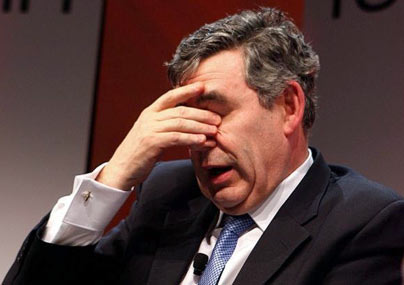
Sometimes you have a bad day; you wish you hadn’t woken up at all that morning. Imagine that for a week. A month. Well, welcome to Gordon Brown’s hell.
Everything started when Abdel Basset Ali al-Megrahi, the Libyan intelligence officer convicted for the Lockerbie bombing, was released two weeks ago. It was not actually Brown’s decision. It was in fact a decision cooked and made in Scotland, Brown’s native country. But as Premier of the UK, he took the blame for it.
Megrahi was early released from his imprisonment sentence under compassionate grounds, after being diagnosed in the terminal phase of a cancer. Visible weak, the Libyan agent took a plane home on the 21st of August, just on time for the beginning of the Ramadan.
Back at home he was welcomed as a national hero. Libyan President’s son, Saif al-Islam el-Qaddafi, was even present at the airport to together with thousands of Libyans who were cheering him.
Immediately, the UK was widely criticized from the inside, the Lockerbie bombing relatives’ victims, and outside, the US. Behind the ghost of an oil deal between the Africans and the Europeans was flying the scene. The American Government stated that if that was what happened, there should be “shame on Britain” and Gordon Brown.
In the past two weeks, speculations surrounding the oil deal implicit in Lockerbie’s bomber’s release grew exponentially. A report from 2007 (when the release was first discussed) stated “British interests” were in between. Those interests have a name: British Petroleum and the rights to exploit several natural gas and oil fields in Libya.
Brown was firmly denying those involvements, however. Until this week, when his Justice Minister Jack Straw had to admit that oil may had have a big role in Megrahi’s release.
But Brown’s nightmare with Libya wasn’t still over.
On Monday, British Premier kinda backed IRA victims’ allegations to look for compensation from the Libyan Government for the arms deals between the African country and the Irish terrorists that contributed to several attacks. However, just a day after that, Brown managed to make a U turn by saying that IRA’s link to Libya wasn’t that strong. And subsequently, managed to get some angry Britons again against him.
Hamas has grown up. After last winter’s war in Gaza between Israel and Hamas, the latter is now the stronger ruler the strip has had in recent years. But with the ruling comes too responsibility and problems. Hamas is tasting now the flavor of power, for good and bad.
A bright example: Shalit. What before was an issue merely between two armed forces, the IDF and Hamas, has evolved into a national issue between Israel and Hamas government (although Israel doesn’t recognizes them as a legal government). Stakes are much higher now than what they were a year ago. A false step, backwards or forward, from any part will be considered as an official position from the other side for both sides.
Israel knows that. And of course, uses it on his favor. Demands from Israel over Shalit release have been growing up exponentially at the same time their concessions have been going down. Likewise, knowing the importance -especially symbolically- of the Jew soldier, Hamas doesn’t want to free him for nothing and their demands have been growing too as Israel toughened his position. That’s why conversations over Shalit are stalled right now.
But ruling over a population also carries the responsibility of accepting the inside critics. Recent movements from Hamas, aimed to impose a stricter religious moral in the daily life of Gazans, has firebacked in all the Palestinian territories, also -or most precisely, specially- in the West Bank.
Palestinians never were as radical as their South (Saudi Arabia) and Eastern (Syria) Muslim neighbors, but more like their West (Egypt) and North (Lebanon) brothers. The strict moral proposed by Hamas hasn’t been warm welcomed by them, not even in the more conservative Gaza. Cracks in the already divided Palestinian society have only worsened. And Hamas is taking the blame for it.
In fact, future doesn’t look brighter either. No-one is happy with Hamas’ ruling over Gaza. Some are unhappy because they consider it too much; some other because it consider it too few. According to Haaretz, Al Qaeda could be preparing an offensive against Hamas in Gaza to counter them and impose an even stricter Sharia law among the population. They already have had exchanges of fire and fights with them, similar to those they held against Fatah three years ago.
I bet right now more than one in Hamas is a nostalgic of times were they were in the opposition; just criticizing, no responsibilities...
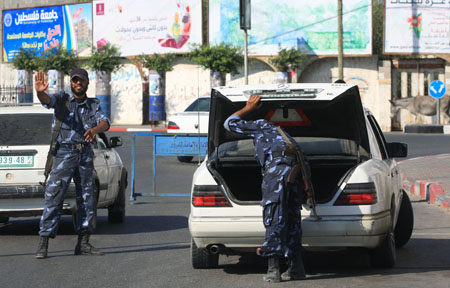
Hamas police officers inspecting a car in Rafah checkpoint into Gaza Photo: Xinhua
I’m not too eager of stopping working for long (journalism is more a lifestyle than a business, although others may have a different opinion). But sometimes it’s good to take a break. And that’s what I’m going to do from today.
Meanwhile, here are the main issues to follow during the next two weeks:
- Iraq: No more multi-national task force in Iraq. Instead, from today on, it will be just a sole force of one country, exclusively American.
- Iran: Yesterday was the 40th day anniversary of Neda Soltan’s death. Tehran saw again thousands in the streets mourning those killed in the repression by the government forces. And the Basiji, again, fought them back violently. At least 20 people died during last month post-electoral clashes.
But the scars are still fresh. An Iranian court urged the police to present charges against those detained (hundreds of them) and finally around two dozens will be prosecuted. Another prominent reformist was moved from his cell to a government house where he will be under house arrest.
It’s to expect a surge in the clashes again for the next weeks.
- Afghanistan/Pakistan: Helmand offensive still goes on. Yesterday, two British soldiers were killed and the casualty report doesn’t make anything but grow. The near Presidential election, due the 20th of August, promises a few busy weeks ahead. Karzai will win again, almost for sure, but his popularity is decreasing. The Talibans have already called for a boycott of the polls.
Meanwhile, in the southern country the drone wars go on. A recent attack killed, according to the CIA, one of Osama bin Laden’s son. The operations in Swat valley, carried on by Pakistani militaries with assistance from the Americans, have allowed thousands of refugees to go back to their homes, avoiding what could have been the worst refugee crisis since Rwanda.
But the Taliban menace persists. Pakistan signed yesterday a deal with Tajikistan to secure the region, cooperate in security matters and blahblahblah. So beautiful; the ‘Stans fighting together...
And just in case the Taliban weren’t enough trouble, a separatist group from Balochistan started to attack foreign aid workers in the area.
- China: The Uighur revolt still is on the frontpages. China revealed last week official numbers for killed and detainees. Detentions that today are still going on.
Also abroad. While the Chinese government was exchanging opinions with Obama and messages with Taiwan -both signs of aperture of the regime-, it was angrily criticizing the words of the Uighur exile leader and the projection of an Uighur documentary in a movie festival in Australia.
Australia, by the way, is engaged in another nasty diplomatic clash with China regarding a few wallabie employees of Rio Tinto detained in a spy case. The problem for those employees is that they revealed data from Chinese companies to their partners abroad. Data that is open source in China. This puts over the edge hundreds of consultants. What to do now? Where is the limit about what to publish and what not?
And if they survive that, still can be themselves into a collective illnes inside their company.
- Horn of Africa: With the comeback of somalian pirates, the region should have enough. There is even a new videogame about it. But this is Africa. There is never enough trouble.
Knowing that -or maybe collaborating to that- the USA has intensified his pressure over Eritrea and his support for the Islamist groups operating in Somalia. Yet a hypothetic deal sounds like a far dream.
Meanwhile, America plays a wild card strongening his presence in the area through the semi-autonomus region of South Sudan. Members of the newly created South Sudanese Air Force -no planes yet- were training this week in the USA. South Sudan is undergoing through a rearming process as the recent images of Faina’s tanks found in the region prove it.
- Rest of Africa: In Nigeria, clashes between Islamist militias and government forces in the north of the country left 150 deaths. The ambushes are still taken place.
In South Africa, newly elected President Zuma has abruptly ended his honeymoon with his voters. A massive strike shook the country during this week.
Meanwhile, a new campaign has been launched by a Namibian NGO. “Lords of bling” tries to remind the African leaders their promise to spend at least a 15% of the money in healthcare, a measure long forgotten by most of the African Union signers of it. The signer Akon has designed this song to remind that fact to the African presidents.
- Israel/Palestine: The settlements center the debate. International pressure grows as the US envoy to the region increases the talks too. Netanyahu agreed yesterday to destroy 900 houses in an East Jerusalem colony.
Inside Israel sensibilities around this are also changing. Some analysts consider Israel’s image abroad is being heavily damaged by the settlements (smart guy). Some settlers even are speaking out and admit they would leave in exchange for the money spent in their homes and similar conditions somewhere else inside Israel. Some others, not so.
What doesn’t change is Netanyahu’s hawkish government. The last idea is askdemand the Netherlands and the UK to stop giving funds to the NGO Breaking the Silence, who has done some research of alleged Human Rights violations in Gaza by the IDF. Next will be to point European governments how they should spend their money.
And meanwhile the Netanyahu’s government asks Holland and the UK to stop funding pro-Human Rights NGOs, their allies from the far right ask the IDF soldiers to cover up for the abuses committed in the West Bank.
On the northside, the IDF has been put on alert after Lebanon forces were movilized too. However, Israelí officials consider unlikely a reedition of 2006 Hezbollah-Israel war, specially now with so many international forces in the zone.
On the other hand, in Gaza, Hamas starts to apply their particular vision of government. Up until now, Palestinian women could consider themselves lucky. I was actually talking about this recently with a Palestinian friend. While Saudi Arabian women cannot drive a car or meet with strangers, Palestinian women can do that and even wear trousers, the head uncovered or -if they want, and also the men- buy alcohol.
All that could be about to change. A judge has ordered in Gaza to all the female lawyers to wear a head scarf. It is just an example of many more that are showing Hamas’ Islamist hand in Gaza. Like restrictions with alcohol or the new religious police. Here an Al Jazeera video on it:
- Latinamerica: Honduras’ political turmoil doesn’t look well. But at least negotiations are moving up. Slower than a sloth, but moving up. Zelaya is in Nicaragua’s border from where he visits periodically his supporters. Meanwhile the interim government is more and more in lack of support. Abroad, the USA revoked several diplomatic visas. Internally, the Army admitted the predisposition to accept a unity government with Zelaya in front. Last word is Micheletti’s.
Further to the south, Colombia and Venezuela are again fighting. This time, a few Swedish grenade launchers were the detonant of the diplomatic turmoil. The weapons, sold by Sweden to Venezuela, ended up being discovered in a FARC’s camp. After that, the usual crossfire between governments and Hugo Chavez’s usual recall of ambassadors.
And basically that’s all. Add some narco fights in Mexico and a political fight in Burma (Google this, I’m tired of linking news today) and you have enough to be busy for these two weeks I’ll be out.
So, until then... Be good, have fun, and don’t do anything I wouldn’t.
We already knew that Bush Administration did it bad. Really bad. We knew it already. But what we haven’t been able to see until the Republicans left the White House is how close they were to screw it up completely sometimes.
Now and then the press shows details of the incompetence of Bush’s team. Especially in the case of Donald Rumsfeld. A few months ago we knew Rummy was really close to blow up the mission in Afghanistan -and jeopardize American soldiers’ lifes there. Later, we learnt that he identified the occupation in Iraq as a Christian crusade, quotating the Bible to justify his decisions.
Saad was reportedly killed last week in Pakistan-Afghanistan border in a drone attack, according to the CIA. However, since 2003 he had been under house arrest in Iran. The Mullahs offered to handover Osama’s son, alive, to the Americans as soon as they knew who he was.
In exchange, Tehran wanted some of the heads of the terrorist group MEK, refugees in a camp near to Baghdad in Iraq. They are, by the way, the same ones that this week were ousted with violence by Iraqi security forces. They probably will face the expulsion from the country, but not to Iran.
Iran made the offer to Washington several times from 2003 to 2008, but the Americans refused it. Five years later, in late 2008 and after losing his value as bluechip prisoner, Saad and several other al-Qaeda commanders were released in the Pakistan border. A few months later, a drone operative who killed several civilians was needed to eliminate Saad.
An excellent interview from Scott Carney appeared in Wired magazine's Danger Room throws some light on the piracy business. Just a couple of examples of the great work done by Scott:
"The financiers are the most important since they organize and plan the big shot operations and are able to pay running cost[s]. Financiers always need to forge deals with traders, land cruiser owners, translators, business people to keep the supplies flowing during operations and manage the logistics. There is a long supply chain involved in every hijacking".
"Hostages — especially Westerners — are our only assets, so we try our best to avoid killing them. It only comes to that if they refuse to contact the ship’s owners or agencies. Or if they attack us and we need to defend ourselves".
"Every government in the world is off our coasts. What is left for us? Nine years ago everyone in this town was stable and earn[ed] enough income from fishing. Now there is nothing. We have no way to make a living. We had to defend ourselves. We became watchmen of our coasts and took up our duty to protect the country. Don’t call us pirates. We are protectors".
A few months ago the USA was kicked off the Kyrgyz air base of Manas. The airdrome had become an important hub for American operations in Afghanistan and the expel order came under suspicion of behind the lines pressure from Russia.
Yesterday, however, the Kyrgyz Parliament backed the letting of Manas Air Base again to the Americans. What has changed?
First is the significative increasement in the rent. From the $17.4 million per year that the USA was paying until now it grows up to $60 million. But in the new deal are many more factors involved.
Manas Air base won’t be used as a military hub anymore. Rumors about the use of the base as a nest of spies to intercept communications in central Asia had widespread long before the expel order. It’s understandable for Russia not wanting foreign ears in their backyard. From now on, only non-military operations, refueling and respelling will be allowed in Kyrgyz soil. Manas will be just a transit base.
But also is important the under the line cooperation deal between the two Governments. Including $117m in upgrades to the airport, anti-narcotics, anti-terrorist training and equipment.
Kyrgyzstan has serious problems dealing with Islamic terrorist groups, like the Islamic Movement of Uzbekistan (IMU). They operate in the Ferghana valley, a region shared by Uzbekistan, Kyrgyzstan and Tajikistan. Concerns around it becoming a Taliban haven have arisen recently.
With the deal, the USA not only gets to keep an important supply hub in central Asia, but also adds another force into the fight against the Taliban.
And what about Russia? No problemo, says Medvedev. The Russian president even encouraged the countries in the area to join the USA in their fight against the Afghan insurgency. Of course, they won’t party over it, but it suits in the new soft line of friendly diplomacy and restarted relations pushed by Obama and Clinton.
- Zombie ants. No, it isn’t next horror blockbuster title; it is something real.
- Iran frees American journalist, who flies home. She wasn’t in jail enough to get a place inside the Time 100 most influential people of the world in 2009.
- Wars simplified to a fool-proof mathematical formula. It’s a pity that for now is everything but accurate.
- The surviving pirate from Maersk Alabama incident, being judge in NY. And according to his smile, not very sad for it.
- A Predator drone down in Afghanistan. It is the third one.
- The F-35, hacked, and the future of American air power in the hands of... these models? Definitely, it is not what it used to be...
- Berlusconi second act. After suggesting their own people affected by a earthquake to take it as a “camping holidays”, now il cavaglieri encourages them to “buy in IKEA”.
I always said that in a fight, is better losing the argument than losing yourself. Quarrels are based on defending a position we think is morally superior to that of our opponent. In the case of wars, we have to add to the balance a few deaths. It is here, when people start to die, when having the moral superiority and the right on our side turns out to be fundamental.
If we punish a murderer by killing him, a robbery by cutting the hands of the robber or adultery by stoning to death, where does that leave us? Definitely not in a better position that those we pretend to judge. And losing the moral battle, takes away from us the capacity to judge them.
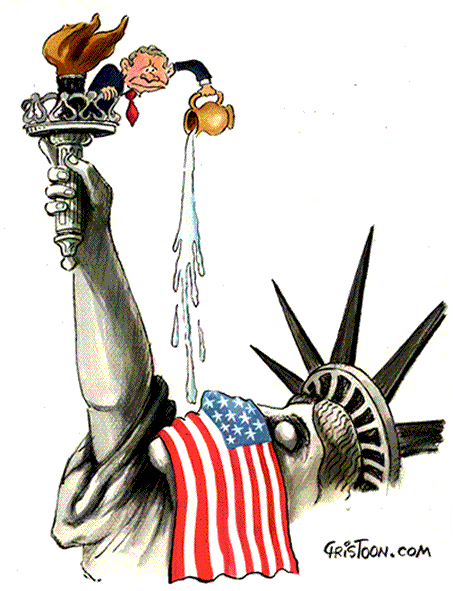
That’s why knowing the limits and not trespassing them is so important. And it is quite clear that the United States did so with torture. For many Americans, it was a shock to watch on TV Abu Ghraib images. If we were the good ones, why were we acting as the bad ones?
The Bush Administration tried to bury it by blaming a few guys, but the second episode of this horror movie goes through Cuba. And even after admitting what it was being done there, they refused to close it down.
Now, with Obama determined to stop that insanity -despite the problems some inmates can cause, like the Yemenis- it will be a matter of time for the American honor to be restored. In order to regain the superior moral position, it’s only left to criticize torture and send to court those responsible for it.
Or maybe not? According to Obama, it is not necessary to prosecute the culprits. The past is past, and better ”look forward”. Really?
Let me get it right. So, a bank robber is not forgiven six months after he steals the money. Neither is a murderer. Not even an average Joe who downloads illegally a song from the Internet. But the ones behind Abu Ghraib and Guantanamo will be walking free on our streets? I don’t get it.
Condemn the torture is good, but it is only the first step. As an alcoholic, American government has identified what’s wrong; now it is time to act and prosecute the culprits. Not doing anything undermines American’s authority (if they ever really had it) to act as the world police and defender of freedom and democracy that has been for the last half a century.
But apparently Obama is serious about this. For now, he had already freed CIA agents from any responsibility, as they acted obeying orders. They will be luckier than their Army counterparts. But Obama hasn’t said anything about officials from Bush Administration. In the case of them, the President is passing the buck to Eric Holder, Attorney General. Holder will be who will decide if prosecute them or not.
Maybe because of that Dick Cheney was so nervous when he knew Obama had authorized -or to be precisely, he didn’t do anything to unauthorized- the publication of four memos that were the base to the legal framework that allowed waterboarding, sensorial privation, the use of attack dogs and other “limit interrogatories” (sic) techniques.
Calling waterboarding a “limit interrogatories” -Dick’s words- technique and denying it is torture is an exercise of bad taste. Especially for Yukio Asano, a Japanese official who had to serve 15 years of hard work after II World War. His offense? To practice waterboarding with an American captive.
But not only that. Apart from what is or isn’t torture for Cheney -who apparently doesn’t have a clear picture of that, it may be the aging- what disturbs more the ex vicepresident is not the publication of the memos. Nope. It is that the information obtained after those interrogations is not released together with the memos.
In a very maquiavelic move, Cheney seems to argue that the aim justifies the means. Maybe that’s why the alleged brain behind 9/11, Jalid Sheij Mohamed, was waterboarded 183 times. Abu Zubaide, supposedly an Al Qaeda member, was lucky: only 83 times.
The New York Times has also another 232 pages document, elaborated by the Armed Services Committee, that points out another heavy weight inside Bush Administration, the former Pentagon Chief Donald Rumsfeld. It also appears (again) the SERE (Survival, Evasion, Rescue and Escape), a USAF training for their pilots to resist after being captured and tortured by the enemy.
Only that this time, the enemy of freedom and democracy was the United States.
------------------------------------------------------------------------------------------------------------- PS. Guantanamo as a night reading for kids before sleeping.
- A man who attempted to kill Obama was detained in Turkey. At least JFK had a year of Government.
- After suffering a horrible earthquake, Italy faces its worst fear, something much worse: Berlusconi. What he said to the victims that had just lost everything, including relatives and friends: “Take it as a camping holidays”. Sure.
- The shoe-throwing fever reaches India. In Iraq, the man who started it all, saw his sentence changed into one year instead of three.
- Elections in Moldova, including assaults to the Pairlament. Follow the revolution via Twitter. Welcome to the new era of cyber-revolutionaires.
Osama bin Laden must be getting really green. With envy. Not even his new videoclip megahit has been able to bring him back to the position of Most Hated Criminal. These days that title goes to Bernie Madoff, the world’s biggest white collar thief for many -just another banker for many more. His are the frontpages and the headlines.
Both for bin Laden and Madoff Jews have been their preferred preys. But the second one, it is estimated, has caused more economic damage than September 11. And it isn’t over.
Bernie woke up being the prisoner no. 61727-054 in a federal low security compound. The old man took over himself the blame in the pyramidal fraud uncovered at the end of past year. He faces a 150 years sentence; a life sentence actually. But he doesn’t have much to lose: being 70 years old and maybe battling a cancer, he has done everything he needed to do on life.
Still, Bernie tries to stay out of prison. Neither the affected are happy with the results. They demanded blood, they wanted revenge, they have a pure hate and want to see Madoff -and his su family- suffer the same way they do. In the end, as The Economist says, here there are not heroes; just villains.
Meanwhile the financial crisis goes on. But optimists began to arise. Ben Bernanke, Fed’s President, thinks all this nightmare will be over by 2009. His European counterpart, Jean Claude Trichet, thinks mostly the same.
Some others don’t give dates, just signs. Like Nobel prize winner Edmund Phelps, who says that the end will be close when the banks start to shut up their mouths a bit more -bad timing for becoming more transparent, ask the Swiss. Professors Nicholas Colas and Oren Klachkin, on the other hand, are betting for giving ten headlines that will anticipate the end of the crisis.
But none of the can guarantee anything. Someone said that “economic forecasts exist just to give astrology some credibility”. Many people went to Madoff thanks to that. And many people listen still to the CNBC to inform themselves.
Ah, the CNBC... A few months ago, Jim Cramer, anchorman of the cable channel, advised his watchers to buy Bear Sterns’ shares just days before it imploded. Jon Stewart, from Paramount Comedy, attacked him. Cramer retaliated. Finally, Stewart’s answer arrived:
Maybe they shouldn’t block Stewart’s “Fuck you!”. Maybe then Cramer will understand it and he would avoid see himself being ridiculized (again) nationwide in a face-to-face with Stewart.
For ten years the resolution of Northern Ireland conflict was set as an example to follow. A perfect case of how diplomacy, talks and give up by both parties can drive into a peaceful solution. And yet, last weekend, a few discontent men wanted to blow up that.
First was the murdering of two soldiers (about to be deployed to Afghanistan), on Saturday night. They were shot at their base’s gates, when they were taking a delivery from two pizza men. Two other people (including the two pizza men) were wounded.
The Real IRA took responsability for the action in a call to a Dublin newspaper. They also said they didn’t apologize for taking British soldiers as targets (logical) but neither for targeting the two pizza men, as they were “collaborating” with the “enemy”.
Then was in a second attack 24 hours alter the first one. A policeman was shot dead in an ambush in County Armagh.
However, until these two attacks, the Northern Ireland peace process was taken as an exemplary process. From the Basque country, nationalists (pro Basques) were always begging for an Ireland-style solution to the ETA terrorism. But the constitutionalists (pro Spanish) had a very Spanish fault: they tend to act impulsively.
Get me right, being impulsive is not always wrong. But in politics, it is. And Spanish politicians show a high predisposition to act impulsively. In Spain, many political actions and laws are a product of the will to maintain the people happy more than of an in deep study of the situation. From the withdraw from Iraq to the approve of gay marriage, from the Parot doctrine to the debate for the reimplantation of the life sentence (not revised).
In the case of the Basque conflict, another act following that path of ad hoc legislation was the ilegallization of the Basque radical parties or abertzaleen ezkerra (patriotic leftists in Basque). There has been a lot of ink running on the more than probable loss of power of the nationalist parties in the Basque parliament after the elections. But no one has spoken about the truth: that the banning of Batasuna and similar parties led into that situation. If it hadn’t been banned, the representation of Basque nationalists in the Parliament would have been much more significant, similar to that from previous elections.
Also, another impulsive act from Spanish politicians regarding to the Basque terrorism was the end of the peace negotiations by Mr. Zapatero’s government after the bombing of Madrid airport in 2006. Here, from the UK and Ireland, Mr. Brown and Mr. Cowen have given a lesson of what should be done in a peace process to Mr. Zapatero. Like Mr. Blair and Mr. Ahern did in the past after the Omagh bombing. Patience, give up, talk. Knowing that there will be obstacles in the way, but that it worths going on with the process and never abandon at first sight of problems.


 7/24/2013
 Ehiztari






 Twitter
 Facebook
 Flickr
 Posts
Posts


