Any questions? Contact us.

Showing posts with label Russia. Show all posts

Sunday, June 16, 2013

Old habits die hard


We live in a world radically different to the one from the Cold War era. In fact, that is a period of time that has been left behind by all of us. No more fear of a nuclear holocaust. In Hollywood, the bad guys are now Arab terrorists, not communist soldiers.

Even the age of the arms race has been overcome. Not only we are reducing our nuclear arsenals –except for you, Kim. The armies in general are shifting their priorities. The United Kingdom doesn’t put its emphasis anymore on nuclear submarines. The Russians are going the same way with their subs.

War has changed. You do not need large armies to fight with other nations’ big armies. Now different weapons are in demand. Remotely controlled drones, armored vehicles that resist homemade mines and guerrilla tactics for compact armies; those are the tactics generals want now.

Not even the United States wants to be a policeman of the world anymore. Its intervention in Libya was on par with the French. In Mali it only provided auxiliary forces. And when it comes to Syria, it's been trying to stay out of it for as long as it has been able to.

Of course, one thing is to want to abandon old habits and quite another one to do so. There are still vestiges of the Cold War that are very active. The most interesting one is the case of old fashion espionage.

During the 90s, the advancement of technology made spy agencies decide to spend less on information from human sources and more on their digital eyes. Satellites in orbit were giving all the information they felt they needed. However, 9-11 changed the paradigm and since then the human spies are living a second youth.

The latest episode, including the capture of an American CIA spy in Moscow, illustrates that little has changed. He wore various wigs, a compass, a blocker for radio signals (tin foil) and as the only element of the 21st century, a mobile phone.

It is not the only recent espionage case. In London, the death of former KGB agent Alexander Litvinenko has led some to believe that his former bosses were behind the poisoning with polonium.

Anna Chapman
Much more striking was the capture of Anna Chapman and nine other Russian spies in the United States. Chapman went immediately on to become a celebrity.

But there is one side of the resurgence of the Cold War times much less reported: the revival of reconnaissance flights. During the '60s, '70s and '80s, American and Russian aircrafts occasionally poked or even went into foreign airspace. It was a sort of cat and mouse game, whose purpose was to check whether the other’s defenses were alert or not.

Russia has returned to this game several times since 2012. Long-range bombers sporadically poke the Arctic and tested the patience of its neighbors. In this regard, Sweden has failed the test. It was not the first time that Russian aircraft entered its airspace and Swedes have failed to respond in time.

This strategy is probably part of another covert war that is beginning to take shape: the battle for the Arctic. But that's a story for another day.

Thursday, March 21, 2013

Syria and the diplomacy game

Syria has become a broken toy no one wants to get their hands on. Truth be told, the situation has escalated and it is way more complicated now. What used to be black or white has now dozens of shades of gray in between. The Balkanization of the conflict has derived in a war with dozens of splinter cells with targets too different between themselves.

There is no more a homogeneous opposition. Some groups want to oust Assad. Others just want to defend their neighborhoods. The Kurds are happy taking care of their own business watching the rest killing themselves. And then there are the ones looking for a Yihad. For those ones, the -theoretically- socialist and laic regime of Assad is as good as a target as anything else.

That is why steps are given carefully. Slow and shy attempts on all sides. Take for example Russia, who started championing Assad. Now they are rather looking for a golden retirement for him and his family in a third country.

We have as well the Arab states of the Gulf. They are between a rock and a hard place. On one hand they would love nothing more than getting rid of Iran’s friend in the region. On the other hand, they are frightened a revolution like that could caught them at home.

In a similar place is Israel, whose is irritated by Assad but fears who could come after him. They have the bad experience of Egypt, where Mubarak was a manageable leader that didn’t give them too many problems. Things have changed with Morsi, if only on the public arena.
Photo: Facebook group

The last one to risk a move has been the USA, announcing they will help directly the Syrian opposition. With a clear red line: no weapons or training. Just medicines and food to avoid future problems.

The Americans don’t want another Afghanistan or Libya. In the former they helped the Taliban; in the later they helped the Gadaffi opposition. Both groups turned their backs on America, one of them in a war still going on, the other one with the attack on Bengazhi’s embassy and Mali.

The Syrian opposition however thinks that all that about food and medicines is good intentions but nothing more. A video uploaded to Facebook shows how much they esteem the help provided by Washington.


However, the lack of a pipeline of weapons from the West isn’t stopping Syrians of getting armed. Recently some images of what looks like Chinese surface-to-air missiles appeared online. How they got there is a mystery. But even without sponsors, Syrians have demonstrated a high dose of imagination. One of them is a Playstation-controlled tank they created out of scrap pieces. That is bringing the game of Libya to a whole new level.


France and the UK have been trying to solve that. They are the top supporters of lifting an EU-embargo on Syria. They are even considering going freelance and arm the rebels themselves, even if that means defying the European Union.

Several Gulf states, however, keep funding and arming rebel groups. Qatar and Saudi Arabia are among them. This, again, could turn counterproductive in the end for the Americans. Without a direct control on the arms pipeline, those weapons could end up in the hands of groups that aren’t so worrying for those Muslim states, like al-Nusra. And this would be the same problem all over again, only that way closer to strategic allies like Israel.

Monday, December 10, 2012

Calling wolf (again)


Last week we woke up to the unsettling news of Al Assad cooking sarin-filled ammunitions. It is not that we didn’t know that Syria has chemical weapons. We knew it. But some intelligence reports suggest now that the regime of Assad may be loading them on the delivery recipients.

Immediately, the US stated that using chemical weapons would be a “red line” that if crossed would carry “consequences”. It is easy to imagine those consequences in the form of a Libya-style intervention.

If the reports are true it would show significant weakness for the Assad regime. That shouldn’t come as a surprise. The rebels are closing the gap with Damascus' airport and fighting for its control, with flights having to be cancelled for hours at some points in the past few weeks. For now, the airport is open but the road to the city is a battlezone.

The recent blackout of the Internet seemed also like a desperate measure by the Syrian government to cut the leaking of videos and information from within Syria. Mixing the sarin and loading them onto the delivery recipients would be the prelude of another desperate measure. Because if done, it all becomes way more complicated.

Photo: TRDefence
While separate on their active ingredients, it is somewhat stable and relatively easy to store. But once mixed, and considering the decades-old technology employed by Syria, it must be used immediately or there would be risks of leaks and deterioration.

It is also more difficult to store, due to the sarin being extremely corrosive. Add to that the degradation of the quality of the gas. In fact, to avoid all these problems, Iraqi soldiers -who used the same tech when attacking the Kurds in the 80’s- mixed the gas on the spot just before firing the ammunitions or loading them onto the bombs.

However, some people see on these reports more of a remake of the Iraq invasion than a real threat. Calling wolf on weapons of mass destruction to fuel their own interest -whatever they could be. And it is not only the Russians, who have a clear conflict of interest with Syria, but also activists among the rebel ranks.

Those rebels, or at least some of them, are what several analysts have said we should be worried about. They are talking of a proper nightmare scenario. If the Assad government fails, all those chemical weapons that do really exist could end up in the hands of the rebel groups, some of them linked to al-Qaeda. And those rebels have already stated that they want those weapons, while their methods aren’t always that different from what they say to be fighting.

This isn’t a new problem. The US came up with a solution to a similar problem in Pakistan, setting a back-up plan in case the government failed to secure the nuclear stockpile of the country. However, Syria is not Pakistan. There are no dollars to put into Assad’s account to shield the sites storing the weapons -for now, Assad just keeps moving them around- and it is unlikely Russia would see with good eyes an intervention on Syrian soil by American soldiers -that was the plan B in Pakistan. 

Instead, the Americans are hoping to train Syrian rebels to secure and handle those weapons. But that plan can only work if those rebels arrive before al-Qaeda linked groups to the sites and if Assad’s government cooperates to some degree. Two very big if’s in a very volatile environment.

Either that or call the Israelis in.

Thursday, November 19, 2009

Friendly fire 19/10/09

Going green to be greener.

Iran to Russia: where are our missiles?

NK boosts its special forces.

In honor to Jordan: no more 23s.

Sarah Palin still on the frontpages. Literally.

Did you like it? Share it Delicious

Friday, October 30, 2009

Friendly fire 30/10/09

- Iraq wants to get into the nuclear club. Yeah, that’s right. Not Iran this time, Iraq.

- Micheletti and Zelaya achieve an agreement for an exit to Honduras coup.

- The EU gets an only strong voice against climate change. Well, sorta.

- Israeli envoy to the UN says that the Human Rights council has give its back to the same values it defends. I think it’s something about Goldstone report, but not in the same way as everyone else aknowledges it.

- Medvedev opposes to the rehabilitation of uncle Joe. Traitor! He should be executed…


Did you like it? Share it Delicious

Friday, October 09, 2009

Obama superstar

Like if anything else was necessary to elevate Obama to the heavens, now he has been awarded with the Nobel Peace Prize. The coronation of his Highness Obama has had more to do with the canonization of a (laic) saint than with the recognition to his achievements. That’s why everybody is asking why. And why now.

Because let’s face it. Obama may have promised a new world, but little of that has been unveiled for now. The White House has done small gestures to break with their precedent. It has been, for example, the first time the US has condemned a coup de Ć©tat made by the right and the army in Latin America. Also, tortures and Guantanamo issues are slowly getting better. But as for the rest, all we have are just promises. The general opinion is that the committee in Oslo has decided it betting for his future achievements. But how easy will he get it?

Obama has promised a cut in the nukes, and this is probably the easiest task of all. The Russians are willing to do it, especially because they have already problems to maintain their current stock. But a hypothetical reduction of the two superpowers arsenals wouldn’t have an immediate effect on the world’s stability, quite the contrary: everything would be the same, with more countries like China, closer to equalize the power of Russia and the USA.

The American president has also promised too a new era for the Middle East, but so far the achievements are minimum. His speeches were great, no doubt to that. But far from freezing the settlement construction in the West Bank, he might have to counter a peak in the hostilities. The increasing clashes in Jerusalem plus the outrage after PA’s decision to postpone the vote on Goldstone report -suspectedly in exchange for a permit to Wattaniya mobile operator to start in business- have made the situation way worse than what it was in 2008. Some Israeli media are even predicting a new Intifada.

But the biggest problem for Obama will be Afghanistan. Leaving already Iraq, the now known as the “Obama war” will take yet too much blood and sweat from the ISFOR to develop results. And that outcome will be most likely what will measure Obama’s performance in office back in History. But for now, he has nothing.

His speech writer, however, should have been awarded with the Literature Nobel Prize.

Barack Obama
Photo: Jonas Karlsson

Did you like it? Share it Delicious

Monday, September 28, 2009

Friendly fire 29/09/09

- Taliban to Germany: Leave Afghanistan or lose Oktoberfest. Now, that's a real threat!

- How easy is policying when you get along well with your partners. Angela Merkel is already doing so.

- China, 60 years of communism with a trademark.

- Fiji troops excluded from UN peacekeeping role.

- How to: Immunize against radiation: drinking vodka.


Did you like it? Share it Delicious

Exposed

The discovery of a secret Iranian centrifuge facility near Qom has been a major blast in International politics during the past week. It surely surprised Mahmoud Ahmadinejad, who didn't expect that question coming out in an interview with Time Magazine -the expression on his face when listening to it (Ahmadinejad had no need of translators to understand that) says it all.

But also shocked the world. For months, international community focused in the possibility that Iran could low-enrich enough amount of uranium and then kick out the IAEA inspectors and upgrade it to a bomb level. This however, changes that scenario.

Not for all, has to be said. Some, like Nathan Hodge from Danger Room, are delighted now getting some weight off their chest by saying the old “I told you so”. They predicted this long time ago. As he noted, if the Iranians are to “build a bomb, they will do it someplace else. Like Qom”. The new facility (still far from operative) can be used as well as a backup for the existing in Natanz or as a training facility -or viceversa.

But back to the present scenario, every day seems more likely an attack on Iran by the end of the year. Israel has stated clearly in the past -last time was today- his intentions to bomb any threat coming from the Ayatollahs, and has been preparing the road for itself and the world for when it happens. But Israel pretensions have encountered always Washington’s opposition.

Until now. It’s believed that the revelation of the plan by Iran to the IAEA in a vague letter was made because the secrecy of the plant had been compromised. That came from the American, British and French secret services. Immediately, in the G20 summit Obama said that although their diplomacy offer remained on the table, none other options had been ruled out. That, although unlikely, includes the military option.

With the US now more inclined to support Israel, the threat for Iran is clearer. However, if there is a major swift in here is concerning Russia. China still is reluctant to impose more severe sanctions to the Persians. The Russians, however, after knowing of the secret facility -and after the withdraw of the American missile shield in Europe-, have slowly joined the European countries and America on their demands on Iran. And having the Russians on Israel’s side is a huge improvement for the Jews.

The major concern for Israel has never been America’s approval or strategic geo-political complicated outputs. It’s been internal problems, their own pilots’ safety and logistical problems. Their worry for the sold of Russian S-300 surface-to-air missiles to the Persian state -which could diminish their chances in an air attack- has even surrounded the mystery of the Arctic Sea.

Later on that incident, Binyamin Netanyahu, Israel’s Prime Minister, made a secret trip to Russia. No-one knows yet what Bibi did in Moscow. The Israeli media didn’t even know about the trip until a week after; not even the embassy staff in Russian capital knew about it. But it’s more than likely that it had to do with the S-300 missiles.

Now, providing Russia opposes too to Iran and joins the group of four (USA, UK, France and Germany) -unlikely- and Iran finally doesn’t get the weapons -more likely and enough for Israel-; the US approves the operation; and the green light from Saudi Arabia; it will clear the road for Israel.

Iran’s only option now is stop playing and coming clear -some steps made- or make a demonstration of force. Obviously, they’re going for the latter, even unintentionally.

For the past three days, the Revolutionary Guards have tested their arsenal of short, medium and long range missiles, including the Shahab-3, with a 2,000km range and capable to hit Israel. Some of the tests were delivered on Sunday, coinciding with the Jewish holiday of the Yom Kippur. Well, at least you cannot say Iranians aren’t concerned about Israelis. If Yom Kippur is all about suffering, they got a lot of people suffering of stress that day. Also in Europe.

And all that, just ahead of tomorrow's talks.

Mahmoud Ahmadinejad
Photo: Reuters


Did you like it? Share it Delicious

Friday, September 18, 2009

Missile shield, down (Twice updated)

A couple of updates that I missed yesterday.

First, Putin welcomes the decision of Obama to withdraw Bush’s plans for a ground based missile shield by freezing Russian plans to install a similar system in the Baltic.

Second, Nathan Hodge from Danger Room finds an interesting coincidence I didn’t: Obama announces the withdraw of the shield the same day that Poland remembers the Soviet invasion of the country in 1939. Unlike me, Polish’s newspapers didn’t miss that point.


Did you like it? Share it Delicious

Thursday, September 17, 2009

Missile shield, down

Rumors, rumors, rumors... For the whole week there have been rumors around the American missile shield and Obama’s decision to withdraw it. Well, finally they got confirmation: the US backs off and won’t install the ground missile system in Poland and the Czech Republic.

Of course, Russia is cheering with this shift and right now a bunch of crazy Ivans are for sure getting drunk in a bunker under the Kremlin to celebrate it. Konstantin Kosachev, head of the Foreign Affairs Committee in the Duma (Russian Parliament), has said that “now we can talk about restoration of the strategic partnership between Russia and the United States”. Clearly, a huge step ahead. Na zdorovya!

But in Poland and the Czech Republic there are mixed emotions about it. On one hand there is the relief for not becoming the primary target in a nuclear war. Which is a big relief, I have to say. But there are concerns that the US and NATO are letting them down. They fear that Russia, encouraged by this partial withdraw, might want to re-enact his influence in the area.

To solve that, American, Polish and Czech diplomats are undergoing through negotiations for other solutions and kinds of collaboration. In fact, the missile shield idea is not completely thrown away but redefined into something more versatile, mobile and lighter, consistent of a ground radar and ten small mobile interceptor launchers. Obama is trying hard to tranquilize the ex-communist NATO allies. And to state clearly that no NATO member will be let alone, President Obama mentioned NATO's article 5 in his announcement -an attack on one will still be an attack on all.

The official statement says that the reason to cancel the deployment is that Iran is not the threat we thought it was going to be. However, the poor performance of the ground defense system might have had some role played in this decision too. So far, the sea-based twin of the program, the AEGIS system, has shown much better results and lacks of the inconvenient of fixing it into a foreign country. Not to mention the economic struggle and cuts everywhere in the American military, and specially, in the Air Force.

Whatever it is, Russia now has lost his American menace on their backyard (yay!). But this is a tricky bet for everyone. Also for the Russians -bad luck for the drunken crazy Ivans, back to the thinking. Sure, they might think now that the hard-line approach they had to the missile shield initiative worked and try to implement it into another problems.

But it’s true too that now the ball is on their court and they will have to move next. The US is seeking more support from Russia with the sanctions against Iran and North Korea, involvement in Afghanistan and further collaboration in disarment.

Of course; trades and millitary alliances with Cuba or Venezuela won't be so justified now. And both have had a huge boost in the last week. As for the first one, Russia's top military commander visited Cuba this Monday. Venezuela fireworks were way more spectacular: a big $2.2b deal which includes 92 T-72 main battle tanks; Smerch rocket artillery systems; and the Antey 2500 anti-ballistic missile system.

Time to move on for Medvedev and Putin.


Photo: Xinhua/Reuters Photo


Did you like it? Share it Delicious

Wednesday, September 09, 2009

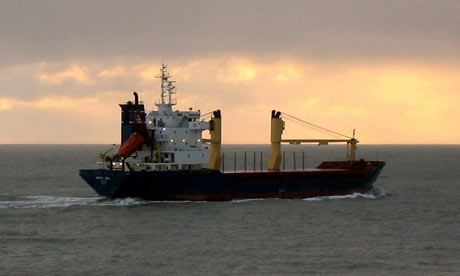
The mystery of the "Arctic Sea" (Updated)

Piracy is often news in Somalia. Or in the Philippines. But rarely happens in the North Atlantic. Not to mention in Europe. That’s why the disappearing of the Arctic Sea, a Maltese freighter with Russian crew, went to the frontpage of newspapers all around the globe.

The official story tells us that the Arctic Sea was transporting a timber cargo worth a couple of million dollars. As the ship was full of crazy Ivans (aka Russians), Putin sent two submarines and several vessels after her. But, why seize a freighter in Europe loaded with wood when it was supposed to go through the Suez channel? And why send two nuclear subs after her to find it?

There had to be something more, and rumours are widespreading as you read this article. The biggest one right now says that the freighter was loaded with Russian anti-aircraft missiles for Iran or Syria. Maybe even the new S-300 model. Other rumours say that the Mossad was involved in the seizure.

Quickly enough Russian authorities have denied it. They are undergoing an investigation to clarify who was behind the incident. But a Russian journalist that suggested some guys to look at has already, according to his own testimony, been contacted to recommend him to leave Moscow.

It is, anyway, strange that a ship possibly loaded with even the anti-aircraft missile most wanted by America and most protected by the Russians went missing.

If in the end it is true that was full loaded with weapons for Iran, this is the second time the Persians see how a packet for them goes missing in less than a month.

UPDATE: Netanyahu's secret visit to Putin. Related to this?


Photo: STR/Reuters

Did you like it? Share it Delicious

Wednesday, August 26, 2009

Friendly fire 26/08/09

- How Poles struggle in Afghanistan.

- China cuts the supply of rare metals.

- One of the kidnapped French spies captured in Somalia, free. How? Well...

- Maybe the Russian freighter kidnapped in the Atlantic wasn't carrying just timber

- The third man in Afghanistan's presidential elections (the ona Obama should listen to)


Did you like it? Share it Delicious

Monday, July 06, 2009

Friendly fire 06/07/09

- The USA and Russia agree cuts for nukes. Missiles, not in the agenda.

- MI6 (British Intelligence service abroad) boss forced to resign after his wife publish photos of his family on Facebook...

- ...and CNI (Spanish Intelligence service) boss resigns after a newspaper aired a scandal out of some photos of him fishing off the African coast. Are these guys spies? Seriously?

- Robert S. McNamara, former Secretary of Defense under JFK and Johnson Administrations, dies at 93. He was one of the brains behind the Vietnam war.

- Italy didn't pass the exams in the G8.


Did you like it? Share it Delicious

Friday, June 26, 2009

US keeps Manas; Medvedev, 'No problem'

A few months ago the USA was kicked off the Kyrgyz air base of Manas. The airdrome had become an important hub for American operations in Afghanistan and the expel order came under suspicion of behind the lines pressure from Russia.

Yesterday, however, the Kyrgyz Parliament backed the letting of Manas Air Base again to the Americans. What has changed?

First is the significative increasement in the rent. From the $17.4 million per year that the USA was paying until now it grows up to $60 million. But in the new deal are many more factors involved.

Manas Air base won’t be used as a military hub anymore. Rumors about the use of the base as a nest of spies to intercept communications in central Asia had widespread long before the expel order. It’s understandable for Russia not wanting foreign ears in their backyard. From now on, only non-military operations, refueling and respelling will be allowed in Kyrgyz soil. Manas will be just a transit base.

But also is important the under the line cooperation deal between the two Governments. Including $117m in upgrades to the airport, anti-narcotics, anti-terrorist training and equipment.

Kyrgyzstan has serious problems dealing with Islamic terrorist groups, like the Islamic Movement of Uzbekistan (IMU). They operate in the Ferghana valley, a region shared by Uzbekistan, Kyrgyzstan and Tajikistan. Concerns around it becoming a Taliban haven have arisen recently.

With the deal, the USA not only gets to keep an important supply hub in central Asia, but also adds another force into the fight against the Taliban.

And what about Russia? No problemo, says Medvedev. The Russian president even encouraged the countries in the area to join the USA in their fight against the Afghan insurgency. Of course, they won’t party over it, but it suits in the new soft line of friendly diplomacy and restarted relations pushed by Obama and Clinton.


Photo: U.S. Air Force photo/Staff Sgt. Lara Gale

Thursday, May 28, 2009

Arms race goes east I (Central Asia)

The USA and Russia, with endangered economies because of the economic instability, seem keen to go forward with the disarment programs. Not for the Asia-Pacific region.

The approach from Medvedev and Obama looks logical. Not only from a strategic and military point of view, but also economically. In the end, if they can forget about the expensive expenditure of the Defense bill -specially the one derivated from the upkeeping of the nuclear deterrent- that could mean a huge relief for their bad economies. In the US there is even a debate around about if Obama should renounce to the “first strike”, something Americans never took out from the table. But the cuttings aren’t only in stuff. Also in staff, even at a senior level.

On the other hand, the threats from our father’s times are over. Now we won’t need big armies to confront other armies in at least twenty years time. In fact, today’s battleground is an asymmetrical warfare, with invisible foes that attack and retreat like the smoke, and where versatility, mobility and adaptability of small unit is essential. Both, the USA and Russia are working in that way. Also the UK follows the path. And even though the US Army wouldn’t do anything else but maintenance for the oncoming years, they will be without doubt the most powerful force on Earth, even more than all his foes together.

But the Americans aren’t just maintaining the arms. It’s the biggest bill of all armies. The US spends in defense 4.6 times more than the Chinese, 7.7 times more than the Russians, 85.2 times more than Iran and 100 times more than North Korea. The difference for this year is that although it is still growing, it grows less.

Not in Asia. Here, it doesn’t only grow, but sometimes growths even more than in previous years. Up until some point it’s understandable. Asia is the hottest part of the planet right now, where most of the conflicts and instability regimes are (letting aside Africa), from Burma to Sri Lanka. Also where most of tomorrow’s threats are, from Iran to the DPRK. And even where today’s conflicts are taking place, like Afghanistan and Pakistan.

So many problematic people together cannot be good. That’s why, imitating the Europeans, America and Russia after WWII, most of the countries in the region are rearming themselves heavily. Just in case, for what could happen in the future. The dates are fixed, as demonstrated by the new Australian Defense white paper and the Chinese PLAN: 2030.

Iran is a crystal clear example of this. Behind the threatening rethorics of Ahmadinejad, facts are that its power up to date can only endanger weak neighbors. It doesn’t matter what Israel tries to sell us with the fear policy; Iran doesn’t represent a threat today for the West.

Today. But tomorrow it can. Iran is planning the basis for what can be the biggest menace for Israel in all its modern history, and made the mullahs capable of face the Jews without any kind of complexes. The tools are being developed: nuclear weapons, ICBMs and drones to deliver the package.

But probably, the biggest problem is not in Iran itself but in its eastern border: the Af-Pak. The irony of this comes out from the fact that, what started as an operation to stabilize a country and kick the Talibans out from a Government has derivated in a fight to avoid the Talibans taking control of another country in more dangerous conditions.

The fall of Pakistan in hands of a fundamentalist regime would be a huge backstep not only in Washington, but also in Tehran, New Delhi, Tel Aviv and even Beijing or Moscow. It’s not only the problem of having a haven for terrorists, with the back from a state. There is too the threat of Pakistan’s nukes.

Between 60 and 150 weapons, plus the missiles to put them anywhere in a few hundreds miles around, could fall into the hands of some crazy guys whose wet dreams are about that. The threat looks real. At least, real enough to make Washington prepare a plan B to take over the nukes in case Pakistan’s State fails.


Photo; Thomas Cole

Monday, April 27, 2009

Friendly fire 28/04/09

- The surviving pirate from Maersk Alabama incident, being judge in NY. And according to his smile, not very sad for it.

- A Predator drone down in Afghanistan. It is the third one.

- The F-35, hacked, and the future of American air power in the hands of... these models? Definitely, it is not what it used to be...

- Berlusconi second act. After suggesting their own people affected by a earthquake to take it as a “camping holidays”, now il cavaglieri encourages them to “buy in IKEA”.

- Russian Police Forces: about water throwing trucks and efficiency (second try).


.

Sunday, April 26, 2009

Should I stay or should I go?

Maybe Russia is withdrawing from Chechnya, but Medvedev doesn't have any intention to pull out from the Caucasus leaving it unattended. It's worth remember that, besides Chechnya, Georgia is also in the region (among other independentist wannabe regions). So the Russian bear shows his fauces to all of them by deploying six attack helicopters Mi-28N. The final number will increase to up to 67 by 2015.

And you though Medvedev was chikening out.


Photo: ITAR-TASS

Monday, April 20, 2009

Matryoshka wars

So in the end Russia is leaving Chechnya. Great, isn’t it? It’s Medvedev the new Russian Obama? Well, not so fast.

After more than ten years of wars, the Russian National Committee for Anti-terrorism has decreted Chechnya as an area free of “antiterrorist operations”. This effectively means that Russia will leave the Republic and won’t consider it anymore a threat.

Maybe the conflict is over -for now-, but the subjacent cause is still there. In fact, all the region is a great threat.

And in this dangerous area, will remain on top the present Chechen President, Ramzan Kadyrov. Probably, he is the worst one for the job. Kadyrov has gained a reputation of sadism and despotism, and his presidency has plenty of examples of disappearing members of the opposition -just to be found later already dead. Russia, leaving him on charge now, just makes him good for the job. And that’s what makes this region even more instable.

But the problem is not only in Chechnya. Have a look on the map. Who is south? Georgia.

To the war the two countries had last summer we have to add now more discrepancies. According to some, that’s just Russia trying to provoke NATO. There are for example troop movements on the borders that talk of a possible incursion inside Georgia. In fact, there are even troops inside Georgia, against what was signed last summer after the ceasefires.

Of course, NATO isn’t either helping. Making some joint exercises in Russian backyard isn’t precisely diplomatic. And just to add more tension, the inside opposition to pro-Western president Saakashvili is highlyagitated.

But let’s give them an opportunity. At least, they have started talking again. Will it be worth? The answer, this summer on your screens.


Photo: English Russian

Tuesday, April 14, 2009

Damn you Kim Jong-Il!

In the end, the United Nations Security Council could make it forward for a document condemning the DPRK’s launch of a long-range missile/satellite-rocket. The text also includes possible new “hard sanctions” for North Korea. And Kim Jong-Il said...

So... What?

As many analysts predicted, the DPRK not only ignored the resolution but also warned the Western countries with going back to the nukes line production. After a long up-down six-party negotiation, Pyongyang dismantled his Yongbyon nuclear reactor and agreed to do so with other facilities in the country. However, last December, the talks got stopped.

New American Administration has been able to attract again the Europeans, calm the Iranians and Russians and even make smile the Cubans. But the DPRK, that's something apparently Obama won't change. Too much ego in such a tiny person.

Tuesday, April 07, 2009

Round the world in 80 summits

The high expectatives generated by Obama led only to one possible scenario: deception. But maybe the new President can reach the first 100 days in office without breaking the hope. Not all of it at least. According to a Washington Post poll, more than 60% of Americans approve Obama’s Government.

That’s at home. But where he was most feared was abroad. Many though he would be like many other US Presidents; maybe good for Americans but a disaster -although not as big as Bush- for the rest of the world. But instead of that, it’s being quite satisfactory the experience so far. In fact, where Obama’s policy has shown more active has been abroad and for now, it has been for the better.

It mostly has been thanks to Clinton’s effort, but also to Obama’s extenuant agenda in the past two weeks. First a congress about Afghanistan -with Russia and Iran among others- in the Hague, then the G20 in London, the EU-USA summit in France, the NATO meeting in Prague, another meeting in Turkey and finally, even an uneschedulled visit to Iraq. And in all of them, American policy hasn’t done anything but gaining popularity and stakes among allies and foes.

For instance, relations with Iran look way better. It has contributed that during the week, Obama has mentioned several times the right of the Persians to have nuclear technology for civil use. Even with Russia things are smoother.

In fact, both countries (Iran and Russia) will help America in the new Afghan strategy. It is unclear if they make this because they are willing to restart the transoceanic relations or because they both hate the Talibans as much as America does.

Obama and Medvedev have put a lot of effort too in the mutual disarment -even though what Russia said. Just yesterday Obama was praising for a world free of nukes, as he has been doing for all week.

Indeed, one of Obama’s highest peaks of popularity came in Prague, talking about nukes. In front of tens of thousands, Obama gave one of his most memorables speeches up to now. Some have already compared it with Kennedy’s “Ich bin Berliner”. If there is something that outstands from it, it is this:

“As a nuclear power -as the only nuclear power to have used a nuclear weapon- the United States has a moral responsibility to act. We cannot succeed in this endeavor alone, but we can lead it”.


Luckily for Europe, their relations with the other side of the Atlantic are also improving. They appreciate as well the new way of policying. Speeches before masses and citizens’ participation have been a constant in Obama’s tour. Like in the meeting between the American President and a group of young professionals and students in Strasbourg.

Also the Governments of Europe are getting in better terms with Americans. The most anti-American European country, France, with Sarkozy in the frontline, couldn’t be prouder of receiving Obama in his soil. Although it should be said that at the end it was more of a meeting between Carla Bruni and Michelle Obama rather than their husbands.

Even those that in the latest years -or even weeks- have had a horrible relation with the United Status, like Spain, have had their little push: Zapatero finally have a photo with an American President, has been invited to the White House -and Obama is eager to pay back the visit as soon as possible- and even has been called a friend! In the middle of an internal crisis and with elections on sight, how many votes does that mean? How many votes are a photo with Obama?

The US wants to get closer to the world and recover the lost time after Bush. And if something, they want to regain the Muslims. The White House inhabitant has said it once and again: “We are not enemies of Islam”.

To show his determination, alter the nomination of Anders Fogh Rasmussen as the new NATO secretary, he made him offer an apology to the Muslims for Muhammad’s cartoons among other concesions. And he even left himself be seen in Turkey in the Alliance of Civilizations forum.

It’s a pity, however, that the Republican machinery has already woken up and started to work agitating the bases at home. And all because of a bow of Obama to king Abdallah from Saudi Arabia. The comments in the pro-right-wing blogs are funny and scary at the same time. They are like “I told you so! He is called HUSSEIN! He is a Muslim!”.

In two months all women in Chicago will wear burkhas. You’ll see.


Photo: Reuters


Are you afraid? Well, this works in that way. First you do what scares you and it's later when you get the courage
Twitter Delicious Facebook Digg Stumbleupon Favorites More

 
Worldwide blog©, WGMreports© and the texts included here are copyright of Javier Garcia Marcos.
All the pictures used in this blog are property of their respective owners. Any innappropiate use of them is unintentioned. Any image or link used without permission will be removed.
Powered by Blogger