Any questions? Contact us.

Showing posts with label Palestine. Show all posts

Sunday, May 26, 2013

The Israeli recklessness


Two Israeli attacks on Syria in less than 48 hours mean, at least unofficially, the entrance of the West in the Arab conflict. Israeli incursions have not only complicated a conflict already very convulsed. And as it happens with everything the Jewish state does, the consequences of these actions will resound beyond its borders.

The attacks came from outside Syrian airspace. According to both Reuters and AP, Israeli aircrafts entered Lebanon from the south and from within Lebanese territory, they released their weapons.

This fact highlights the impunity of Israel in the region. It's not the first time that Israel targets military objectives beyond its borders invading foreign airspace, nor the first time it does it with Syria. It is not even the first time that Syria is the target since the beginning of its bloody civil war.

Both Turkey and the Arab League have strongly condemned the attack. On the other hand, the vulnerability of Hezbollah and Syria has been highlighted. Again. Little or nothing can they do against the technological superiority of Israel.

Tel Aviv in the meantime neither confirms nor denies the news. All the information on the press was leaked through anonymous sources, faceless informants and unidentified spokespersons. The official stance is to deny the attack and to insist that there is no interest in entering the Syrian conflict.

That last part may be true. Assad, although an uncomfortable neighbor, is not a belligerent one. And without doubt, the government of Bashar al-Assad is better than some of the alternatives among the rebels, such as al-Nusra’s Islamists, who have been linked to al-Qaeda.

Photo: IAF
No one in Tel Aviv wants another Islamist government in the region after the experience with Egypt. In contrast, Syria's Assad is a controllable and controlled danger. The Syrian government has limited itself to be an intermediary between Iran and Hezbollah. And this is probably what has led to these attacks.

In fact, most analysts agree in stating that this attack is against Iran and Hezbollah and not against Syria. The targets of the bombs would have been, again according to anonymous sources, shipments of Iran-made Fateh-110 missiles to the Lebanese militia.

Israel's red lines in this case are different to those for Obama. The United States does not want to get involved in Syria and puts the limit in the use of chemical weapons, but deliberately does not specify how or how much is too much.

For Israel, the red line is the transfer of advanced military equipment to Hezbollah, and it does not mind getting into Syria as it has done for years. In Wired, Noah Shachtman speculates that the danger comes not from the type of missiles held by the Lebanese militia, but their numbers.

Currently Israel is able to defend themselves from the threats in possession of Hamas with the Iron Dome missile defense system. For the Fateh-110 Israel has another system, the Arrow-2, but unlike the Iron Dome, it has not been tested in combat.

This is aggravated by the fact that these systems are not foolproof and all they can achieve is minimizing the impacts. They will never be able to avoid them altogether, that’s something completely out of reach.

If Israel allows arming Hezbollah with substantial amounts of Fateh-110 (which can also carry chemical weapons), this further reduces interception rates. And it is enough for one of the missiles to impact in an Israeli city to destabilize the whole region.

That may be the main reason for Israel to get into the conflict. However, it is an extremely selfish reason and their actions have consequences for more people than those in the Jewish state.

To begin with, the Assad regime has now the perfect excuse to demonize the rebels. According to a spokesman of the regime, the rebels are "friends of Israel" and the attack was made in a coordinated manner.

The UN has helped to this extent, albeit involuntarily, by saying through Carla del Ponte that chemicals attacks recently detected in Syria may actually have been the work of rebel militias. They later announced in a separate statement that there are no definitive conclusions yet.

Beyond Syria’s and Israel’s borders, these attacks push the West into a war that it doesn’t want. According to Robert Fisk, if there is no condemnation of the bombing means the de facto U.S. and European support for Israel's actions.

Obviously Washington is not going to condemn the attacks. In fact Obama has already said that Israel has the right to defend itself, without specifying further. Surely his government is upset that Netanyahu did not inform in advance of the incursions, but that will not change its official position.

The Israeli attack has also polarized the Arab public. Except for Jordan, no other country in the area wants Europe and America to send aid in the form of weapons and military equipment to the rebels. Let alone to have a Western military intervention in Syria.

On the other side of the world, the recent visit of Israeli Prime Minister to China has been the perfect excuse for the Asian giant to begin the rehearsal of his role as a global superpower. Meanwhile, the two former superpowers -the United States and Russia- continue to disagree in almost everything.
Tuesday, December 04, 2012

Israel's open hand to the Palestinians


Photo: Baz Ratner/Reuters
Netanyahu promised consequences if the UN voted in favor of the Palestinian statehood bid. That would have been an optimistic view. In a conflict fuelled by retaliations -who shot first?- there was to expect some sort of payback.

However, Western democracies probably didn’t expect this degree of bitterness. It is a diplomatic Cast Lead operation against the Palestinian Authority and the West Bank.

The Palestinians felt the hand that the Israelis tend in peace to them, as the Israeli ambassador to the UN said last week in New York. Only that it was more of a fist than an open hand. Immediately after the UN vote, Israel announced that it would confiscate the tax revenues it collects on behalf of the PA.

We are not talking about some spare change; it is $120m that pay mostly Palestinian civil servants’ salaries. That money will go to pay a debt of around $200m that the PA had with the Israeli electrical company, who provides energy needs for the West Bank.

An Israeli official told the Guardian the move came now in response to the UN bid and it could be repeated next month. "A lot depends on what the Palestinians do or don't do," he said.

But that is not all of it. Israel announced as well the construction of 3000 new homes in the West Bank, including in East Jerusalem. The plan projects the building of a new corridor of homes in the E-1 sector, connecting north-east and south-east Jerusalem.

This is a red line even for Washington and Tel Aviv. There is no way back from there. It erases any possible two-state solution. It effectively surrounds and disconnects East Jerusalem from any possible Palestinian state.

This decision infuriated the American and European governments, who criticized harshly the move. Some even recalled their ambassadors, like in the case of France, Britain, Spain, Denmark and Sweden.

Despite this, Netanyahu is focused on keeping on track with this plan. Not only that, but he has also defrosted a plan to build an extra 1700 homes in Ramat Shlomo, beyond the Green Line, that was suspended in 2010. Additionally, Israel has renewed patrols to identify and demolish Arab houses illegally built in East Jerusalem.

Israel has gotten used to play hard and being isolated internationally. It is not the first time the US criticizes an Israeli decision. Neither is it the first time European countries recall ambassadors.

But somehow, Netanyahu has been always able to pull some advantage out of it. It is part of Netanyahu's twisted idea of a negotiation. Back in 2010, Obama offered him 20 fifth generation F-35 jets in exchange for a 90-day moratorium on the construction of new homes. If this happens again, it wouldn’t be the first time someone sees bribing or blackmailing on it.

Friday, November 30, 2012

What after Palestine-194?


Jehad’s birthday is on the 30th of November. As a Palestinian living in the UK, the news of Palestine being recognized as a state arrived from America just on time to celebrate his birthday. At that moment, the UN was voting in favor of granting Palestine recognition as a non-member state and a seat as an observer state at the UN.

His fellow nationals back across the West Bank and Gaza were as well celebrating. It is indeed a huge step forward for the Palestinians towards a two state solution and an upgrade to their situation, at least internationally.

Photo: AP/Seth Wenig
Upgrades, however, are as good as the originals they are based on and this one is not an exception. If the base is not good enough, the upgrade probably will fall on the short side. The change of status may be a small victory but the real repercussions are few and not all of them satisfactory for the Palestinians.

When Palestinians sobered up from the UN vote, Israeli settlers were still building, the checkpoints were still there, the wall was still present and the blockade in Gaza was still in effect. Even back at the UN, the Palestinians’ seat will remain at the same place where it has been since 1974, besides the Holy See’s.

The benefits are widely diplomatic more than on-the-ground results and they will take time to become real. For starters, this would give the Palestinian Liberation Organization (PLO) more weight in their negotiations with Israel.

The most talked about benefit is the possibility for the PLO to apply for access to the InternationalCriminal Court (ICC) and prosecute Israeli citizens. However, even this move could turn into a double edged sword because it would allow as well Israel to prosecute Hamas militants after a rocket attack kills Israeli civilians.

Furthermore, the Palestinians don’t need to use the ICC. Several processes open in European countries -specially in the UK and Spain- have proven effective bringing Israeli leaders to a courtroom or, at least, limiting their travel freedom.

Photo: Anna Day/Instagram 
The one effect this UN bid has gotten is clearly propagandistic. Fatah is the biggest winner and they needed it. Hamas was growing in popularity not only in Gaza but also in the West Bank and this gives the PLO some air to breathe. As journalist Mikel AyestarĆ”n commented from Ramallah, in the celebrations on the street you could see “more Yellow (PLO) flags than Palestinian flags”.

On the other hand, the vote shows how Israel has gotten yet even more isolated internationally. 138 countries voted in favor of the Palestinians for only nine against. 41 abstained.

Out of the nine that voted against, four were Pacific island micro-states; the rest being one European (Czech Republic), three American (the US, Canada and Panama) and, obviously, Israel. Among the European countries, after being unable to agree on a common position, Germany, Netherlands and the UK abstained while France, Spain, Ireland and Italy voted yes.

But this international isolation is something Israel is used to. They actually expected it and the vote maybe comes just as the realization that they have “lost Europe”. The only country whose swift would actually mean something for Israel would be the US, and they have a strong ally in there.

Thursday, December 03, 2009

Better?

A few months ago I talked in this blog about the new impulse for the Palestinian economy in the West Bank, simbolized by Nablus rebirth. I'm not the only one seeing this, but, then, why not more publicity about it?


Did you like it? Share it Delicious

Monday, November 09, 2009

Down with the wall!

Today marks the 20th anniversary of the fall of the wall in Berlin. The end of the “Mauer” was also the end of an era and reshaped not only Berlin and Germany but all Europe.

Today as well in Palestine, around 300 demonstrators gathered in the town of Ni’lin to protest against a present wall, the one built in the West Bank by Israel allegedly to protect themselves against terrorist attacks. The demonstrators managed to topple one of the eight meters high concrete portions of the wall. Here is the video.


Did you like it? Share it Delicious

Thursday, November 05, 2009

And here it goes again...

Once again, a ship loaded of guns seized by Israel is on the frontpage. But this time the Jewish country is not accusing Iran of being the end of the trail, but the beginning. Israeli commandos seized yesterday a freighter off the coast of Ciprus, in international waters. The cargo ship was loaded with small guns and rockets that Israeli authorities say were destined to Hezbollah. Of course, immediately the domino effect invaded the Middle East.

Israel accused Hezbollah of being the final destination of the cargo. Hezbollah denied it. Israel accuses Iran of being the ones who sent it -and just in case, accuses too Syria of being the receptors. Both denied it. Israeli PM, Binyamin Netanyahu, accuses Iran of crimes of war -how lightly Israel accuses others of that and how hard is to get them to recognize their own crimes- and sees the guns as a new wild card against Tehran. The ayatollahs tell Bibi to fuck off and get a life. And here it goes again.

In fact, many Arab commentators have said that what Israel is doing is actually just a diversion to distract the attention from the Goldstone report. But this comes as well at the same time that Hamas test fires a rocket capable of hitting Tel Aviv. The rockets are, according to Israel, a technology transfer from Iran and Syria. And there, there it goes yet again.

Truth is that Israel is not a saint, but neither are Iran nor Syria. And the most frightening of all is that all of that -Goldstone report, arms smuggling- might be true.

Rockets seized by Israel
Photo: Tsafrir Abayov/AP


Did you like it? Share it Delicious

Friday, October 30, 2009

Friendly fire 30/10/09

- Iraq wants to get into the nuclear club. Yeah, that’s right. Not Iran this time, Iraq.

- Micheletti and Zelaya achieve an agreement for an exit to Honduras coup.

- The EU gets an only strong voice against climate change. Well, sorta.

- Israeli envoy to the UN says that the Human Rights council has give its back to the same values it defends. I think it’s something about Goldstone report, but not in the same way as everyone else aknowledges it.

- Medvedev opposes to the rehabilitation of uncle Joe. Traitor! He should be executed…


Did you like it? Share it Delicious

The blockade strategy

When the other day the IDF uploaded in its twitter account this unusual tweet it surprised me. The entrance of more than a hundred trucks in a day PLUS fuel is not that common. Then, the office of Lieberman posted it again. In total, three similar posts in less than two days.

Taking into account the usual cheapness of the Israelis when letting trucks crossing Erez, sending 300 in less than two days -more than double the usual- awoke something in me. There had to be something going on. That led me into the BBC, who was informing about the permission from Israeli authorities to get 130,000 tones of cement into Gaza. That was even weirdest. Was the vegetative Ariel Sharon dictating the politics in Tel Aviv now? Was Israel going to lift the shoe off the Palestinians?

Not at all. Checkpoint Jerusalem blog had the answer. It’s not the product of an ethylic intoxication of some Israeli official but an operation that has the beneplacit of Israel: the reconstruction of Erez crossing.

Of course, Israel is in this adventure with Hamas only because it benefits them too. The blockade itself doesn’t seem to disappear anytime soon. Actually, quite the contrary. Israel is preparing the closing of the main fuel terminal that supplies Gaza. Million and a half Palestinians depend on that plant for everything, from gas for cooking to fuel for the only power plant in the strip.

The plans of Israel are to habilitate a new plant in Kerem Shalom, but the new installations won’t be finish any time soon and according to human rights groups, it lacks the capacity to supply all the Gazan population. Not exactly the same for Israel, where not only is thought the new plant is more than enough but also some are arguing that the blockade should be tightened because is not enough:


Recently, an Israeli government official was boasting that military surveillance showed that Gaza markets were full and teeming with goods. He pointed it out to suggest that Israeli restrictions were not harming Gaza.

Of course, he deftly neglected to mention that most of the goods found in Gaza markets these days don't come from Israel. They come through the dangerous network of illegal smuggling tunnels to Egypt...


The fact of the people in Gaza having a shortage of everything -and the few they have is thanks to the tunnels- is already worrying. People saying the blockade should be increased, is more than worrying. But what I definitely don’t understand is how the hell that insufficiency to “harm Gaza” fits into Israeli speeches about the blockade being aimed against Hamas and not the general Palestinian population.


Did you like it? Share it Delicious

Friday, October 09, 2009

Obama superstar

Like if anything else was necessary to elevate Obama to the heavens, now he has been awarded with the Nobel Peace Prize. The coronation of his Highness Obama has had more to do with the canonization of a (laic) saint than with the recognition to his achievements. That’s why everybody is asking why. And why now.

Because let’s face it. Obama may have promised a new world, but little of that has been unveiled for now. The White House has done small gestures to break with their precedent. It has been, for example, the first time the US has condemned a coup de Ć©tat made by the right and the army in Latin America. Also, tortures and Guantanamo issues are slowly getting better. But as for the rest, all we have are just promises. The general opinion is that the committee in Oslo has decided it betting for his future achievements. But how easy will he get it?

Obama has promised a cut in the nukes, and this is probably the easiest task of all. The Russians are willing to do it, especially because they have already problems to maintain their current stock. But a hypothetical reduction of the two superpowers arsenals wouldn’t have an immediate effect on the world’s stability, quite the contrary: everything would be the same, with more countries like China, closer to equalize the power of Russia and the USA.

The American president has also promised too a new era for the Middle East, but so far the achievements are minimum. His speeches were great, no doubt to that. But far from freezing the settlement construction in the West Bank, he might have to counter a peak in the hostilities. The increasing clashes in Jerusalem plus the outrage after PA’s decision to postpone the vote on Goldstone report -suspectedly in exchange for a permit to Wattaniya mobile operator to start in business- have made the situation way worse than what it was in 2008. Some Israeli media are even predicting a new Intifada.

But the biggest problem for Obama will be Afghanistan. Leaving already Iraq, the now known as the “Obama war” will take yet too much blood and sweat from the ISFOR to develop results. And that outcome will be most likely what will measure Obama’s performance in office back in History. But for now, he has nothing.

His speech writer, however, should have been awarded with the Literature Nobel Prize.

Barack Obama
Photo: Jonas Karlsson

Did you like it? Share it Delicious

Thursday, September 17, 2009

Israel against the world

Finally the UN has released his report on the alleged war crimes that Israel may have incurred during Operation Cast Lead. The report states that Israel, among other charges, “terrorized” the population of Gaza and reckons the role played by the Israeli blockade of the strip before the war to trigger Hamas into rocketing Israel. It also recognizes that Hamas rockets over civilian populated areas might be considered as well as war crimes.

However, the Jewish country criticized the report even before it came into the light and the fact of it blaming both sides -Hamas too- of war crimes in Gaza is not changing that. Quite the contrary, Israel is taking the 575 pages report as a declaration of war. From the UN? And after bombing UN compounds and killing UN workers in Lebanon and Gaza? Really?

Truth is that some indicators say Israeli diplomats can be scared. There is obviously the real danger of having more Doron Almog cases widespreading through the small and cyclic diplomatic-political field in Israel. Or even worse, having to face the ICC.

In Yedioth Aharanoth, commentator Eitan Haber warns that the image of Israel being built with these reports can isolate the Israelis in the international arena. More voices inside Israel want a critical insight on the country’s own armed forces and procedures.

But for now, the response has been the usual. The anti-Semitism trigger is easy to pull for Israeli politicians. Race card is already being played. In Israel Today, Dan Margalit called the report, prepared by a team led by the Jewish, South African jurist Richard Goldstone, classic anti-Semitism. In fact, Goldstone hand actually softened the report, which could have been way worse for Israel.

Once again, it’s the Jews against the world, standing alone. Amira Hass reckons that “like the Serbs of yore, we Israelis continue thinking it's the world that is wrong, and only we who are right”.

Ari Shavit, in Haaretz, even calls for Obama -and other NATO countries like Germany, Britain, France, Spain, the Netherlands, Belgium and Norway- being charged too for the civilian casualties in Afghanistan and Iraq. The tu quoque it’s clearly a way easier argument than being critic with oneself.

Indeed, Israel is moving on in an offensive to try to discredit the report from UN and the UN itself. But they are not the only ones. Just this week, it was known that Human Rights Watch’s senior military analyst Marc Garlasco, who reported the use of white phosphorus by Israel in Gaza, is a private collector of Nazi medals, gear and uniforms. Weather if Garlasco’s hobby is an unusual hobby, a fetish, or a sign of anti-Semitic, Israel prefers to stick with the last option and use it to discredit Garlasco’s work and, by extension, Human Rights Watch’s work.

However, Israel rejections of the report and allegations against Garlasco don’t change the facts. And most importantly, they make more complicated another attack from Israel to a foreign country -let's say... Iran- on the eyes of the world. Does Israel care about that? Well, that's another different question.

Photo: IDF


Did you like it? Share it Delicious

Wednesday, September 09, 2009

Friendly fire 09/09/09

- Israel signs 455 new homes expanding settlements (and controversy) in the West Bank before the freezing...

-...while calling the Arabs “occupiers”.

- Iran offers a new nuke-deal over growing concern for their nuclear plans (meanwhile, NK enters the “final stage” of his program)

- Kidnapped British journo freed in Afghanistan. Local translator and British commando, dead. Debateover releasing information of kidnapped people, heating up.

- Report: Most Gazans killed in Cast Lead war were civilians. Nothing to worry: Israel gains support in Europe, even in the anti-semite Spain.


Did you like it? Share it Delicious

Tuesday, September 01, 2009

Hamas grows up

Hamas has grown up. After last winter’s war in Gaza between Israel and Hamas, the latter is now the stronger ruler the strip has had in recent years. But with the ruling comes too responsibility and problems. Hamas is tasting now the flavor of power, for good and bad.

A bright example: Shalit. What before was an issue merely between two armed forces, the IDF and Hamas, has evolved into a national issue between Israel and Hamas government (although Israel doesn’t recognizes them as a legal government). Stakes are much higher now than what they were a year ago. A false step, backwards or forward, from any part will be considered as an official position from the other side for both sides.

Israel knows that. And of course, uses it on his favor. Demands from Israel over Shalit release have been growing up exponentially at the same time their concessions have been going down. Likewise, knowing the importance -especially symbolically- of the Jew soldier, Hamas doesn’t want to free him for nothing and their demands have been growing too as Israel toughened his position. That’s why conversations over Shalit are stalled right now.

But ruling over a population also carries the responsibility of accepting the inside critics. Recent movements from Hamas, aimed to impose a stricter religious moral in the daily life of Gazans, has firebacked in all the Palestinian territories, also -or most precisely, specially- in the West Bank.

Palestinians never were as radical as their South (Saudi Arabia) and Eastern (Syria) Muslim neighbors, but more like their West (Egypt) and North (Lebanon) brothers. The strict moral proposed by Hamas hasn’t been warm welcomed by them, not even in the more conservative Gaza. Cracks in the already divided Palestinian society have only worsened. And Hamas is taking the blame for it.

In fact, future doesn’t look brighter either. No-one is happy with Hamas’ ruling over Gaza. Some are unhappy because they consider it too much; some other because it consider it too few. According to Haaretz, Al Qaeda could be preparing an offensive against Hamas in Gaza to counter them and impose an even stricter Sharia law among the population. They already have had exchanges of fire and fights with them, similar to those they held against Fatah three years ago.

I bet right now more than one in Hamas is a nostalgic of times were they were in the opposition; just criticizing, no responsibilities...


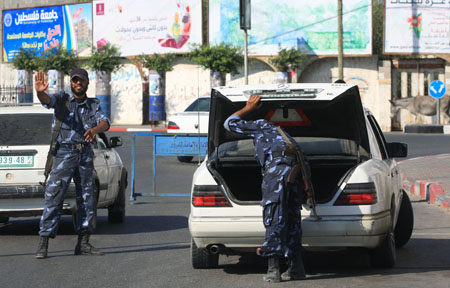
Hamas police officers inspecting a car in Rafah checkpoint into Gaza
Photo: Xinhua

Did you like it? Share it Delicious

Friday, July 31, 2009

Holidays round

I’m not too eager of stopping working for long (journalism is more a lifestyle than a business, although others may have a different opinion). But sometimes it’s good to take a break. And that’s what I’m going to do from today.

Meanwhile, here are the main issues to follow during the next two weeks:

- Iraq: No more multi-national task force in Iraq. Instead, from today on, it will be just a sole force of one country, exclusively American.

- Iran: Yesterday was the 40th day anniversary of Neda Soltan’s death. Tehran saw again thousands in the streets mourning those killed in the repression by the government forces. And the Basiji, again, fought them back violently. At least 20 people died during last month post-electoral clashes.

But the scars are still fresh. An Iranian court urged the police to present charges against those detained (hundreds of them) and finally around two dozens will be prosecuted. Another prominent reformist was moved from his cell to a government house where he will be under house arrest.

It’s to expect a surge in the clashes again for the next weeks.

- Afghanistan/Pakistan: Helmand offensive still goes on. Yesterday, two British soldiers were killed and the casualty report doesn’t make anything but grow. The near Presidential election, due the 20th of August, promises a few busy weeks ahead. Karzai will win again, almost for sure, but his popularity is decreasing. The Talibans have already called for a boycott of the polls.

Meanwhile, in the southern country the drone wars go on. A recent attack killed, according to the CIA, one of Osama bin Laden’s son. The operations in Swat valley, carried on by Pakistani militaries with assistance from the Americans, have allowed thousands of refugees to go back to their homes, avoiding what could have been the worst refugee crisis since Rwanda.

But the Taliban menace persists. Pakistan signed yesterday a deal with Tajikistan to secure the region, cooperate in security matters and blahblahblah. So beautiful; the ‘Stans fighting together...

And just in case the Taliban weren’t enough trouble, a separatist group from Balochistan started to attack foreign aid workers in the area.

- China: The Uighur revolt still is on the frontpages. China revealed last week official numbers for killed and detainees. Detentions that today are still going on.

Also abroad. While the Chinese government was exchanging opinions with Obama and messages with Taiwan -both signs of aperture of the regime-, it was angrily criticizing the words of the Uighur exile leader and the projection of an Uighur documentary in a movie festival in Australia.

Australia, by the way, is engaged in another nasty diplomatic clash with China regarding a few wallabie employees of Rio Tinto detained in a spy case. The problem for those employees is that they revealed data from Chinese companies to their partners abroad. Data that is open source in China. This puts over the edge hundreds of consultants. What to do now? Where is the limit about what to publish and what not?

And if they survive that, still can be themselves into a collective illnes inside their company.

- Horn of Africa: With the comeback of somalian pirates, the region should have enough. There is even a new videogame about it. But this is Africa. There is never enough trouble.

Knowing that -or maybe collaborating to that- the USA has intensified his pressure over Eritrea and his support for the Islamist groups operating in Somalia. Yet a hypothetic deal sounds like a far dream.

Meanwhile, America plays a wild card strongening his presence in the area through the semi-autonomus region of South Sudan. Members of the newly created South Sudanese Air Force -no planes yet- were training this week in the USA. South Sudan is undergoing through a rearming process as the recent images of Faina’s tanks found in the region prove it.

- Rest of Africa: In Nigeria, clashes between Islamist militias and government forces in the north of the country left 150 deaths. The ambushes are still taken place.

In South Africa, newly elected President Zuma has abruptly ended his honeymoon with his voters. A massive strike shook the country during this week.

Meanwhile, a new campaign has been launched by a Namibian NGO. “Lords of bling” tries to remind the African leaders their promise to spend at least a 15% of the money in healthcare, a measure long forgotten by most of the African Union signers of it. The signer Akon has designed this song to remind that fact to the African presidents.


- Israel/Palestine: The settlements center the debate. International pressure grows as the US envoy to the region increases the talks too. Netanyahu agreed yesterday to destroy 900 houses in an East Jerusalem colony.

Inside Israel sensibilities around this are also changing. Some analysts consider Israel’s image abroad is being heavily damaged by the settlements (smart guy). Some settlers even are speaking out and admit they would leave in exchange for the money spent in their homes and similar conditions somewhere else inside Israel. Some others, not so.

What doesn’t change is Netanyahu’s hawkish government. The last idea is ask demand the Netherlands and the UK to stop giving funds to the NGO Breaking the Silence, who has done some research of alleged Human Rights violations in Gaza by the IDF. Next will be to point European governments how they should spend their money.

And meanwhile the Netanyahu’s government asks Holland and the UK to stop funding pro-Human Rights NGOs, their allies from the far right ask the IDF soldiers to cover up for the abuses committed in the West Bank.

On the northside, the IDF has been put on alert after Lebanon forces were movilized too. However, IsraelĆ­ officials consider unlikely a reedition of 2006 Hezbollah-Israel war, specially now with so many international forces in the zone.

On the other hand, in Gaza, Hamas starts to apply their particular vision of government. Up until now, Palestinian women could consider themselves lucky. I was actually talking about this recently with a Palestinian friend. While Saudi Arabian women cannot drive a car or meet with strangers, Palestinian women can do that and even wear trousers, the head uncovered or -if they want, and also the men- buy alcohol.

All that could be about to change. A judge has ordered in Gaza to all the female lawyers to wear a head scarf. It is just an example of many more that are showing Hamas’ Islamist hand in Gaza. Like restrictions with alcohol or the new religious police. Here an Al Jazeera video on it:


- Latinamerica: Honduras’ political turmoil doesn’t look well. But at least negotiations are moving up. Slower than a sloth, but moving up. Zelaya is in Nicaragua’s border from where he visits periodically his supporters. Meanwhile the interim government is more and more in lack of support. Abroad, the USA revoked several diplomatic visas. Internally, the Army admitted the predisposition to accept a unity government with Zelaya in front. Last word is Micheletti’s.

Further to the south, Colombia and Venezuela are again fighting. This time, a few Swedish grenade launchers were the detonant of the diplomatic turmoil. The weapons, sold by Sweden to Venezuela, ended up being discovered in a FARC’s camp. After that, the usual crossfire between governments and Hugo Chavez’s usual recall of ambassadors.


And basically that’s all. Add some narco fights in Mexico and a political fight in Burma (Google this, I’m tired of linking news today) and you have enough to be busy for these two weeks I’ll be out.

So, until then... Be good, have fun, and don’t do anything I wouldn’t.


Did you like it? Share it Delicious

Monday, July 27, 2009

Friendly fire 27/07/09

- India gets into the selected club of Navies with indigenous built nuclear submarines. It’s just the frontline of what’s still to come, an improvement of the Indian Navy that will include an increase from the actual 140 vessels to the 170 planned. That includes two more nuclear subs and two indigenous carriers.

- Korea continues playing; now they accept to talk about their nuclear program.

- Sarko collapses while jogging. Did he saw a hot chick jogging besides him? Fortunately, it was all just a scarce.

- Obama starts pushing for a deal in the Middle East. Meanwhile, back at home, Sarah Palin resigns; but not without a fight.

- Iranian courts are pushing in favor of the detainees: their future must be decided within a week or be released. Ahmadinejad, may be busy for the last days of his government. Unless he has to quit over a confidence vote from the Parliament.


Did you like it? Share it Delicious

Wednesday, July 22, 2009

Soccer game or tear gas?

A few days ago we showed here the new ad from an Israeli company, showing a soccer game between Palestinians (not shown) and Israeli soldiers over the separation wall. Here is the ad:


However, the real test is slightly different:


Did you like it? Share it Delicious

Palestinian sweet future

During the last week several articles have appeared in international newspapers talking about the rebirth of Palestinian economy. Although rebirth is way too optimistic (there should had been something first to be able to rebirth), it has some sense. Most of the articles focused on Nablus city. It isn’t casual.

The small new hopes for Palestine have the shape of a new theatre, a festival and a World Guinness Record. The last one is for the world longest knafa, a traditional local dessert honored this way by 170 local bakers, who have made 74 m of sweetness.

However, like the knafa, Palestinian economic rebirth may be too sweet to allow us to see the whole pack. The West Bank needs still more freedom from Israel if they want to grow up. Plus it is just half of the Palestinian reality. The other one, in Gaza, suffers the Israeli blockade and the debris cleaning from the last Gaza war will last for at least one year.

It is true that in the West Bank things are, slowly, getting better. Five years ago I remember being myself in Nablus with serious shortages of entertaining offers, water and freedom of movement. Weekends were spent in Jasmine’s hotel’s terrace watching the Israeli jeeps below during curfews making arrests.

Today, however, pressure has been lowered. Still the problems persist, but a new cinema has opened, festivals arrive to the city, freedom of movement for the Palestinians have eased and the north checkpoint of the city has disappeared. And against those who claim that it could have ended in a disaster, the security has improved.

Most of the merit is for the Palestinian police officer. Created with European Union equipment and training (in Jordan), now they are a truly police force and not the paramilitaries that I met the first time. The efficiency of these officers to maintain the order surprised even the Israelis, when in the last winter they were able to keep the order on the streets even though the operation in Gaza.

But all that is just an illusion that sooner or later can break. Without taking into consideration Gaza, Israel should leave from the settlements in the West Bank if they want to avoid incidents. Sure, they are not as often as before (from more than 200 in 2004 to just 2 in 2008) but still sometimes, it happens.

However, Binyamin Netanyahu’s government seems decided to continue the expansion of settlements in the West Bank. They accepted to demolish 30 illegal (just those considered illegal by the Israel courts) settlements, but still goes on with plans to expand East Jerusalem colonies, even against the USA and the EU will.

The truth is that the situation doesn’t improve substantially in the West Bank and it gets worse in Gaza. The IMF warned about it on its last report on the region. And even inside Israel’s military recognizes and denounces abuses against the Palestinians.

At the other side of the wall, it doesn’t help that Fatah is more and more like a despotic Arab regime, more worried about keeping the chair than anything else. Last example came with the suspension of Al Jazeera broadcastings after airing an opinion contraire to Abbas.

Neither of them are democratic; neither of them are good for the Palestinians. Neither Hamas does it better implementing his new religious police forces -Iranian or Saudi Arabian style- in Gaza. And the ones who lose in between all this are the Palestinian people. Used by everyone for their own interests, once again.


Nablus from the Jasmine hotel, 2004.
Photo: me


Did you like it? Share it Delicious

Sunday, July 12, 2009

Together or separated?

One of the last ads from Israeli cellphone operator Cellcom shows a few IDF soldiers playing soccer resides the wall in the West Bank. The balls isn’t theirs, but from the other side. Some Palestinian(s) throw it over the wall, the Israelis throw it back and a small game starts among the two sides.

This is the ad:


A Facebook group is already asking to pull out the commercial. They argue it is racist. Sincerely, it can be accused of many things -first of all, for not being careful with sensibilities- but not of racism.

Cellcom’s business is tending -communication- bridges among the people. Both Palestinians and Israelis, because its network covers all the region. If in Hamas’ HQ in Gaza, or in the Knesset in Jerusalem, ones and the others were doing the same, we should be now talking about the shameful wall mirror of the one in Berlin.

There is a clear statement in the commercial:

"After all, what are we all after? Just a little fun."


I wish that were true. We wouldn’t be arguing now if it was.


Did you like it? Share it Delicious

Friday, July 10, 2009

Human ammunition

Gilad means monument. Since when three years and one month ago the Israeli soldier Gilad Shalit was kidnapped by Hamas in Gaza, the young man has become also a symbol himself, not only his name meaning. And even in something more: a weapon. For both sides.

Since the 25th of June 2006, at least four times one side or the other has claimed the imminent liberation of Shalit. None of them was made true. In twice of them Hamas blamed Israel, the third one was the opposite. Last one, this Thursday, Israel is to be blamed again, but this time by Mubarak, Egyptian president and the negotiator in the three party talks.

It’s not the first time Israel plays to fool everyone. In fact, the trick of tiring the opponent until they throw the towel is far known in the region. Of course, it’s been played for everyone during the last 60 years. And if the side who bet their lives are the Arabs, Israel is happy. But if there is one Israeli under risk, it changes.

In January, Shalit’s father charged against Olmert government for stopping the offensive in Gaza. More than fifteen hundred casualties, two thirds of them civilians, weren’t enough if his son wasn’t at home by Hanukah.

But what didn’t realize Noam Shalit, the soldier’s father, and neither does Israeli society, is that few people is now really concerned about Shalit. Every moment he spent in Hamas’ hands makes him more valuable, makes more expensive the deal and makes the Palestinian to suffer more -which in the end, makes longer the conflict. There is a good sentence in this Haim Watzman’s article, in the last paragraph, that illustrates perfectly it:

Here is our dilemma, and that of our leaders: As we enter Gilad Shalit’s fourth year of captivity, we must be cool and collected, and bold and courageous. We must be prepared to pay a heavy price to bring Gilad home, but we must not pay too much. I do not know what that price should be. My policy analyst’s head tells me that every price that Hamas has asked has been far too high; my father’s heart tells me that we should have paid it long ago.


Let’s put it on numbers. Olmert’s government accepted a year ago a liberation in exchange of 1,000 prisoners. Then they demanded the list to be reduced to 450 high caliber prisoners. Now, Netanyahu’s government, according to Mubarak, boycotted in the last minute that deal.

Meanwhile, in those three years have been thousands of attacks (in both sides), retaliations (in both sides) and deaths (mostly in one side) that have fueled the cycle again. Many of those operations or attacks, like last Gaza war, were supposedly backed on Shalit’s freedom.

But truth is that one more day, one more month, one more year in captivity; everything goes down to a justification for one operation more, one political decision more or one radical recruitment more. Even Israeli iconography surrounding Shalit reminds to that used by the Palestinian to remember their own prisoners or martyrs.

Hamas stated in January during the offensive in Gaza that Shalit’s health wasn’t anymore a priority for them (understandable after all that was going on over them -literally- then) and that Shalit’s life was as worthless as “a cat”.

They lie. Shalit is their best weapon right now, as it is for Israel.


Did you like it? Share it Delicious

Tuesday, June 23, 2009

Talking about nothing

While people is still talking about Netanyahu’s speech -which although a bit better than their precedents couldn’t match Obama’s speech and said nothing new- he is already adding more wood to the fire. This time by saying that the debate about the settlements is a waste of time:

"I think that the more we spend time arguing about this, the more we waste time instead of moving towards peace".


I wonder then, if the Palestinians need to give up an army, a return to their pre-Nakba homes, a capital in at least part of Jerusalem, half of their elected representatives (Hamas politicians) even if Hamas leaves the weapons, and now, also, don’t even think about the dismantle of the settlements...

Then what is left to talk about?


PS. At least, after three years of imprisonment, Palestinian Parliament speaker was released today.

Wednesday, June 10, 2009

The Jewish Borat

Ido Aharoni, chief of Brand Israel, a PR project that aims to clean Israel’s public image abroad, has accused the Arabs of damaging Israel the same way Sacha Baron Cohen did with Kazakhstan.

"The Arabs, our adversaries, have succeeded in doing to us what 'Borat' did for Kazakhstan", Ido Aharoni told the Knesset Defense and Security Committee on Tuesday, referring to the 2006 Sacha Baron Cohen film in which Cohen portrayed a Kazakh filmmaker touring the United States.


Letting aside the fact of Borat being in fact good for Kazakhstan -at least he made the world know about the country-, it seems a bit weird to see an Israeli accusing the Palestinians for Israel’s reputation internationally.

Why should that happen? What could be thrown into Israel’s face for that?

Is it because of the war crimes and disproportionate response in Gaza? Or because of the settlements? Is it the humanitarian siege to the Palestinians? Because of the block of access to water sources? Is it because Israel is the only country in the region with nukes? Because they spend the biggest amount per habitant in the Defense budget in the entire world? Or is it for attempting to create first and second class citizens inside its borders on a religious criteria?

In fact, all that has benefit the Palestinians. The more radical the Israeli president is, the better for them. They should be grateful.


PS. I always have defended a separation while judging a country between governments and common people. First ones are almost always pricks. Second ones, on the other hand, maybe are the opposite of their politicians, but don’t get enough time or exposure to show it.

PS2. And anyway, Israel deserves a special sympathy because of their women.


Are you afraid? Well, this works in that way. First you do what scares you and it's later when you get the courage
Twitter Delicious Facebook Digg Stumbleupon Favorites More

 
Worldwide blog©, WGMreports© and the texts included here are copyright of Javier Garcia Marcos.
All the pictures used in this blog are property of their respective owners. Any innappropiate use of them is unintentioned. Any image or link used without permission will be removed.
Powered by Blogger