Any questions? Contact us.

Wednesday, May 08, 2013

Why the conservatives have regained Iceland?


Much has been said in the media about the victory of the conservatives in the latest election in Iceland. However, while it is true that the leftist coalition has suffered a debacle, there are many more factors to consider in the equation.

For starters, as in Italy, Greece and Spain, many small parties have raised their percentage in votes. Some have been on the verge of parliamentary representation. Others, like the pirate party, are full on with strength.

Overall, the Parliamentary cake was previously divided between two or three forces. Nowadays a quarter of those votes have been grabbed by minority parties. However, half of them will have no parliamentary representation because they did not meet the minimum percentage required. That percentage has gone on to benefit other parties.

This fragmentation has hurt the left. But they also have been punished for the policies undertaken under their rule.

Despite being held up as examples to what the left should do in countries like Spain, Ireland or Italy, the reality is that the coalition has not deployed a policy different from that carried out in the German modeled EU.

Budget cuts, controlling the deficit and austerity measures have been the norm. This was completed with the insult that represented having to go to the EU for help, losing independence in the process.

The main winner of these elections, the ultranationalist party Progressive Party, has made a good use of the prospect of losing autonomy and is a strong anti-EU advocate.

Meanwhile, contrary to the general idea held outside Iceland that the country has been prosecuting its bankers, it is very little what really has been done about it. The people behind the credit crunch crisis in Iceland have been left mostly untouched, as in Spain, Italy, Greece or Ireland. In fact, Germany has opened more cases against bankers than Iceland.

The Icelandic popular revolution, once admired outside, had many people disappointed inside the country. Living standards, partly due to the devaluation of the Krona, were down at least 30%. To this we must add a high inflation (an increase of 75% since 2005) and the ruin of the housing market.

Although the houses were now worth between 30 and 40% less, many mortgages had been signed in Euros. This was a horrible combination. The houses were less valued, but the owners’ debts had increased. The gap was too big to overcome for many families.

The situation was so desperate that the coalition government wrote off any mortgage debt above 110%, but that still left a lot of people deeply in debt. Unable to afford their homes’ mortgages and with commodity prices skyrocketing, the situation was complicated.

One of the promises of the Progressive Party in this election has been to eliminate up to 20% of all the household debt. Looking at the results from the polls, the strategy worked. They have not won, and they are not likely to carry it forward, but they have increased in number of votes and seats in the Parliament.

In the end, what has made people decide to punish the left has been mostly disappointment. Many thought that a leftist government would end the austerity policies, imprison bankers and remain independent.

The reality is that despite their intentions, in the end the leftist coalition did not know or could not remain true to their ideals. The disenchantment among voters caused many to stay home and not go to vote.

That along with the reasons given above, explains the collapse of the revolution envisioned by many in Europe. A revolution that just maybe, it was just all faƧade and had no foundations.

Thursday, May 02, 2013

Boston conspiracies or the triumph of human stupidity


Sooner or later it always happens. After any tragedy -or feat- created by man there is always a group of people waiting to jump to talk about conspiracies. It happened and happens whether with 9-11 or the Moon landing. The Boston bombings weren’t going to be less and in the Internet age, just in a week we have all kind of theories.

Personally, I am very skeptical of the skeptics. For others, it is easier to see conspiracies.

A website has compiled “evidence” that, according to the author, shows that everything that happened in Boston was orchestrated. There are some that are based on physical similarities, such as arguing that Jeff Bauman is actually a double amputee Iraq veteran named Nick Vogt. However, beyond a certain physical resemblance, they are two clearly different individuals.

Others say that the Chechen eldest brother was alive when arrested. As proof, they show a video posted online in which they say the naked person being escorted by police is the oldest of the Tsarnaev.

This however conflicts with the testimony of dozens of neighbors. And a very obvious fact: Tamerlan Tsarnaev had a hairy chest (seen both in old photos and in post-mortem pics distributed by the police), while the guy in the video is shaved.

Other theory suggests that a private security company (Craft International) is the one that planted the backpack-bombs. Some even claim that the same three individuals of that company who were in Boston were also in Sandy Hook after the shooting that killed several children and adults in a local school.

If so, these three men would be doing a lot of overtime. It is hard to believe that a security firm has only three men in charge of doing all the dirty work of conspiracies.

On the other hand, is not so hard to believe that just as in the case of Bauman-Vogt it is just a physical resemblance. Nor is it hard to believe that in the birthplace of capitalism it is normal to hire external companies to do the work of the police and take over part of the security of a public event.

Quite another thing is to think that there are private security companies that want to cash in the misfortune of others. That's not a conspiracy; it's as real as life itself. Vultures are everywhere, but taking advantage of disasters does not mean they want to nor have the ability to provoke them.

There are many more theories. Like the one that puts a wounded Saudi citizen as a terrorist involved in the attack who spoke to Michelle Obama at the hospital, implying it was all a Government plot and a false flag attack.

Conspiracists forget to mention that the First Lady also visited many more people wounded in the attack in the same hospital as part of a visit by the President and her. Maybe the President and the First Lady visiting wounded people in a terrorist attack seems like a weird thing to these conspiracists too.

But even if we accept for a moment that any of the theories raised could be plausible –which they aren’t-, to do this for the simple fact of doing it, for fun, would make no sense. The question to ask is not who, but why. The motive behind the actions is what gives us more information about an event in itself.

Who wins here? Not the Obama administration, for starters. The bombers didn’t use assault weapons but handmade devices, which does not serve to promote legislation for gun control as the U.S. government wants to do.

It has not been either an enemy country behind the attack, no matter how Muslims are the Chechens. In fact, in the past Chechnya has been a great tool to poke Russia and Putin in the eye, for their violent handling of the problem. Russia has told many times America to mind their own business and let them take care of their “internal affairs” alone.

It makes no sense to organize this now and be forced to agree with Russia that the Chechens are terrorists, nor is viable an invasion in Chechnya (Russian territory).

In the end, many of the conspiracy theorists, and many of those who jump on the bandwagon with them, are the same who commit serious blunders in other matters. From using the attack to defend their personal causes (such as the possession of firearms or the legality of torture of detainees) to order the stupid idea of an invasion of the Czech Republic (which forced the Czech ambassador to issue a statement reporting that Chechnya and the Czech Republic are in fact two different entities and geographically separated).

The youngest of the brothers, now that he has begun to talk, will certainly further clarify things.

Meanwhile, I personally find the tinfoil hatters have a vast the imagination. But in the end, in these cases it is best to apply Occam's razor: the correct solution is the simplest. In this case probably the brothers Tsarnaev were lone wolves acting alone.

A possibility, by the way, that should be even more frightening. In a more or less organized group, even if it is based on cells, it is easier to control what will happen. If we are fighting lone wolves that can act independently and at any time, everything gets much more unpredictable and dangerous.

Tuesday, April 16, 2013

The silenced genocide


It's our fault, the media’s fault. We are experts at making huge deals of a sand grain while failing to realize about the huge mountain in front of us. While everyone -including us- is looking to Pyongyang, silence prevails in other parts of Asia such as Burma.

In Korea there has not been yet a single shot, a single death, nor more refugees or displaced in fifty years. Nevertheless, hundreds of foreign correspondents have traveled to the area to tell that absolutely nothing has happened. In the meantime, the Rohingya suffer a very real conflict that gets silenced.
Burma's case is especially flagrant. There are currently several active conflicts against various ethnic minorities in the country. The Karen, Shan, Kachin and Rohingya are just four of the groups that are currently fighting the government in Yangon.

The Karen are an ethnic group divided between Thailand and Burma. Since 1976 they have been fighting for their own state or, more recently, at least greater self-government. Relationships are clearly better than a few years ago and last week both sides sat down to negotiate. That doesn’t mean they are in good terms.

The Shan’s situation is slightly better. They have some degree of autonomy and its own army, but they are subject to the central government. However, both the Shan and the neighboring Kachin have been abused by the majority Bamar that governs Burma. Unlike with the Karen, tension with these two groups has increased in recent weeks.

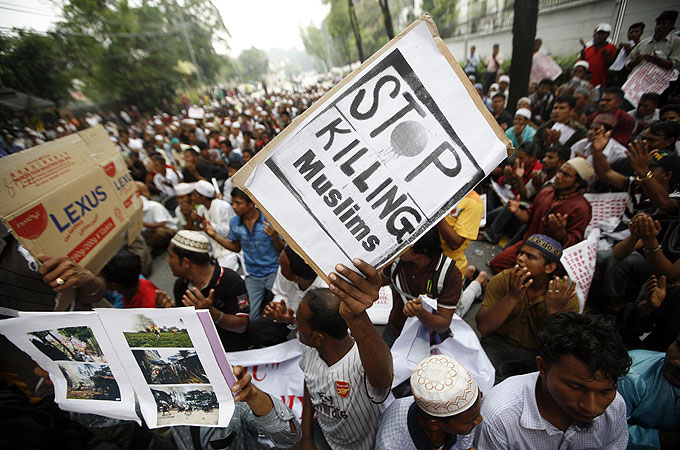
But the most significant case is that of the Rohingya. Not only they are different ethnically, as the rest of the other groups, but also on the religious level. The Rohingya, mostly Muslims, have suffered all sorts of attacks against their properties and their people for years by the country's Buddhist majority.

In 2012 these attacks increased exponentially. And they do not respect anything or anyone. In early April, a school with 70 children burned down in what appears to be an unprovoked attack. Thirteen of the children died in the fire.

The seriousness of the issue has led some to declare that what is occurring in Burma is nothing less than ethnic cleansing. However, little or no response has been made by the international community.


It is particularly striking that the Nobel Peace Prize Aung San Suu Kyi has not said anything about it. If we take into consideration how the international media are usually always listening to everything she says, her silence is the more disturbing. The once ardent defender of human rights in Burma seems to prefer silence and turn a blind eye in the case of the conflict with the Rohingya.

The Burmese central government has called the Buddhist New Year celebrations to demand national unity. But in the current situation that is more of an utopia than reality. The main concern for Yangon is to prevent the ethnic conflicts to endanger the much needed flow of foreign investment.

What will happen to the country’s ethnic minorities is secondary. Problems endemic to the region, such as amputees by landmines, forced labor with refugees and sex tourism are already threatening the Shan, Karen, Kachin and Rohingya. And no one seems to care about it.

Monday, April 15, 2013

Thatcher's legacy


Margaret Thatcher is dead. But the woman who was probably one of the most influential people after World War II, not only in the UK but in the world, lives on through her legacy. 

Summarize what Thatcher meant would be impossible in just a few words. Years after the Iron Lady left No. 10 Downing Street, the effect of her policies is clear everywhere. Ask to the Scottish and northern English about the dismantlement of their industry, or to the Occupy movement about deregulation of the banks, and her name will likely appear.
  
Glasgow is an example of an industrial city that was literally abandoned to their fate. The once booming industrial hub became an “every man for himself” situation when the Thatcher government washed its hands and decided not to help the industry. Exactly the opposite to what Obama did with Detroit.
  
Thatcher’s decision ended up in rampant unemployment, crime and economic depression. It was so severe that only now the city is beginning to raise above the mud. The miners of northern England didn’t have better luck despite their year long strike.  

Photo: Javier Garcia Marcos/WGMreports
Not only the mining and the heavy industry suffered through her policies over the years. The shadow of the Iron Lady is felt today in all deregulations the UK has had since. From healthcare to banking, to education; no sector was left unscattered. Thanks to Maggie, children in Britain stopped getting a glass of milk with every meal at school.

These deregulations not only were continued by his party, but also by Labour. Some people used to joke that Thatcher's greatest legacy was Tony Blair. Truth is that for better or worse, after her every single politician changed their ways. Both Conservative and Labour, none wanted, knew or could get away from the influence left by the Baroness.

Internationally, Margaret Thatcher was also able to make her mark. As hated or loved as back in Britain, she left no one unimpressed. She was a great friend of both Kissinger and Gorbachev, she helped Pinochet evade justice, she aided the government of Pol Pot in Cambodia and she called Mandela a terrorist.

Meanwhile, the tories are today Eurosceptic mostly thanks to the Iron Lady. No one did more against the EU than her. And from within. It is also part of his legacy the decision to stay out of the euro, which to be honest today seems like one of the best decisions arising from Thatcherism.

In Argentina the Falklands war will be always remember. In domestic terms, with the country in ruins, the war served as an unbeatable propaganda platform for Thatcher, who regained popularity and managed to inflame the patriotic sense.

It was a perfect play for her: the Baroness was reelected for a second term, in which she carried out most of the privatizations of public companies. Only the postal service was spared. After Tatcher, Major, Blair and Brown would finish the job with the centralization of power in London and the loss of autonomy for the municipalities.

For all this and much more is not surprising that hundreds of people went out to the streets to celebrate her death. Hatred for Thatcher and Thatcherism continues in many who even today see her mark on proposals like David Cameron‘s Bedroom tax. Those who idolize her will also have their moment at the state funeral.

Down in History, she will always be the first woman at the helm of the British government, but she never did much to promote the role of women, either in politics or society. When he entered No. 10 Downing Street, 3% of the Commons were women; when she left it was only a fraction more at 6.3%. However, her example was enough to encourage other women to follow suit.

One thing we do need to recognize is that the country's situation when Thatcher took office was miserable. Britain was paralyzed, with even coffins lined up waiting to be buried because everyone was on strike.  The country had an alarming unemployment rate and had been humiliated after having to resort to an IMF loan.

Thatcher managed to lift the country from the ashes, but the price to pay was too high for society. But since according to Thatcher "society does not exist", that was a price that the Iron Lady was more than willing to pay.

Nuclear diplomacy


From time to time we hear about the imminent threat that Iran posses to the West. It is usually coming from Israeli or the US. Being Iran as cheeky as it usually is when it comes to its nuclear program, this shouldn’t be a surprise.

Like in a game, the IAEA inspectors and Iran are constantly playing out each other. So far Iran wins. They managed to fool the International Agency several times and with a wide array of tricks. Either by undisclosing secret facilities built buried inside a mountain or plain lying about the program, they have earned a reputation of dishonesty.

Yet the constant nagging about Iran meets always strong arguments against that premise more often than not. In fact, it is usually within the US Pentagon that we get reminded that Iran is not a threat, nor it will be in a near future.

We have so many eyes on the country that building up enough uranium to make a bomb under our noses would be impossible. More precisely; it would be possible, but we would know it.

If that was the case and Iran decided to go ahead and set hell loose, it still wouldn’t be a matter of a blink of an eye. It would take at least a year for that to happen. The last few steps made by the Persian country set them back rather than forward. 

Ahmadinejad talking nuclear/Reuters
Even more, according to analyst Meir Javedanfar from The Diplomat, building a bomb could be a bad move for Iran. Unlike North Korea, who has made of isolation and nuclear diplomacy an art, Iran needs the world and does not need a bomb.

Actually, getting a bomb would mean more sanctions for the country. For an oil-exporter like Iran, difficulties to export oil are very damaging for its economy. And sanctions are amongst the biggest difficulties.

This scenario would mean a bigger strain on the already weak economy of Iran and a more discontent population. That, trouble at home, is what North Korea doesn’t have to worry about but Iran does. And it is what ultimately would deter Iran from seeking the bomb.

It is interesting, however, that while the rest of the world is forced to comply with the sanctions, a selected group of countries are allowed by the USA to bypass that and get the much needed Iranian oil.  


Are you afraid? Well, this works in that way. First you do what scares you and it's later when you get the courage
Twitter Delicious Facebook Digg Stumbleupon Favorites More

 
Worldwide blog©, WGMreports© and the texts included here are copyright of Javier Garcia Marcos.
All the pictures used in this blog are property of their respective owners. Any innappropiate use of them is unintentioned. Any image or link used without permission will be removed.
Powered by Blogger